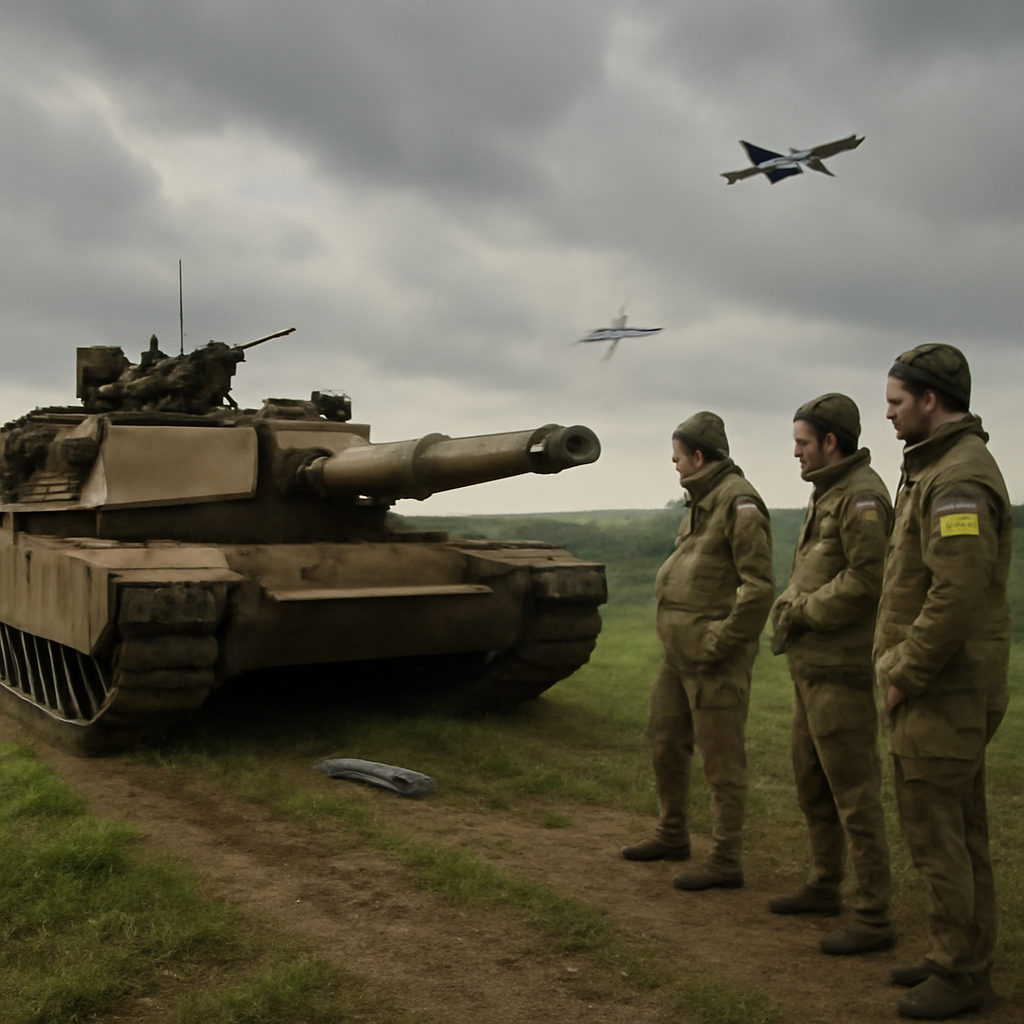
"The enemy has developed their drone component very heavily, and for now we don’t have the means to counter that," said the unit commander with the callsign Kubik, summing up why the 425th Separate Assault Regiment "Skala" has stopped using its Australian‑supplied M1A1 Abrams in frontline operations for the moment.
The 425th Separate Assault Regiment "Skala" and the decision to stand down the Abrams
Crews from Ukraine’s 425th Separate Assault Regiment "Skala" told Hromadske that the barrage of small uncrewed aircraft has made active deployment of their Abrams tanks untenable for now. Kubik said the regiment is "not using them further — there’s no way to." The men nevertheless reject the claim that main battle tanks are permanently obsolete: Kubik added, "It’s not over … They’re just waiting it out for now, biding their time."
Two combat deployments in and near Pokrovsk
The regiment’s crews described two major uses of the Abrams in the fight for Pokrovsk. The first, in December, put an Abrams behind a mine‑clearing tank and ahead of two infantry fighting vehicles (IFVs) while assault troops dismounted; the crew with the callsign Kent said their task was to draw fire and engage three assigned target points, recalling: "We went right in there, poured it on, and drove back out." The second, on March 31, aimed to enter and hold an industrial area to block Russian movement toward Hryshyne; it was prepared for more than two weeks with reconnaissance flights, route examination, and extensive video and imagery so "they knew every meter of the route," Kubik said.

This site is the portfolio.
OSINTSights runs on Cloudflare Workers, D1, R2, and Vectorize, with an AI pipeline on Hetzner ARM. Nubivance designed, built, and operates it. We do the same for clients.
See what we buildFPV and reconnaissance drones: how the threat played out
During the March operation the unit relied on fog and rain to blunt drone surveillance, but the weather window closed. Kubik said that "once the fog lifted, they started working on it with an FPV drone," and the assault group suffered heavy losses — the crew reported four of five armored vehicles destroyed or disabled in the action. Kent recounted another engagement in which "more than 20 drones hit me" while his tank was on the move. Visual material cited in the interviews and publicly shared video show FPV drones striking tanks and other armored vehicles; in one clip an M1A1 endured nine FPV impacts before being destroyed while its crew survived. A social‑media post cited in the source attributes some attacks to Russia’s Rubicon Drone Center.
Abrams strengths, battlefield modifications, and practical limits
The crews praised the Abrams for accuracy, mobility, a roomy interior, and a strong fire‑control system. Kubik said he had driven an Abrams "to 50 miles per hour cross‑country," calling the engine "an absolute beast." They also emphasized crew survivability: when asked whether deploying a roughly $5‑million tank made sense if a single sortie could destroy it, one commander replied, "Yes, of course it makes sense to deploy it ... First and foremost — it saves the lives of the crew inside it."
At the same time, the tank’s size makes concealment difficult: "It’s very tall — and very large — so it’s hard to conceal," Kent said. Crews described layered, relatively low‑tech countermeasures fitted to Ukrainian Abrams: added explosive reactive armor (ERA) bricks, rubber strips, and a foldable wire cage on the turret intended to detonate or blunt incoming strikes before penetrating critical elements. They noted the absence of so‑called "hedgehog" protective coverings seen on Russian tanks. The Ukrainian M1A1s operate with diesel‑reconfigured gas turbines (prior reports noted the engines were reconfigured to use diesel), but are M1A1 variants rather than the latest configuration and "lack the classified armor" of U.S. Army counterparts, with "less sophisticated electronics" than newer variants.
Operational logistics remain acute constraints: crews reported inspecting and servicing running gear after every sortie, and fuel consumption of roughly 400 to 700 liters per 100 kilometers (106 to 185 gallons per 62 miles), depending on terrain — "on asphalt it burns about 400 liters," one crewman said, while in boggy terrain consumption can reach "700 liters or more."
What this means for Ukrainian crews, policymakers, and technologists
- Ukrainian crews: For now, crews are prioritizing survival and force preservation over continued Abrams employment in high‑drone environments; they favor operations in weather and conditions that limit aerial surveillance and hope for new counter‑drone solutions.
- Policymakers and military planners: The regiment’s experience highlights that without more effective counter‑drone capabilities, even heavily armored platforms can be repeatedly targeted and eventually lost — a point underscored by at least 25 Abrams visually confirmed to have been destroyed, damaged, or abandoned in Ukrainian service to date from the 31 provided by the United States and 49 from Australia.
- Technologists and field engineers: Crews point to incremental hardening — ERA, cages, rubber strips — as immediately useful but limited; Kubik expressed confidence that "the day will come when one of our bright minds figures out some excellent solution against drones — and we’ll start using them again."
For now, the picture is stark: Abrams tanks remain potent for direct fire and protected mobility, but persistent reconnaissance drones expose them, FPV drones can attack from above, and current countermeasures have not fully closed that vulnerability. The 425th Regiment has parked its Abrams until either tactical conditions change or new defensive solutions arrive — and the unit’s commanders are clear that pausing use does not equal permanent retirement.