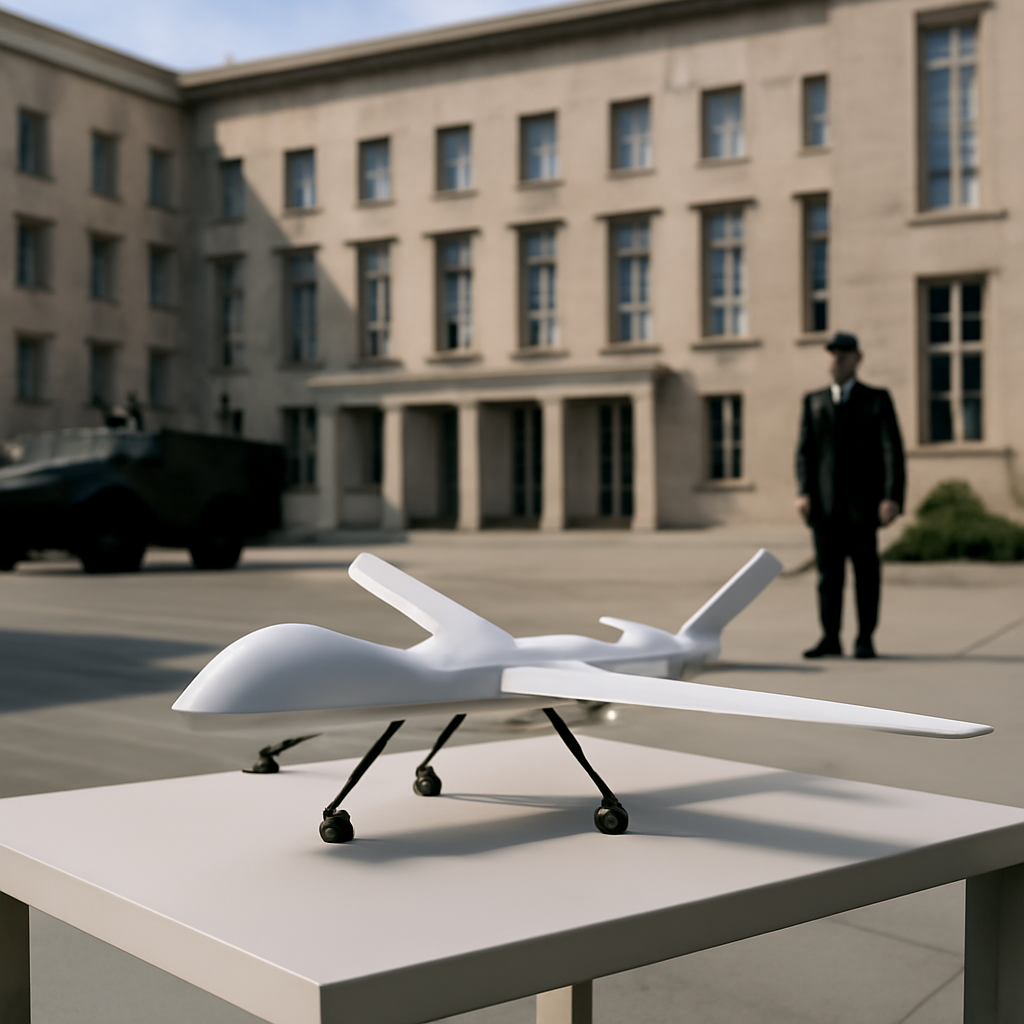
“With Boeing Defense Australia as a partner, we are laying the groundwork to optimally tailor the MQ-28 to the Bundeswehr’s requirements,” said Armin Papperger, CEO of Rheinmetall AG, in March — a statement that now reads against the grain after Germany informed Boeing it will not proceed with a direct acquisition of the larger Block 3 MQ-28 Ghost Bat combat drone.
Germany’s Ministry of Defense halts direct MQ-28 procurement
Boeing confirmed to Breaking Defense that Germany’s Ministry of Defense told the company it would not move forward with a direct purchase of the MQ-28 Ghost Bat Block 3 that had been previously lined up. The change, first reported by Politico and publicly acknowledged by Boeing, removes a rapid route to a fielded collaborative combat aircraft (CCA) capability that Berlin had hoped to achieve.
The ministry declined to discuss the specific procurement with Breaking Defense, telling the outlet that “[as a] matter of principle — and regardless of the specific case in question — we cannot provide information regarding potential procurement projects,” citing public contracting regulations and parliamentary processes. A Boeing spokesperson said the company “stands ready to support” its German customer on next steps.
Rheinmetall–Boeing partnership and industrial stakes
Earlier this year Boeing announced a partnership with Rheinmetall — Germany’s largest arms manufacturer — to tailor the MQ-28 for the Bundeswehr. In March, Rheinmetall’s CEO Armin Papperger said the company would act “as a system integrator” to ensure “integration, operation, and further development come from a single source” and predicted “revenue potential for Rheinmetall in the range of three-digit millions of euros.”
With the direct-purchase route now off the table, that industrial plan faces delay or reconfiguration even if the MQ-28 remains a contender in a more open competition.

The cyber insurance questionnaire just landed. Now what?
SOC 2, HIPAA, insurance renewals - someone has to own security strategy. Nubivance provides fractional CISO leadership without the full-time salary.
Get a security leadTimeline and capability implications: 2029 goal pushed toward the early 2030s
Germany had set an ambitious goal: fielding CCAs by 2029. The reported change in acquisition approach casts doubt on that target. Politico reported that Germany is now looking toward the early 2030s for a delivered capability, with flight testing expected to begin in 2027 — a schedule that suggests the original 2029 ambition was tied to buying an already-tested system like the MQ-28 rather than developing a new design.
The source details the complexity behind any fielding: CCAs must be integrated with crewed fighters, communications and mission-planning systems, weapons and sensors, and require testing, certification, training and supporting infrastructure. For Germany specifically, clearing an armed drone to operate routinely in commercial airspace has long been an issue — a regulatory and operational hurdle that factors into the longer timetable.
Competing designs and the widening field
The pause on a direct MQ-28 buy opens room for competitors. Recent and potential entrants named in reporting include:
- Airbus and Kratos’s U740 Valkyrie — which completed a first flight in Europe — and Airbus’s larger U760 Ravenstorm, intended for early-2030s service, plus Airbus’s previously pitched Wingman concept.
- Industry names such as Anduril, General Atomics partnered with Germany’s INTEC, and Lockheed Martin.
- German contenders: Helsing and Hensoldt pursuing the CA-1 Europa, described in reporting as an MQ-28 lookalike.
The reporting also notes one procurement architecture that Germany might consider: a split high–low approach pairing longer-range, more capable systems for deep strike with cheaper, attritable CCAs that fly alongside crewed fighters.
What this means for Boeing, Rheinmetall, and the Luftwaffe
- Boeing: The company retains the MQ-28 as a possible contender should Germany move to a competitive process; Boeing said it “stands ready to support” Germany’s next steps.
- Rheinmetall: The integrator role and the “three-digit millions of euros” revenue potential Papperger described now face a delayed timeline or re-scope if Germany opens the field to demonstrations rather than a direct buy.
- The Luftwaffe and German defence planners: The decision increases the chance that an operational CCA will arrive later than 2029. Reporting indicates the Ministry continues to define requirements for what German media have called a Jagdbomberdrohne (fighter-bomber drone), and has not publicly clarified whether it wants an uncrewed wingman, a long-range strike platform, or a system combining both roles. Separate reporting also notes Germany is set to receive the F-35 and is looking forward to receiving more Eurofighters — options that factor into force planning while the CCA timetable slips.
The immediate next milestone named in reporting is flight testing slated for 2027; beyond that, the decision leaves open whether Berlin will pick an existing, mature design like the MQ-28 or favor a longer development and competitive demonstration phase that could stretch fielding into the early 2030s. Either path will require resolving integration, certification and airspace-clearance challenges the reporting highlights — and it will determine whether Germany meets, misses or simply redefines the ambition it set for an operational CCA by 2029.
Source: https://www.twz.com/air/germany-drops-boeing-mq-28-ghost-bat-rapid-procurement-plan