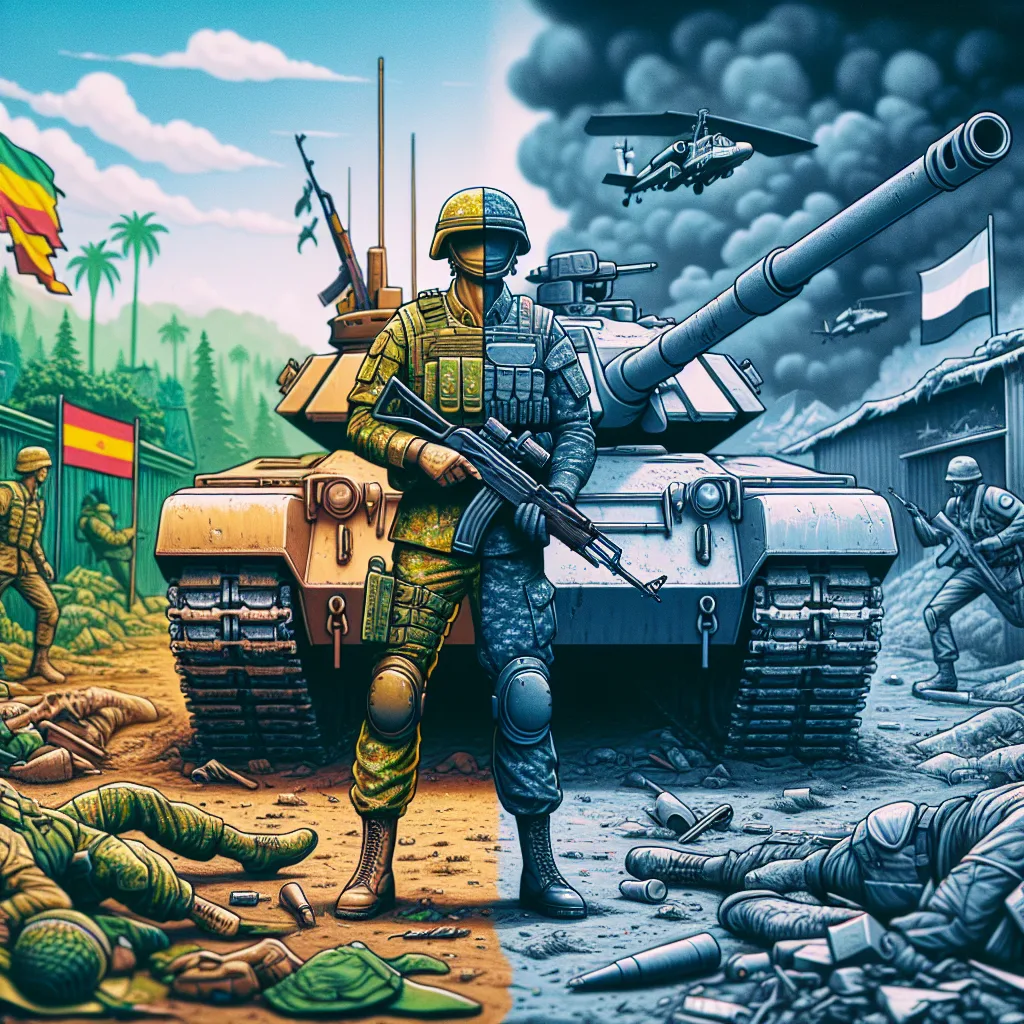
Reassessing Western Armor: Internal Critique Amid Ongoing Conflict
In a recent interview that has captured the attention of defense analysts and military strategists alike, Sergey Chemezov, the CEO of the Russian defense conglomerate Rostec, delivered a pointed critique of Western armored vehicles deployed by Ukrainian forces. His observations cast a critical light on American, German, and British designs – suggesting that while some platforms, such as the German Leopard 2 main battle tank, are of commendable quality, they fall short when measured against the evolving demands of modern combat.
Chemezov’s comments, reported previously by Defence Blog and echoed through various military analysis forums, come at a time when the conflict in Ukraine continues to expose vulnerabilities in both offensive and defensive systems on all sides. His assertions are not merely an exercise in strategic rhetoric; rather, they reflect a broader conversation about technology, innovation, and the challenges inherent in rapidly adapting military hardware to real-world battle conditions.
Historically, armored warfare has been defined by a continuous cycle of innovation and counter-innovation. Since the advent of the tank in World War I, military powers have strived to reconcile mobility, firepower, and protection. The Cold War era saw a clear demarcation between Eastern and Western philosophies of armored design. In recent decades, however, the lines have blurred as global defense industries have sought mutual technologies, even as geopolitical conflicts often force divergent interpretations of what it means to be “state-of-the-art.”
Chemezov’s comments are indicative of this ongoing evolution. During his interview, he noted that while Western designs offer reliability and robust engineering, they often lack the incremental innovations deemed critical by Russian defense planners. In particular, he critiqued the extensive reliance on legacy design principles, arguing that such vehicles are not sufficiently optimized for the type of asymmetrical and hybrid warfare that characterizes many of today’s combat scenarios.
Drawing upon the specific example of the Leopard 2, Chemezov offered a nuanced assessment. He acknowledged that the Leopard 2 has long been celebrated for its advanced armor composition and precision fire control systems. However, he contended that these strengths are offset by complexities and features that are less adaptable in the theater of war faced by Ukrainian forces. The critique suggests that while Western armored vehicles perform well in controlled test environments and conventional warfare scenarios, they may not deliver the necessary performance under the chaotic conditions of modern conflicts.
For defense strategists, such criticisms raise several pertinent questions about the balance between technological sophistication and agile battlefield performance. Reports from the field have, at times, indicated that the operational deployment of these systems has encountered unforeseen limitations. Issues such as maintenance difficulties, logistical challenges in hostile terrain, and vulnerabilities exposed under sustained combat conditions have fueled a debate over whether high-end technology can, in fact, translate into decisive battlefield advantages.
Beyond the technical and operational details, Chemezov’s analysis invites reflection on broader strategic imperatives. It is a reminder that technology, however advanced, must be matched by adaptability and an acute understanding of the operational environment. The divergence in assessment between Western military planners and their Russian counterparts underscores a longstanding ideological and methodological divide—one that reflects distinct operational doctrines and differing assessments of what constitutes effective armored warfare today.
While the interview has been met with varied interpretations in defense circles, several key points resonate across the board. Analysts from reputable institutions such as the International Institute for Strategic Studies (IISS) have noted that debates over the efficacy of current armored platforms are not new. They underscore the fact that no single platform can meet all combat requirements. Instead, flexibility, modularity, and the capacity for rapid upgrades are increasingly seen as essential features for any modern armored vehicle.
Notably, the critique of Western armor by Chemezov has not been without its detractors. Some experts argue that the rigorous design standards and extensive field testing of platforms like the Leopard 2 have established a benchmark for reliability and combat performance that continues to serve Western armies well. They contend that the issues raised by the Rostec chief are context-specific and may not reflect the full spectrum of combat operations, especially in scenarios where advanced communication systems and networked battlefield integration play a transformative role.
Looking farther into the strategic horizon, one can expect that the ongoing conflict will continue to drive rapid technological and doctrinal adaptations across militaries worldwide. Future developments in unmanned systems, directed-energy weapons, and integrated battlefield networks may further blur the lines between armored and digital combat capabilities. Moreover, these shifts will likely catalyze joint doctrinal reviews in NATO and allied military formations, potentially leading to updates or overhauls in armored vehicle design and deployment strategies.
In light of these evolving dynamics, military procurement agencies and defense policymakers are watching closely. They are tasked with balancing tried-and-tested designs against the pressing need for technological innovation. As history has shown, military effectiveness often depends on the ability to learn from conflict and rapidly implement changes—a principle that holds as true today as it did in past conflicts.
From the Russian perspective, Chemezov’s remarks are not merely an internal critique but a strategic message—a signal to both domestic audiences and international observers that the perceived technological edge of Western defenses may be more limited than often claimed. It is a perspective rooted in Russia’s broader approach to military modernization, one that emphasizes adaptability and the unique demands of its operational theater. For many analysts familiar with Russian defense policy, this critique is part of a longstanding narrative aimed at justifying the country’s investments in novel systems and asymmetric capabilities.
For Western military experts, the discussion offers an opportunity for introspection and reassessment. While ample evidence supports the operational effectiveness of Western armored vehicles in conventional roles, the lessons emerging from this conflict may prompt a closer review of their performance in hybrid and irregular warfare scenarios. As debates continue, there is consensus that a blend of high-tech innovation and robust, battle-tested engineering is essential for the armies of tomorrow.
Ultimately, the discourse surrounding Western armor is emblematic of a larger, global dialogue on innovation in military technology. It highlights the tension between legacy systems and emerging innovations, a balancing act that defense ministries worldwide must master to remain effective in an increasingly complex security environment.
As this narrative unfolds, several key considerations come to the fore:
- Operational Effectiveness: How well do state-of-the-art designs perform under real combat conditions, and what adjustments are needed to enhance their field viability?
- Technological Adaptability: In an era marked by rapid advancements, can existing armored platforms be upgraded at a pace that rivals emerging threats?
- Doctrinal Evolution: Are current military doctrines sophisticated enough to integrate both traditional armored warfare and the multifaceted challenges of modern combat?
- Strategic Communication: To what extent are critiques like Chemezov’s used as strategic tools to influence public and politico-military perceptions?
Both supporters and critics of Western armor agree on one fundamental point: the future of armored warfare will be defined by its ability to evolve. The injuries inflicted by rigid technologies and inflexible systems are a lesson that history equips military planners to remember. In the end, the success of any defense strategy hinges on its capacity to balance technological prowess with operational pragmatism.
As the dust of conflict continues to settle over contested battlefields, the debate over Western versus Russian armored innovations remains a pertinent reminder of the inherent complexities in modern warfare. It calls on military policymakers, defense contractors, and frontline commanders to reassess their strategies in the face of new challenges. The interconnected nature of technology, policy, and human factors ensures that no single aspect of military capability can be considered in isolation.
In a world where the fog of war often obscures clear judgment, one must ask: How will emerging lessons from current conflicts reshape the future of military technology and strategy? The answer will likely emerge as a blend of traditional resilience and modern innovation—a testament to the enduring human drive to adapt under pressure.



