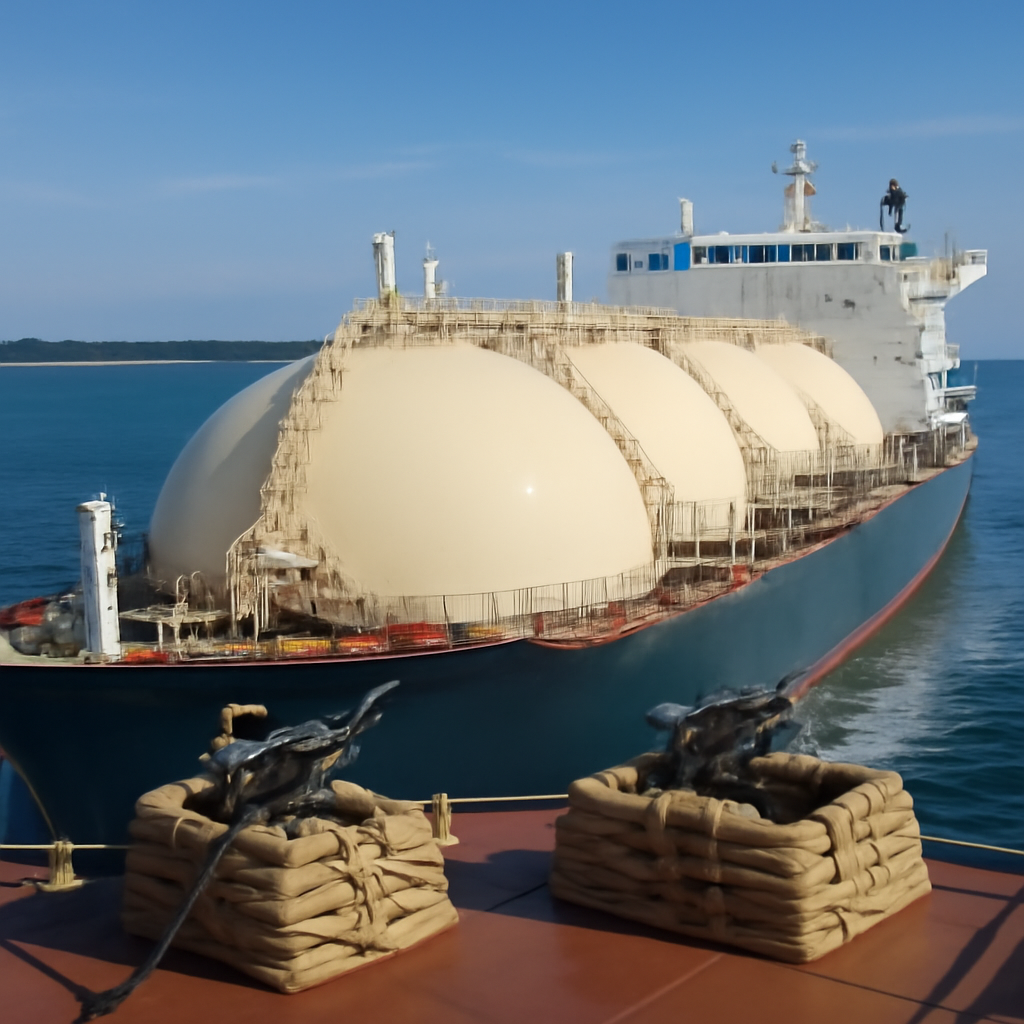
The Marshal Vasilevskiy is a 945-foot liquefied natural gas tanker of 118,000 gross tonnage — and last month Estonian surveillance imagery showed it carrying sandbagged heavy machine‑gun positions on the deck above its bridge.
Marshal Vasilevskiy: a unique asset supplying Kaliningrad
The Marshal Vasilevskiy is Russia’s only floating storage and regasification vessel (FSRU). Owned by Gazprom, the ship converts super‑cooled LNG into gas that can be fed into pipelines — in this case, to support the Russian exclave of Kaliningrad. Estonian Border Guard aircraft photographed the vessel as it sailed past Estonia’s western islands toward the Russian port of Bolshoi Bor in the Gulf of Finland. Investigative journalist Holger Roonemaa of Delfi Estonia secured and published those images, which show the ship with heavy machine‑gun positions mounted on either side of the deck above the bridge. Four voyages supplying Kaliningrad have been identified since last August.
12.7mm Kord machine guns: capability and probable intent
Close‑ups released with the surveillance footage show sandbagged emplacements with 12.7mm Kord heavy machine guns. The Kord is a belt‑fed weapon used in infantry, vehicle, and naval roles; it fires at roughly 600–650 rounds per minute and has an effective range of about 2,000 yards. Reporting notes that, almost certainly, the guns are intended to provide close‑in protection against aerial drones and small surface craft. The presence of such weapons also creates the option to fire warning shots at approaching boarding parties or helicopters — and the source observes that, with Kord guns, a helicopter could be brought down at short range. The account further raises the likelihood that the ship’s complement includes personnel beyond a typical merchant crew, noting that members of the military or the Federal Security Service (FSB) may be aboard and that man‑portable air‑defense systems (MANPADS) could be stored below decks.

This site is the portfolio.
OSINTSights runs on Cloudflare Workers, D1, R2, and Vectorize, with an AI pipeline on Hetzner ARM. Nubivance designed, built, and operates it. We do the same for clients.
See what we buildUkrainian drone operations and a widening Baltic threat
Those defensive measures appear linked to the expansion of Ukrainian strikes beyond the Black Sea. Earlier this month, Ukraine used aerial drones in an attack on the Kronstadt naval base near St. Petersburg — an operation the reporting characterizes as the first of its kind against the Baltic Fleet while in port. Video shared online shows a Ukrainian FP‑1 drone flying a few meters above the water in the Gulf of Finland during that attack. The reporting also references large coordinated drone operations elsewhere, noting a past operation described by Ukrainian sources as employing 117 drones. While Ukraine has not, as far as is known, launched uncrewed surface or underwater vessel (USV/UUV) attacks in the Baltic, the analysis in the reporting states such attacks would be within Kyiv’s capabilities and that short‑range drones launched covertly from nearby platforms could threaten tankers operating there.
Shadow fleet protection and the militarisation of civilian shipping
The armed fit on the Marshal Vasilevskiy arrives amid broader Russian efforts to shield vessels tied to sanctioned exports. The reporting situates this development alongside measures to protect the so‑called “shadow fleet,” which carries sanctioned Russian oil to buyers in markets such as China and India. European authorities have intercepted shadow‑fleet tankers repeatedly over the past year. The piece cites evidence that shadow‑fleet crews often include former mercenaries and soldiers; Roonemaa’s work also established that nearly half of the “passengers” listed as boarding the Marshal Vasilevskiy have backgrounds in Russia’s military, the National Guard, or the FSB. Russian Navy warships are increasingly reported to escort and monitor shadow‑fleet tankers in the Baltic. Taken together, these details are presented as evidence of a deliberate trend: the militarisation of civilian vessels that support critical operations, an evolution the reporting calls unusual in Baltic waters.
How Kaliningrad authorities, NATO forces, and the FSB are implicated
- Kaliningrad authorities: The Marshal Vasilevskiy’s role as the only FSRU makes it a strategic lifeline for the exclave; the ship’s protection directly affects the ability to sustain pipeline gas deliveries to the region.
- NATO forces: The presence of heavy weapons on a commercially flagged tanker sends a signal intended to deter interference from nearby NATO assets, and the reporting notes that warning shots have already been used by Russian vessels elsewhere as a tool of maritime coercion.
- The FSB and Russian naval forces: The reporting raises the likelihood that security personnel from the FSB or military are aboard, and documents an increasing use of Russian Navy warships for escort and security missions related to shadow‑fleet operations in the Baltic.
The photographs and details released by the Estonian Border Guard and published by Delfi Estonia represent, in the reporting’s account, the first direct evidence of a commercially flagged vessel openly carrying heavy machine guns in the Baltic. For a ship described as unique in Russia’s merchant fleet, the weapon fit underlines both its strategic value and its vulnerability: loss of the FSRU would have asymmetric consequences for Kaliningrad’s gas supply. Whether Moscow will further upgrade the Marshal Vasilevskiy’s defenses — or replicate this pattern on other logistics vessels — remains a pressing question raised by the record now in the public domain.