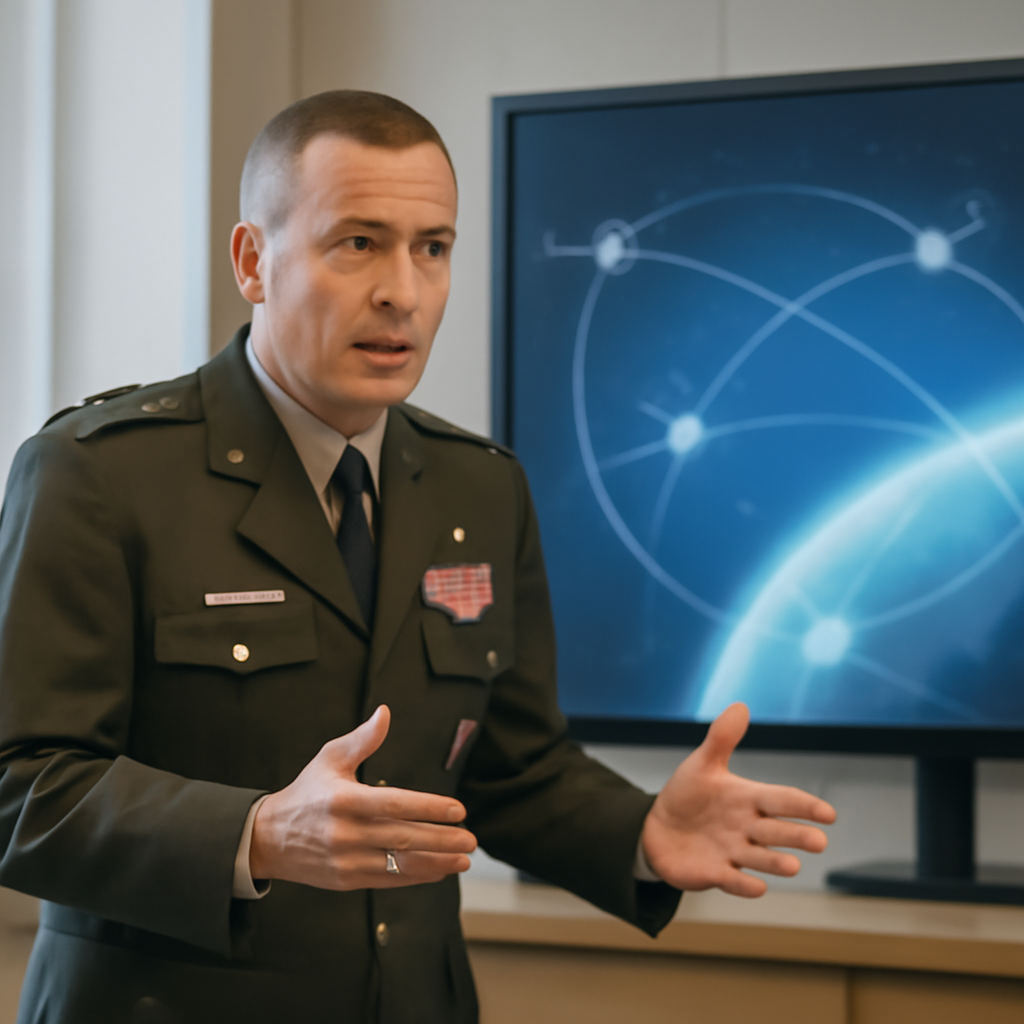
"In space, there is no safe harbor. You can’t dig a trench or build a shield," U.S. Space Force Gen. Stephen Whiting told the annual Space & Missile Defense Symposium in Huntsville — a blunt preface to a demand that the military build new offensive capabilities to deter and, if necessary, fight for control of orbit.
Gen. Stephen Whiting lays out FY29–33 integrated priorities for SPACECOM
Speaking at the SMD Symposium, the head of U.S. Space Command described a five-line integrated priorities list for Fiscal Years 2029–2033 intended to close assessed risks and capability gaps. Whiting said survivability must matter "at least as much as performance" and framed his list as "a clear demand signal" for warfighting capabilities the command needs to meet its Title 10 and Unified Command Plan responsibilities. He identified the top two items by name: "integrated space fires and counter-pLEO," and emphasized that the list was not a wish list but a mission-driven requirement.
What "integrated space fires" and counter-pLEO mean in Whiting’s remarks
Whiting described "integrated space fires" to include both non-kinetic and kinetic options "in orbit and/or within the atmosphere." He said the United States needs "credible, acknowledged, kinetic, and non-kinetic fires" to establish space superiority and restore credible deterrence. A briefing slide shown alongside his talk depicted what might be a laser-directed energy weapon delivering a kinetic effect on a satellite from inside the atmosphere. Whiting also stressed that U.S. space assets must "shoot, move, and communicate just like the rest of the joint force" so that they can enable the joint force to operate.

Audit-ready is a season. It shouldn't be.
Evidence in spreadsheets, controls drifting between audits, frameworks multiplying on flat headcount. Nubivance runs continuous compliance on Rapid7 Cyber GRC - SOC 2, HIPAA, ISO 27001, PCI, CMMC.
End the scrambleDirected energy, cyber, and the challenge of proliferated LEO
At a separate panel during the symposium, Deputy SPACECOM commander U.S. Army Lt. Gen. Rick Zellmann argued that proliferated low Earth orbit — "pLEO," meaning distributed constellations of hundreds or thousands of satellites — changes both defensive and offensive calculations. Zellmann said adversaries will likely seek "one-to-many solutions" against such constellations, naming cyber and directed energy as the two technologies of greatest concern. Brig. Gen. Drew Morgan of the Army’s Space and Missile Defense Command noted non-kinetic directed energy effects, including laser "dazzling" that can blind satellite optics without permanently damaging hardware.
Inspector satellites, MRVs, and the dual-use problem
Gen. Whiting singled out several adversary capabilities as current realities: "direct ascent ASAT missiles, ground-based lasers, jammers, and maneuverable co-orbital ASATs, and dual-use satellites like the SJ-21," he said. The SJ-21, launched in 2021, carries a grappling arm and has demonstrated towing other satellites — a capability described as ostensibly for servicing and debris removal but with "obvious potential to be weaponized." The U.S. Defense Intelligence Agency highlighted robotic arms among ways on-orbit attack can be carried out.
At the same time, U.S. industry is deploying similar capabilities for benign purposes. Northrop Grumman launched the first Mission Robotic Vehicle (MRV) last month, a spacecraft Northrop hopes will become part of a servicing constellation; DARPA and the Naval Research Laboratory supplied a payload with a pair of robotic arms. The source material notes questions have already been raised over whether MRVs could have an offensive counter-space role, underscoring the dual-use tension that Whiting warned about.
What this means for Northrop Grumman, DARPA, and SPACECOM
- Northrop Grumman: The company has moved from development to deployment with an MRV launch and will face scrutiny over how robotic-servicing capabilities might be used, as the article notes questions have already been raised about offensive roles.
- DARPA and the Naval Research Laboratory: Having provided key payload technology for the MRV, the agencies are directly involved in developing robotic arms that the military and commercial customers will use — technology Whiting described as having both operational utility and potential weaponization pathways.
- SPACECOM and joint force planners: Gen. Whiting has publicly prioritized integrated space fires and counter-pLEO, and the command has put those priorities on the FY29–33 integrated list. SPACECOM’s public statements now treat the active pursuit of new counter-space weapons as official U.S. priority.
Several additional programmatic and policy details pepper the record: the Counter Communications System (CCS) remains "the U.S. military’s only publicly acknowledged offensive counter-space capability," with the Space Force operationally accepting Block 10.3 (codenamed Meadowlands) in June. The article also notes President Joe Biden’s 2022 self-imposed moratorium on destructive direct-ascent ASAT testing, while saying it is unclear whether that moratorium remains in force and that it did not preclude other testing approaches. Separately, the Golden Dome missile defense initiative includes space-based anti-missile interceptors, and Lt. Gen. Gregory Gagnon of Space Force Combat Forces Command argued that "protect and defend" alone is insufficient and that "sometimes you got to turn around and punch."
Gen. Whiting closed his remarks with a sober insistence that the threats are present now: "These are not future possibilities... they exist today," he said, listing the types of counter-space capabilities he sees as active challenges. With that declaration, the push for offensive and non-kinetic options in space moved from fuzzier debate into a named, prioritized set of requirements for the coming budget and acquisition cycles — and into the public record.