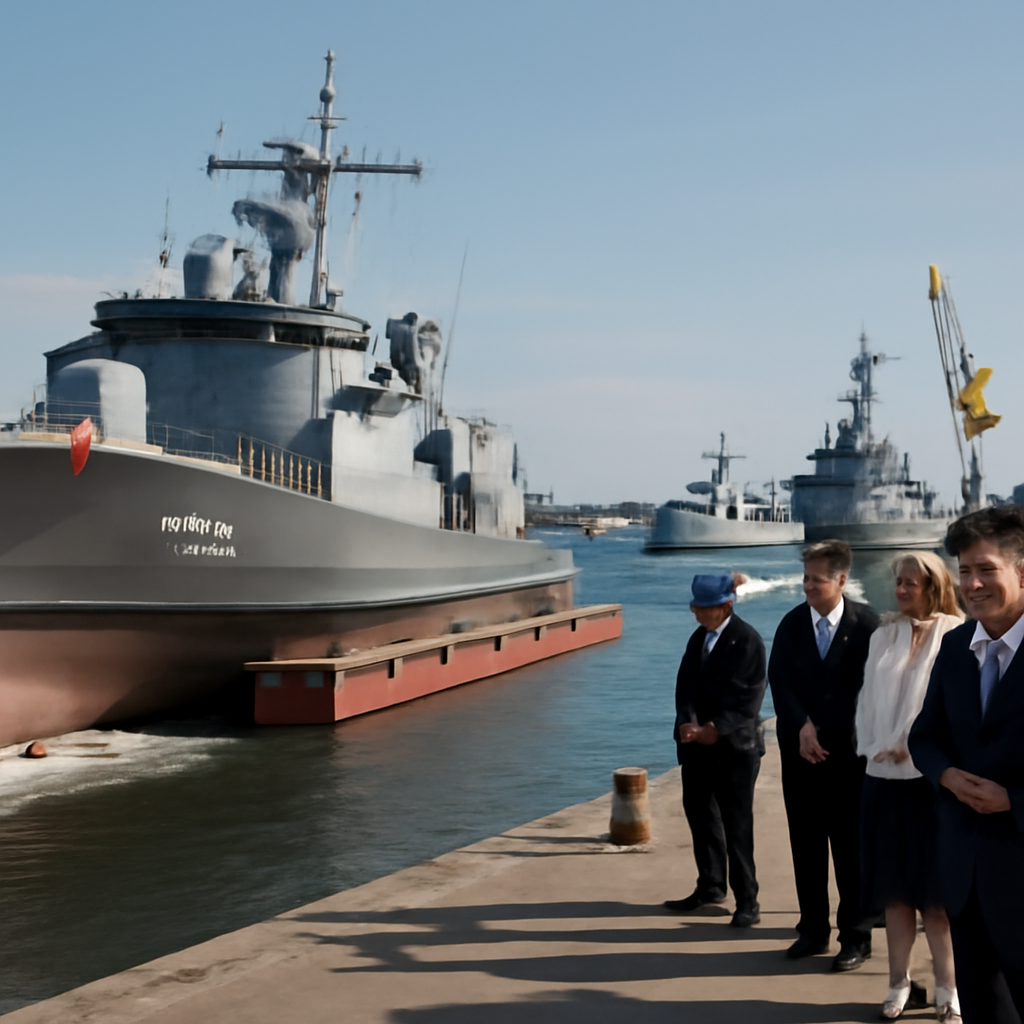
“Within the PGZ Group, we are implementing projects of strategic importance to national security,” said Adam Leszkiewicz, CEO of PGZ, as Poland’s largest surface combatant since the interwar period slid into the water in Gdynia on August 13, 2026.
Wicher’s launch: the event and immediate facts
The frigate Wicher (pennant number 274) was floated off a semi-submersible heavy‑lift barge, BOABARGE 33, in the Gulf of Gdansk after being rolled out of the PGZ Stocznia Wojenna hull hall in Gdynia. The christening and naming ceremony was attended by Polish President Karol Nawrocki. Two of the Polish Navy’s existing frigates — Kościuszko and Pułaski, both Oliver Hazard Perry class ships transferred from the U.S. Navy — marked the occasion with horn blasts; Pułaski remains in dry dock at the shipyard.
Design and performance: Arrowhead 140 adapted for Poland
The three-ship Project 106 Miecznik (Swordfish) class is built locally to Babcock International’s Arrowhead 140 design, a modular hull derived from the Iver Huitfeldt class and related to the U.K. Type 31. Each Miecznik frigate will measure 138 meters overall with a beam of approximately 20 meters and a maximum displacement of about 7,700 tons when fitted with additional equipment and armor. Propulsion is four combined diesel and diesel (CODAD) piston engines driving two propellers for a top speed of 28 knots and a maximum range near 8,000 nautical miles. The standard crew is about 120 with accommodation for an additional 60 personnel.

This site is the portfolio.
OSINTSights runs on Cloudflare Workers, D1, R2, and Vectorize, with an AI pipeline on Hetzner ARM. Nubivance designed, built, and operates it. We do the same for clients.
See what we buildWeapons, sensors and uncrewed systems
The Miecznik design places emphasis on anti‑air warfare (AAW) and anti‑submarine warfare (ASW). Primary AAW armament is the MBDA CAMM family. The frigates will carry standard CAMM (maximum range roughly 28 miles) and the CAMM‑MR variant for medium‑range threats (beyond 62 miles) developed jointly by Poland and the United Kingdom under the Future Common Missile program. CAMM can be quad‑packed in a U.S. Mk 41 vertical launch system; a 32‑cell Mk 41 could therefore hold up to 128 CAMM rounds, a configuration the program notes as important given concerns about magazine depth in the face of sustained drone and missile barrages.
For ASW, each ship will carry two dual‑tube launchers for MU90 Impact lightweight torpedoes and will be able to embark AW101 helicopters that also operate MU90s. Surface‑strike capability is provided by eight Kongsberg Naval Strike Missiles (NSM) with an option to install an additional eight launchers. Gun armament includes a Leonardo 76mm Strales optimized for anti‑missile and anti‑drone defense with DART guided projectiles, plus two 35mm guns likely to be the domestically produced OSU‑35K remote weapon stations. Self‑defense includes a Terma C‑Guard decoy system with eight fixed 130mm launchers.
Sensors and combat systems are led by Thales under the TACTICOS combat management system, including primary and secondary multifunction radars, a panoramic electro‑optical suite, hull‑mounted sonar and a towed array. Electronic warfare is provided by Rohde & Schwarz KORA. Additional systems listed include a laser warning receiver, navigation radars and a diver detection sonar. Arrowhead 140’s internal space and four boat bays permit integration and deployment of uncrewed surface vessels (USVs) and small boats, while a large helicopter deck can accommodate rotary‑wing drones and manned helicopters — a design focus the Polish Navy has applied explicitly toward operating and countering uncrewed systems.
Programme timeline, industrial implications and capacity
Poland selected the Arrowhead 140 design in 2022 and held a keel‑laying for Wicher in January 2024. Wicher is slated for commissioning in 2029 after sea trials and qualifications; the second ship, Burza (Storm), was under construction by early 2026 with a planned launch in 2027 and commissioning in 2030. The keel for the third vessel, Huragan (Hurricane), is planned for late 2026 with a launch in 2028 and commissioning in 2031. The Miecznik program is scheduled for completion by the end of 2031. Poland holds an option with Babcock to build a further five ships to the same design, and the yard capacity and skills base established for Miecznik are flagged as strategic national assets that could support future projects.
What this means for the Polish Navy, PGZ, and NATO partners
- Polish Navy: The Miecznik class represents a major capability increase over aging, second‑hand Oliver Hazard Perry frigates and will expand Poland’s ability to undertake AAW and ASW roles as part of higher‑end maritime operations.
- PGZ and domestic industry: The launch underscores PGZ Stocznia Wojenna’s role in delivering a compressed, ambitious program and preserves shipbuilding infrastructure and a skills base that the company and state view as strategically important.
- NATO and regional partners: Warsaw frames the frigates as part of a broader regional shift — Finland and Sweden joining NATO, Germany strengthening maritime capabilities, and Baltic states expanding forces — intended to give Poland more reach and a larger role in alliance maritime architecture.
- Adversaries and the Baltic security picture: The program responds to a maritime environment where Russian capabilities in air defense, electronic warfare and strike, plus a relatively modern Baltic Fleet and denial tools (long‑range missiles, submarines, mines), pose threats inside the Baltic and beyond. Russia is also described as employing cyber operations, sabotage, GPS/electronic interference and drone activity in gray‑zone tactics around NATO’s eastern flank.
The Wicher’s launch is both symbolic and practical: a first float for a ship that still needs full outfitting and systems integration in Gdynia, and a visible start to a compressed effort to field three modern multirole frigates by 2031. The program extends beyond a single hull — it tests Poland’s ability to expand personnel, maintenance and sustainment capacity while pursuing one of Europe’s most ambitious concurrent military modernizations.