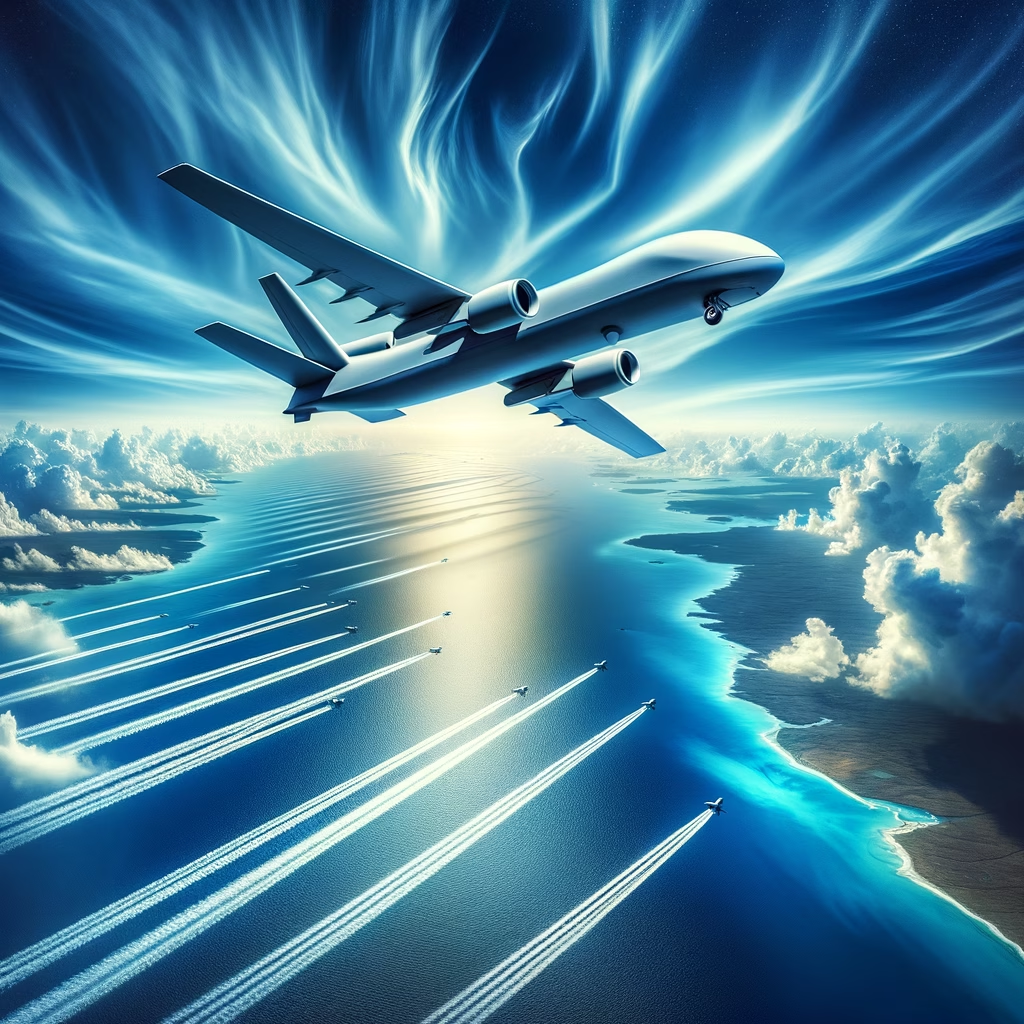
Can a cargo plane cross the vast Pacific without a pilot in the cockpit and still keep the supply lines of a theater of operations secure? That question moved from thought experiment to field test this year, as the U.S. Air Force quietly folded remotely‑operated cargo flights into its massive REFORPAC exercise in a bid to drive down the cost of moving materiel across the region.
For decades, the logistics tail has been both backbone and budget sink for military operations: aircraft, crews, fuel and maintenance that keep forward forces fed and equipped. Now, with technology maturing and budgets tightening, the Air Force is pursuing a simple premise—remove the human from the cockpit where you can, and lower unit costs while increasing sortie rates. Defense One reported that the service incorporated remotely‑operated cargo flights into REFORPAC as part of that effort.
REFORPAC, an expansive multinational exercise in the Pacific, provided a live environment to test whether remotely piloted or remotely controlled cargo aircraft can perform routine resupply missions in dispersed operations. The initiative is not a sudden leap into full autonomy; the emphasis in these trials is on remote operators and human oversight rather than unmonitored, self‑governing aircraft. Still, the concept seeks to harness automation, advanced communications and new operational concepts to make sustainment cheaper and more resilient.
Why now? There are three converging pressures. First, fiscal: moving critical supplies across oceanic distances is expensive, and defense leaders have grown increasingly attentive to ways to squeeze inefficiencies from the logistics enterprise. Second, technological: secure satellite links, improved ground control stations and more reliable autonomous systems lower the barrier to remotely‑operated flight. Third, strategic: the Indo‑Pacific’s geography—long distances, dispersed islands, limited basing—favours innovation in logistics that reduce reliance on a small number of vulnerable hubs.
The advantages the Air Force hopes to harvest are real. Remotely‑operated cargo aircraft can extend the hours that aircraft are available for missions by reducing crew rest constraints, shorten response times for tactical resupply, and reduce personnel risk in contested zones. From a pure cost perspective, fewer flight crews and lower training burdens translate into long‑term savings on manpower and personnel sustainment.
Yet the promise comes tethered to significant challenges. Communications and command‑and‑control are critical: Pacific operations depend heavily on satellite links, which are increasingly contested by sophisticated adversaries. A remotely‑operated lift fleet introduces new attack surfaces—cyber intrusion, jamming, spoofing and kinetic attacks against the space and ground infrastructure that enable remote control.
There are also operational tradeoffs that are often overlooked in headline accounts. Aircraft engineered to fly without a pilot still require maintenance, preflight preparation and, importantly, ground crews and communications specialists. Cost savings on aircrew do not automatically translate into net savings if the program shifts those personnel costs into expensive signal and cyber defenses, new maintenance regimes, or complex training pipelines for remote operators and technicians.
Likewise, interoperability and regulation matter. Allied partners in the Pacific have different rules and air‑traffic control regimes; integrating remotely‑operated flights into multinational logistics will demand new agreements on control, liability and airspace deconfliction. Civilian airspace issues are less central in a military exercise, but any pathway to broader employment will need to reckon with international and commercial aviation rules.
Consider how different stakeholders view the development:
/ Technologists see a natural progression—automation and remote control can multiply sortie generation and reduce human risk. Advances in secure communications, edge computing and resilient autonomy make the concept increasingly feasible.
/ Policymakers and budget officials look at the potential for reduced personnel and flight‑hour costs, but they worry about the hidden expenditures—cyber hardening, satellite capacity, and diplomatic work to clear airspace for remotely‑piloted logistics chains.
/ Users on the ground—logisticians and combatant commanders—welcome more reliable and flexible lift, especially for dispersed or austere operations. But their calculus includes reliability under stress: will these systems continue to operate when satellites are degraded or when an adversary actively contests the electromagnetic spectrum?
/ Potential adversaries may view remotely‑operated logistics as both a vulnerability and an opportunity. Interdicting or degrading remote control links could create outsized effects on sustainment, making these systems attractive targets in any high‑intensity campaign.
History offers a cautionary frame. The Defense Department has periodically chased unmanned or remotely piloted sustainment concepts—some experiments yielded clear operational advantages; others faltered because the logistical and security overhead outstripped the benefits. The current push in the Pacific appears to be an attempt to learn those lessons under realistic, long‑distance conditions.
Execution will matter. If remotely‑operated cargo flights are fielded without commensurate investment in resilient satellite and terrestrial communications, cyber defenses, and allied integration, their vulnerabilities could outweigh their advantages. Conversely, if the Air Force pairs these platforms with hardened, redundant command chains and sensible operational doctrines, the result could be a more affordable and agile logistics posture in a region where agility matters.
The trials at REFORPAC are therefore less a technological spectacle than an operational experiment: can the logistics apparatus be reimagined so that cost savings do not come at the expense of resilience? The answer will shape basing decisions, force posture and deterrence calculus across the Indo‑Pacific.
One final thought: cost savings are seductive, but logistics is about trust—the trust that supplies will arrive when and where they’re needed. Removing the pilot from the cockpit may reduce payroll, but it shifts that trust to satellites, software and networks. Are we ready to put as much faith in those systems as we have in trained aircrews?
Source: https://www.defenseone.com/technology/2025/09/air-force-debuts-pilotless-cargo-flights-pacific/407918/