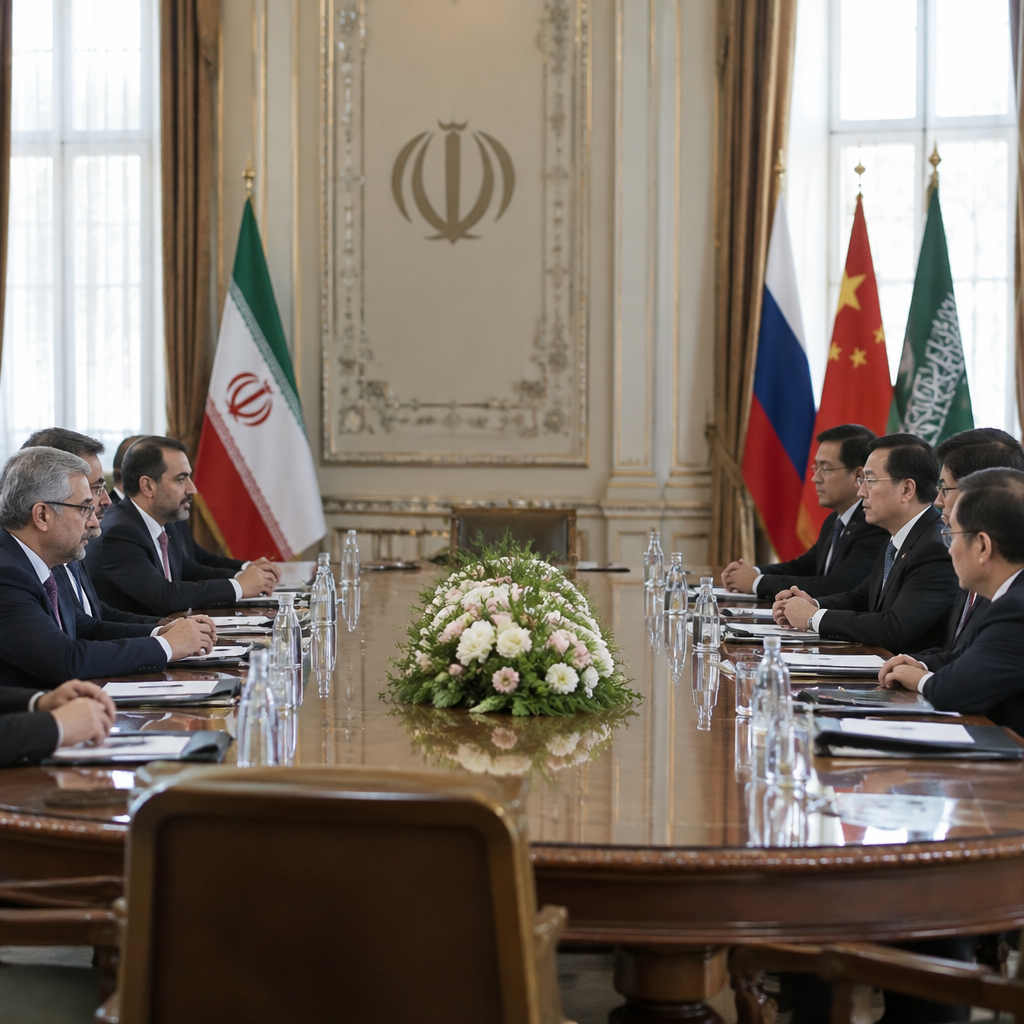
"Very good discussions took place between us," Mohsen Rezaei, secretary of Iran’s Supreme National Security Council, told Iranian state television after a hastily called meeting in Tehran on October 26, 2026.
Who attended in Tehran
Officials from Iran, Saudi Arabia, Pakistan and Turkey convened in Tehran in what the four countries described in a joint statement as an effort “to continue the dialogue to strengthen cooperation amongst the four regional countries, including for peace and security in the region.” The summit was the first meeting between Iran and the other three states since they formed the Mecca Joint Defense Agreement in August.
Participants included Iran’s President Dr. Masoud Pezeshkian and Mohsen Rezaei. Saudi Arabia’s delegation was led by Minister of Defense HRH Prince Khalid bin Salman bin Abdulaziz Al‑Saud. Pakistan was represented by Field Marshal Asim Munir, the Chief of Army Staff, and Turkey by Ibrahim Kalin, director of the Turkish National Intelligence, Saudi Deputy Minister for Public Diplomacy Rayed Krimly said on X ahead of the meeting.
Makkah Joint Defense Agreement and the June MoU
The meeting came against the backdrop of a regional security architecture reshaped this year. The Mecca (Makkah) Joint Defense Agreement — originally framed to assist the Kingdom against Houthi attacks — has broadened to address wider regional stability concerns, the source reported. The Tehran talks were described as “part of the continued efforts by the Makkah Joint Defense Agreement countries for de‑escalation,” Rayed Krimly said.
Earlier diplomatic efforts involving Qatar and Pakistan produced a 14‑point Memorandum of Understanding signed on June 17 that gave a 60‑day extension to a ceasefire and sought broader guarantees — including preventing Iran from pursuing nuclear weapons, ending U.S. sanctions, and reopening the Strait of Hormuz. That effort “soon fell apart as the U.S. and Iran resumed striking each other,” the report noted, although it has been more than a month since the two nations exchanged direct blows.

Audit-ready is a season. It shouldn't be.
Evidence in spreadsheets, controls drifting between audits, frameworks multiplying on flat headcount. Nubivance runs continuous compliance on Rapid7 Cyber GRC - SOC 2, HIPAA, ISO 27001, PCI, CMMC.
End the scrambleU.S. and Israeli posture
The Tehran meeting occurs while the United States and Israel continue planning options. A senior U.S. official told TWZ, “The United States is in a very strong position with control of the Strait of Hormuz and the Iranian economy collapsing,” adding that “one way or the other, the conflict in Iran will be over very soon. President Trump holds all the cards.”
CNN, citing two U.S. officials, reported U.S. forces in the Middle East were “prepared to launch new, potentially major, military operations against Iran ‘within 96 hours of receiving’ an order from President Donald Trump,” and that sufficient forces were deployed. The aircraft carrier USS Theodore Roosevelt and its carrier strike group are reportedly being deployed to the Middle East.
Israel also signaled readiness. Prime Minister Benjamin Netanyahu warned Iran or its proxies could launch attacks to disrupt Israel’s October 27 election and declared, “The (military) is ready both to defend and to strike,” adding, “You will suffer disproportionate blows far greater than you can imagine.” Reports in the Jerusalem Post of a clash between Netanyahu and IDF Chief of Staff Lt. Gen. Eyal Zamir over a pre‑election military action were publicly disputed by Israeli Defense Minister Israel Katz.
Houthis, oil and the Strait of Hormuz
Delegates in Tehran addressed fighting between Saudi Arabia and the Iranian‑backed Houthi rebels in Yemen. The Houthis have increased attacks on Saudi oil infrastructure, including a recent strike near the Shaybah oilfield, and claimed another attack on Riyadh’s international airport; Gulf News reported fresh explosions in Riyadh overnight before the meeting.
Those strikes, combined with an uptick in Iranian attacks on shipping through the Strait of Hormuz, have pressured oil markets: OilPrice.com reported Brent crude at over $115 per barrel Monday evening, a slight drop from more than $117 on Friday.
U.S. Central Command commander Adm. Brad Cooper visited the Strait of Hormuz on Oct. 25. CENTCOM said U.S. forces had helped Gulf partners export more than 1.5 billion barrels of crude oil since summer and that more than 3,000 commercial vessels have transited the waterway with CENTCOM support over the last six months. CENTCOM also said American forces cleared Iranian sea mines and that “over 95% of ships navigating the Strait of Hormuz have sailed through safely,” a claim TWZ said it could not independently verify.
How Saudi Arabia, the United States, and Pakistan and Turkey are responding
- Saudi Arabia: Sending its defense minister and framing the Tehran talks as part of the Makkah agreement signals Riyadh’s dual focus on deterring Houthi attacks and seeking broader regional security arrangements.
- The United States: Officials have publicly described a posture of military readiness — with carrier groups deploying and CENTCOM operations supporting commercial passage through the Strait — while U.S. intelligence leaders warned of “advanced stages” of threats to Americans, according to reporting in The Wall Street Journal and a memo described in that coverage.
- Pakistan and Turkey: Their high‑level representation — Field Marshal Asim Munir and Ibrahim Kalin — and prior roles in mediation underscore continued engagement in attempts to convert ceasefires or memoranda into longer‑term mechanisms for regional security, Iranian Foreign Ministry spokesperson Esmaeil Baghaei said the talks could be “a first step towards establishing regional security mechanisms.”
The Tehran meeting was described by participants as a first of multiple rounds and concluded with a joint pledge to continue dialogue. Whether that pledge alters the immediate calculations of Washington, Jerusalem or Tehran remains an open question; the participants themselves said only that “an understanding” had been reached that “the security of the region is achieved through its countries.”