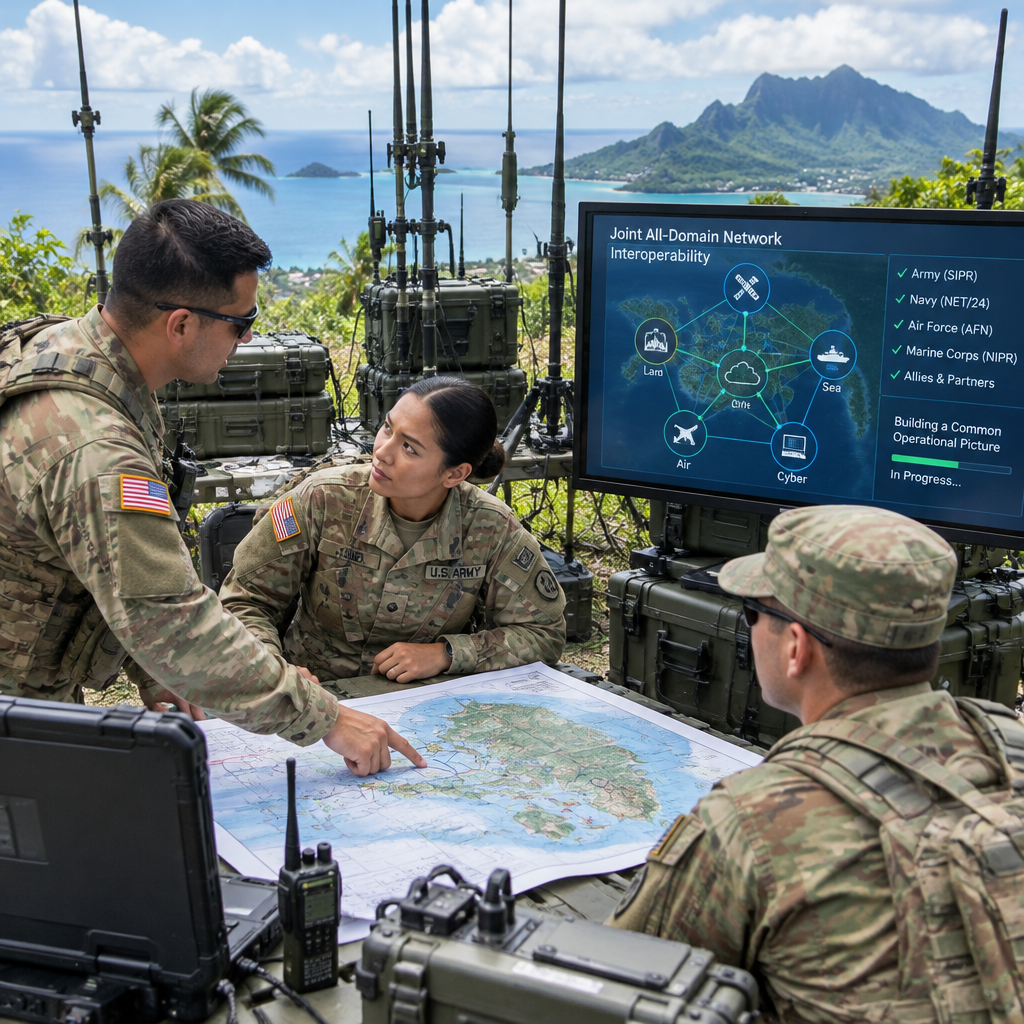
"It was so frustrating to me because I just left working in the Pentagon where I had literally attended both the signing ceremonies for AUKUS…sharing our most sensitive defense technology. But we are using basically a swivel chair to have a conversation with regard to land forces," Gen. Ronald Clark said, describing an early exercise in Japan shortly after he took command of U.S. Army Pacific.
Gen. Ronald Clark on the problem and the progress
Clark used that moment at the Association of the U.S. Army’s annual conference earlier this month to frame why upgraded networking matters to U.S. forces in the Pacific. He recounted an early trilateral exercise with Japan and Australia where participants "literally couldn't pass voice data to each other" and could not create a common operating picture without manually adding icons. Clark now describes movement toward a different reality: the mission partner enclaves are working and the Pacific Mission Network is becoming an "important and critical innovation" for sharing target-quality data and a common operational picture without forcing commanders to swivel between separate workstations.
Pacific Mission Network: the linchpin for allied data sharing
The Pacific Mission Network — previously known as the INDOPACOM Mission Network — has been the backbone for linking U.S. forces with allies and partners across the region. An Army spokesperson told Defense One that the network was used during the large Balikatan exercise earlier this year to obtain a "real-time picture of participating forces across the entire training area." That same network was central to U.S. Army Pacific’s effort to test whether U.S. and partner forces could share and see the same information during multinational exercises.

This site is the portfolio.
OSINTSights runs on Cloudflare Workers, D1, R2, and Vectorize, with an AI pipeline on Hetzner ARM. Nubivance designed, built, and operates it. We do the same for clients.
See what we buildBalikatan 26 and Yama Sakura 91: testing live and simulated sharing
Two recent exercises used the Pacific Mission Network in different but complementary ways. Balikatan demonstrated the live sharing of real-time information across a physical training environment and multiple echelons, while Yama Sakura 91 — an annual exercise with Japan and Australia that ended Sept. 10 — demonstrated the live sharing of simulated information in a command post exercise, the Army said. Clark described how commanders such as Maj. Gen. Bernard Harrington could gather inputs across domains — "land-based long-range precision fires, sensors, space capability, [electronic warfare], cyber" — and then share that data with Pacific Fleet leadership so it "can then integrate that [data] into a joint context in the fight."
Bayonet Quest near Lake Huron: unmanned systems, a single data layer, and a large language model
Seventh Infantry Division’s Bayonet Quest, which wrapped Oct. 6 near Lake Huron, demonstrated how the Army is trying to bring diverse sensor and effect systems onto a single data fabric. Maj. Gen. Harrington said the division coordinated high-altitude balloons and aerial and maritime drones using a shared data connection. The exercise used "multiple [unmanned aerial systems], multiple [unmanned surface vessels], long-range, one-way attack, and a high-altitude balloon," and collected and analyzed data from all those systems with a single data layer.
Harrington told reporters the division was able to orchestrate the unmanned systems and coordinate simulated attacks with an "adaptive and agentic" command-and-control system. He added in a statement to Defense One that the unit "was able to pull in a vast amount of data, make sense of it quickly, and then task those systems through a large language model, reducing the need for soldiers on individual ground control stations." The division plans to continue training with this concept and to "employ it in future exercises with allies and partners."
What this means for commanders, technologists, and allies
- Commanders: Better ability to fuse land-based fires, sensors, space, electronic warfare and cyber into a joint picture — enabling commanders to pass "target-quality data" and to integrate that data with fleet leadership.
- Technologists and security teams: Increasing reliance on mission partner enclaves, a single data layer, and adaptive command-and-control systems means engineering, cybersecurity, and interoperability work will remain central as more unmanned platforms and automated decision tools are added.
- Allies and partners (Japan, Australia): Exercises show movement from stove-piped communications toward real-time and simulated sharing across echelons — a practical change from earlier exercises in which voice and common operational pictures did not flow between partners.
After years of frustration that required "physically putting icons into this system," U.S. Army Pacific and its partners report tangible gains: mission partner enclaves moving from theory to practice, exercises demonstrating both simulated and real-time sharing, and experiments tying unmanned systems and automated decision tools to a common data layer. The record in the source material ends with continued training and planned integration in future exercises — concrete next steps that will determine whether this progress scales beyond individual exercises and into sustained, multinational operational capability.