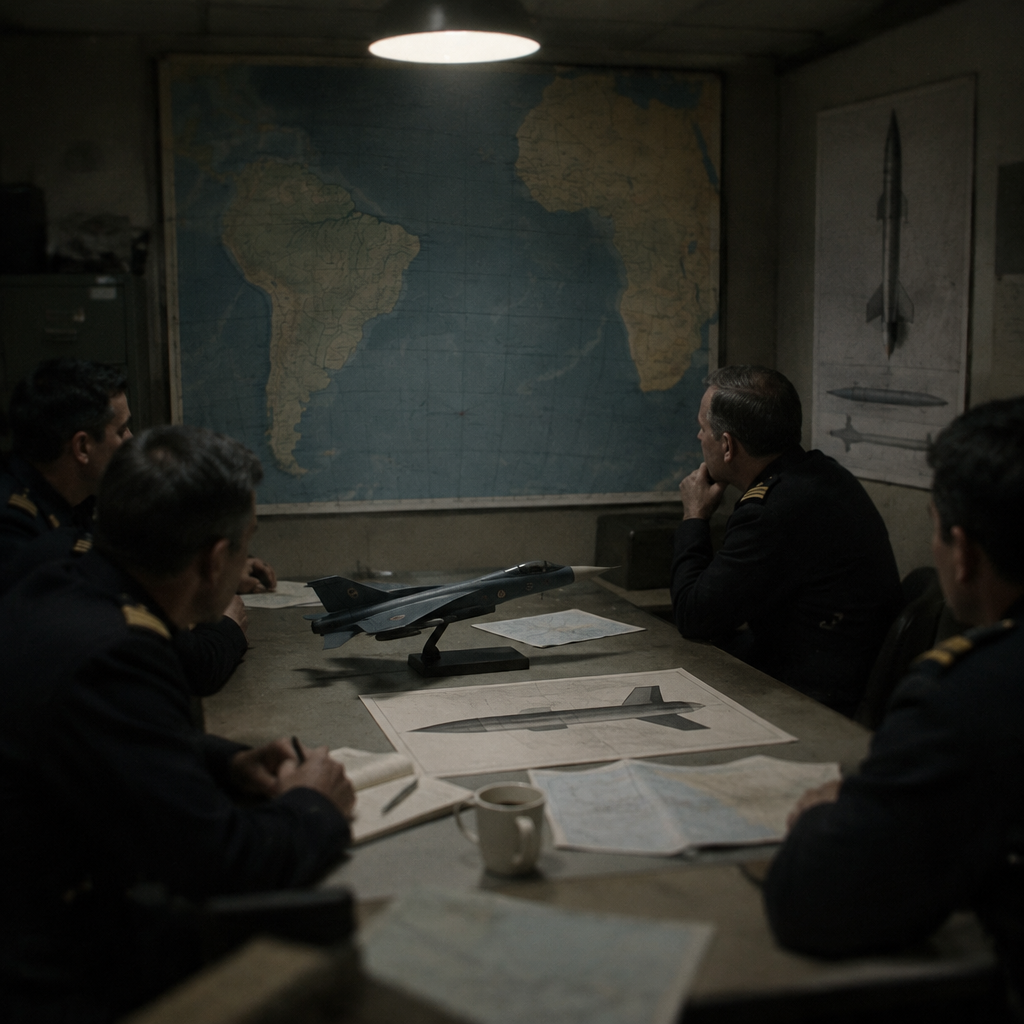
“Five Super Étendard aircraft and five AM39 Exocet missiles had been delivered to Argentina before a French embargo took hold.”
The Exocet pairing that drove British planning
The threat of the Dassault Super Étendard strike fighter paired with the AM39 Exocet anti-ship missile dominated British operational thinking during the 1982 South Atlantic conflict. That pairing had already contributed to the loss of the destroyer HMS Sheffield on May 4 and the container ship Atlantic Conveyor on May 25. The five Étendards and five Exocets were operated by the Argentine Navy’s 2nd Naval Fighter and Attack Squadron out of Río Grande, Tierra del Fuego — and that concentration of capability was the single Argentine capability most feared by British planners.
Four-phase special-forces plan: PLUM DUFF, MIKADO, KETTLEDRUM and IMPI
British special-operations work against the Super Étendards unfolded as a sequence of named phases. PLUM DUFF was the insertion and reconnaissance phase: on May 16 an RAF Hercules airdropped a recce party onto RFA Fort Austin, and a Sea King HC4 attempted a one-way flight to Tierra del Fuego on the night of May 17/18 but the patrol failed and the helicopter was deliberately burnt in Chile while its crew sought to evade capture.
MIKADO was the planned strike that would have used two Hercules to air-land up to 70 men of B Squadron, 22 Special Air Service, at Río Grande (with Río Gallegos a named alternative). Military planners and aircrews judged the operation highly risky — formation landings of heavy transports on a possibly icy, defended runway at night with inadequate intelligence — and MIKADO was formally cancelled on June 4.
KETTLEDRUM would have targeted Puerto Deseado and envisaged insertion by the submarine HMS Onyx, but like the others it was not executed as planned.

Audit-ready is a season. It shouldn't be.
Evidence in spreadsheets, controls drifting between audits, frameworks multiplying on flat headcount. Nubivance runs continuous compliance on Rapid7 Cyber GRC - SOC 2, HIPAA, ISO 27001, PCI, CMMC.
End the scrambleOperation IMPI: resourced, rehearsed, and then halted
Cancelling MIKADO produced a fourth plan: Operation IMPI. On June 4 the U.K. Ministry of Defense tasked Commander Task Force 317 to draft a replacement; the planning document (Ops 1/3) is dated June 14, the day Argentina surrendered in the islands. Signals show IMPI had been resourced: at 2240Z on June 12 Maj. Gen. Jeremy Moore signalled Rear Admiral Sandy Woodward’s battle group and others that B Squadron, 22 SAS, was to be made available “as soon as possible” and that IMPI was, Moore noted in passing, “self-sufficient.”
Naval and special-forces units were physically preparing for IMPI. On June 9 HMS Conqueror received preparatory information and was briefed to act as a periscope‑depth radio beacon to aid navigation. On June 14, at 0815Z in San Carlos Water, HMS Onyx embarked a party of 10 men from B Squadron, 22 SAS and the SBS; they carried out practice landings from a Gemini inflatable on June 15. The maritime half of IMPI — submarine insertion, demolition of aircraft and missiles ashore — was therefore real and rehearsed even as the strategic situation was changing ashore.
The contested air element and No. 47 Squadron
The air component of IMPI, however, is the subject of sharp dispute within the surviving record. The concept in later narratives was leaner than MIKADO: a single RAF Hercules would fly from Ascension, refuel in flight, route east of the Falklands and south of Cape Horn to approach below Argentine radar and land at codenamed strips (San Jose and Arco Iris). The submarine Conqueror was to provide a radio reference for this low-night navigation.
That aerial plan rests in the public archive on a single paragraph in an RAF historical narrative compiled years later and held in a folder opened on April 18, 1986. The document names a Special Forces Flight capable of probe-fitted aerial refuelling — the record identifies No. 47 Squadron, RAF — but members of the flight who were at Ascension say they never saw the operation’s codeword, never heard of IMPI at the time, and find it inconceivable that a special-forces Hercules and crew could have been earmarked without the detachment knowing. Unit logbooks contradict parts of the narrative’s account of exercises, and the detailed IMPI file (DEFE 71/980) that would settle the matter remains closed at the National Archives.
What this means for the Royal Navy, Special Forces, and the RAF
- Royal Navy: The record shows the navy deployed both nuclear and conventional submarines in support roles — HMS Conqueror as a navigational beacon and HMS Onyx to carry special-forces teams — underscoring how naval assets were repurposed to neutralize a shore-based air‑to‑sea threat.
- Special Forces (SAS and SBS): B Squadron and SBS were explicitly resourced and embarked for IMPI; the operation’s resourcing consumed theatre special-forces assets to the point that a fresh SAS squadron was called forward to cover other contingencies.
- RAF and No. 47 Squadron: The air‑element dispute points to a tension between staff‑level narratives and unit logs. No. 47 Squadron’s probe‑refuelling capability existed and crews had rehearsed long‑endurance sorties, but the squadron’s own detachment in-theatre deny knowledge of an earmarked IMPI Hercules.
Forty‑four years on, the British state still retains the full IMPI file (DEFE 71/980). The operational record that remains publicly visible is therefore one of two distinct halves: a solid, resourced maritime insertion that was rehearsed aboard HMS Onyx and briefed to the nuclear submarine Conqueror, and an aerial plan that survives in a single paragraph and in disputed secondary records. That duality — concrete preparations at sea and unresolved questions about the air option — is itself a revealing measure of how far planners were prepared to go to eliminate the Super Étendard/Exocet threat.
Source: Britain’s Final Plan To Kill Argentina’s Super Étendards Attack Jets — The Warzone