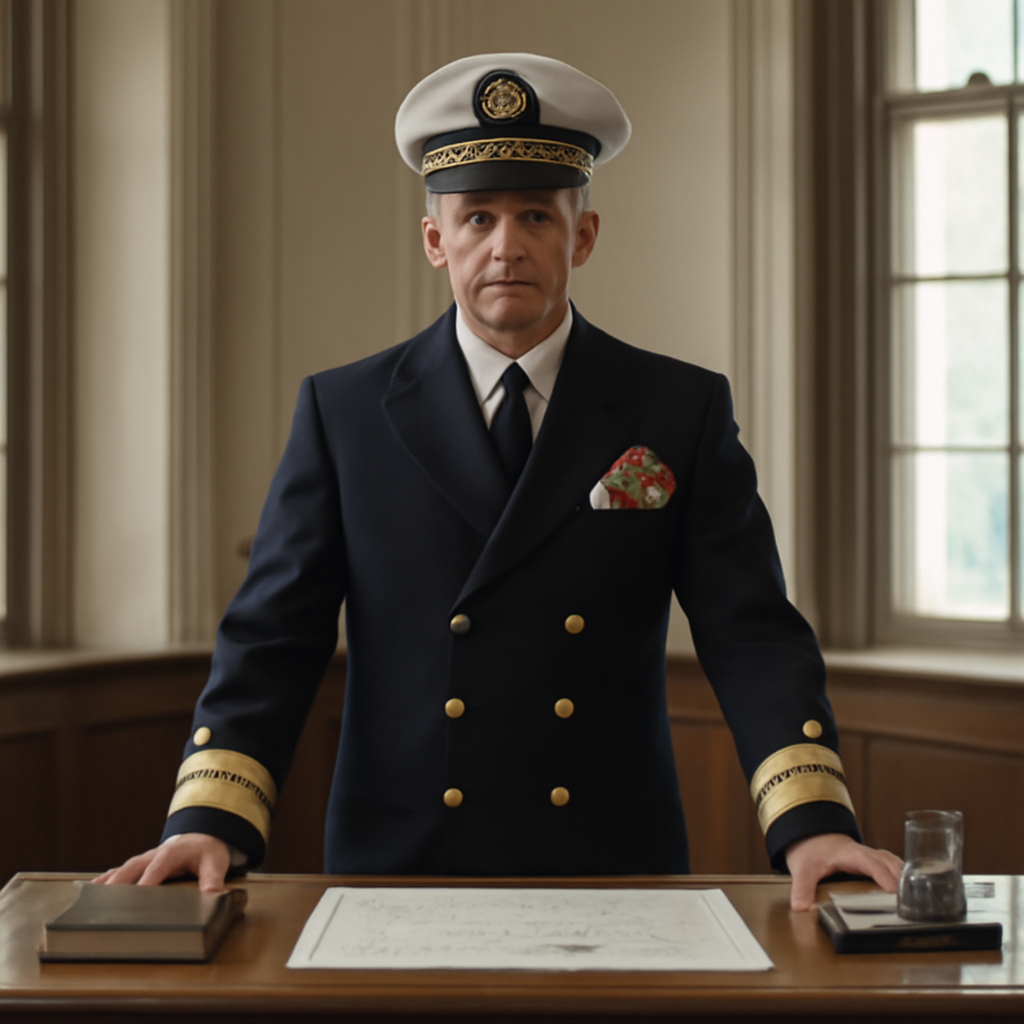
"the world was full of people who wanted to become Secretary of the Navy,"
Jimmy Carter’s Secretary of Defense, Harold Brown, said that not as a lament but as a warning: the office is glamorous, coveted and easy to misunderstand. The authors of a recent checklist of what makes a successful SECNAV lay out a compact but exacting set of requirements — and illustrate them with historical examples ranging from Theodore Roosevelt and Gideon Welles to Graham Claytor, Paul Nitze and James Forrestal. Their conclusion is plain: talent, experience and circumstance matter, and political support is decisive.
What the checklist demands: six core attributes
The article lays out six concrete attributes it says an effective Secretary of the Navy must bring to the job. They are: a grounding in history, geopolitics and economics; familiarity with the Navy and Marine Corps as institutions; skill as a bureaucratic operator; private-sector experience, especially with procurement and finance; credibility on Capitol Hill; and political top cover from the Secretary of Defense and the President. The authors warn that many well-connected nominees lack several of these qualities and cite former Secretary John Phelan as "the most recent example" of someone unsuited to survive in the role.
History, geopolitics and economics: selling the Navy’s purpose
One principal task for any SECNAV, the authors write, is to "justify and articulate the purpose of the U.S. Navy to the Congress and the American people" when fighting for the Navy’s budget. That requires an appreciation that the United States is a maritime nation dependent on sea lines of communication (SLOCs) for economic and national security. The piece notes that Assistant Secretary of the Navy Theodore Roosevelt often quoted Alfred Thayer Mahan; while modern SECNAVs need not echo Mahan verbatim, they must grasp the lessons of history and the conditions for sea power — especially the role of "determined, consistent political leadership."

This site is the portfolio.
OSINTSights runs on Cloudflare Workers, D1, R2, and Vectorize, with an AI pipeline on Hetzner ARM. Nubivance designed, built, and operates it. We do the same for clients.
See what we buildInstitutional familiarity and private-sector experience: Welles and Forrestal
The article argues it is an "obvious advantage" to have served in the Navy or Marines, in uniform or civilian capacity, because SECNAVs must understand the distinct communities that comprise the Navy and Marines. It points to Gideon Welles, who ran the Navy’s Bureau of Provisions during the Mexican‑American War and was thus well placed to expand the Navy’s logistics and blockade capability during the Civil War.
Equally important, the authors say, is private-sector experience. They credit James Forrestal — initially as Under Secretary of the Navy — with recognizing that the Navy’s antiquated procurement system could not keep pace with modern war demands. Over the objections of Chief of Naval Operations Ernest J. King, Forrestal "created a new office to oversee the billions of dollars of contracts" the Navy planned to sign and to ensure those contracts generated the needed forces without conflicting with other services’ requirements.
Bureaucratic fights and civilian control: Claytor, Rickover and Nitze
Changing the Navy’s direction, the piece cautions, frequently provokes resistance from uniformed leaders and the civil service. Graham Claytor, serving under President Jimmy Carter, persuaded Secretary Brown not to relegate the Navy to a purely defensive posture and "used the Navy to strike at the Soviet Union’s weak flanks." Claytor also "deftly outmaneuvered Adm. Hyman Rickover" when Rickover attempted to influence policy through congressional lobbying.
The authors emphasize that SECNAVs must not hesitate to exert civilian control. They recount Paul Nitze — the SECNAV for Presidents John F. Kennedy and Lyndon Johnson — firing an admiral who tried to slow‑roll him by telling Navy employees that "Secretaries of the Navy come and go." Those historical vignettes underscore the piece’s central point: effective civilian leadership can reshape entrenched practices.
Hung Cao’s nomination and what it means for Congress, the Navy, and the White House
The article places its checklist in the context of the Trump administration’s nomination of Hung Cao for SECNAV. It says Cao "has shown some of the attributes to thrive in the job": considerable military experience, "good relations with key leaders in the administration," courage to take on strong opponents, a willingness to be labeled "controversial," a reputation as a fast learner, and loyalty to friends and teammates. The authors add the sober caveat that Cao will need to acquire other skills on the list if he is to succeed, concluding, "Only time will tell."
For Congress: the SECNAV must spend "a great deal of time in person on the Hill, cultivating, socializing, lobbying and convincing congressional leadership" that the department has a coherent plan and the determination to implement it.
For the Navy and the Marine Corps: the piece implies they will look for a SECNAV who understands the service communities' roles and can translate those into budget priorities and organizational changes without being outmaneuvered by uniformed or civil‑service actors.
For the White House and the Secretary of Defense: the authors stress that SECNAV authority "flows from the defense secretary and president’s belief that the SECNAV is serving as a faithful executor of the administration’s policies." They note the co‑author’s own experience in the Reagan administration: although he "never had a close personal relationship with either President Ronald Reagan or Secretary of Defense Caspar Weinberger," he remained effective because White House, Navy and Pentagon leaders recognized his policies supported the administration’s grand strategy and because the Secretary of Defense delegated significant authority to service secretaries.
The authors close with a pointed summation: regardless of who occupies the office, "the secret of success for an effective Secretary of the Navy is a combination of talent, experience and circumstance." They add that the Navy is "in the midst of its most challenging period since the end of the Cold War" and therefore needs someone with the right blend of skills — and, they quip, "charm" — to steer it back on course.