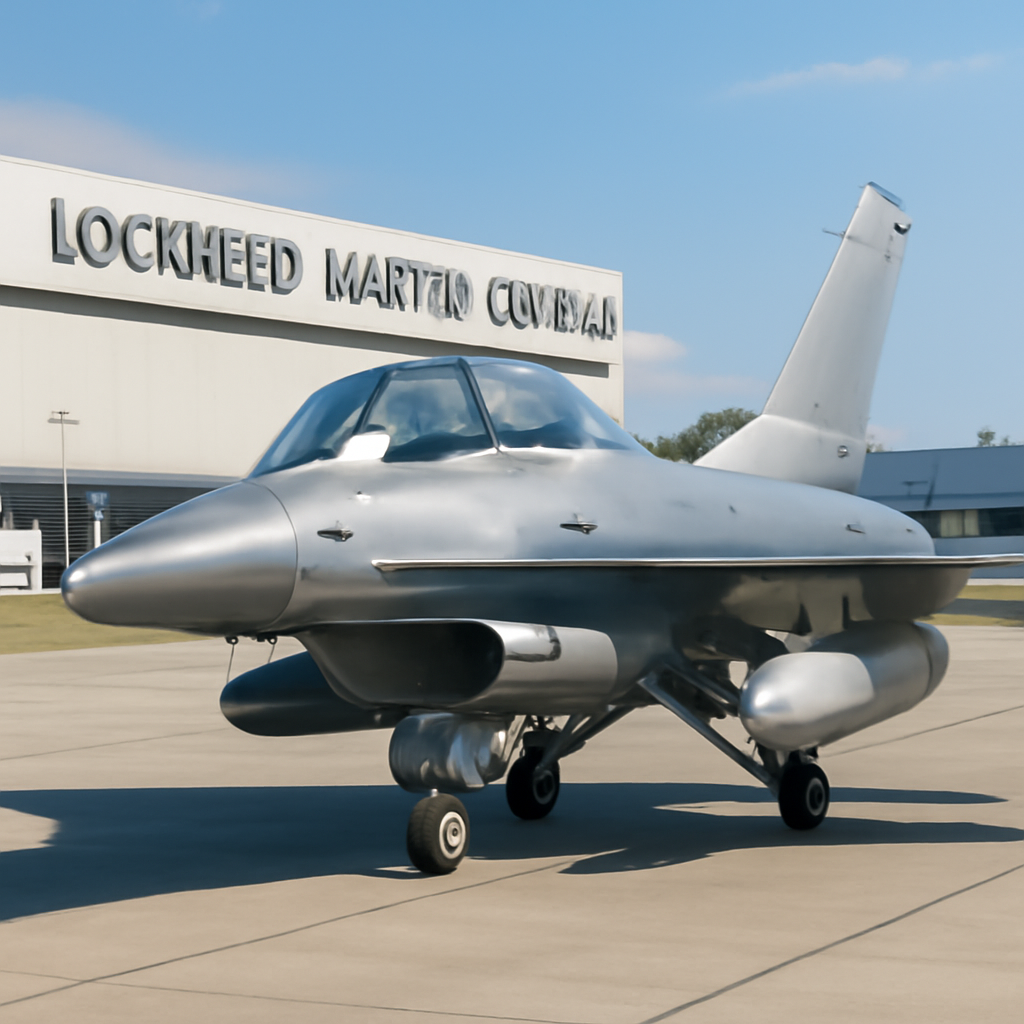
"Morocco’s first @LockheedMartin F-16 Block 72 aircraft has taken flight in Greenville, South Carolina. The milestone marks another step toward delivering the most advanced F-16 configuration to the Royal Moroccan Air Force." — Lockheed Martin News.
Lockheed Martin: a two-seat F-16D completes its maiden flight in Greenville, South Carolina
Lockheed Martin announced that the first-ever F-16 Block 72 — a two-seat F-16D destined for the Royal Moroccan Air Force (RMAF) — completed its maiden flight at the company’s Greenville, South Carolina facility on October 6, 2026. The company said the aircraft will now proceed through flight testing ahead of delivery to Morocco. Photographs published by Lockheed Martin show a pilot in the front cockpit wearing a Digital Joint Helmet Mounted Cueing System (D-JHMCS), a helmet the source notes is not often seen on F-16 pilots and whose procurement by Morocco remains unclear.
Block 72 technical choices: the F100‑PW‑229 engine and shared avionics suite
The Block 72 configuration is distinguished from the Block 70 chiefly by its engine selection: the Block 72 uses Pratt & Whitney’s F100‑PW‑229, while the Block 70 uses General Electric’s F110‑GE‑129. The source describes the Pratt & Whitney engine as providing "fractionally more power." Otherwise, the two configurations share the same major avionics and systems modernization package. Planned equipment for Morocco’s proposed Block 72 buys — as described in a March 2019 U.S. government notification — included the AN/APG‑83 Scalable Agile Beam Radar (SABR), new mission computers, Link 16 Multifunctional Information Distribution Systems, modernized navigation systems, helmet‑mounted cueing systems, and an array of air‑to‑air and air‑to‑ground weapons.

The cyber insurance questionnaire just landed. Now what?
SOC 2, HIPAA, insurance renewals - someone has to own security strategy. Nubivance provides fractional CISO leadership without the full-time salary.
Get a security leadMorocco’s procurement timeline: March 2019 DSCA notification and fleet upgrades
Morocco was the first customer to select the Block 72 configuration when the U.S. government approved its purchase in March 2019. At that time the Defense Security Cooperation Agency said Morocco was seeking 25 F‑16C/D Block 72 aircraft in a package estimated at $3.787 billion. A separate March 2019 notification covered plans to upgrade Morocco’s existing 23 F‑16C/D Block 52+ aircraft to the F‑16V standard, a modernization broadly similar to the new‑build Block 70/72 baseline. Lockheed Martin frames the new and upgraded aircraft as part of a move toward greater commonality across the RMAF fleet.
Operational record and partnerships: combat deployments and multinational exercises
The source places Morocco’s F‑16 force in active operational use and multinational training. In recent years, Moroccan F‑16s have participated in the campaign against ISIS and have been deployed on missions against Houthi rebels as part of the Saudi Arabia‑led coalition in Yemen. The source recalls that a Moroccan F‑16 crashed in Yemen in 2015; Moroccan authorities attributed that loss to a technical malfunction, while Houthi forces claimed they had shot the aircraft down. Outside combat, the RMAF regularly participates in exercises such as African Lion, the annual multinational exercise led by U.S. Africa Command and partner nations; a photo in the source shows a Utah Air National Guard KC‑135 refueling a Moroccan F‑16 during African Lion 2019.
Benslimane MRO and Moroccan industrial roles: Maintenance Aero Maroc and an 86,000‑square‑foot facility
Lockheed Martin is linking the Moroccan F‑16 program to broader industrial and sustainment investments in Morocco. The company says it is working with Moroccan industry, including Maintenance Aero Maroc, on an upcoming maintenance, repair and overhaul (MRO) facility at Benslimane. The more than 86,000‑square‑foot facility is intended initially to support heavy maintenance and modernization of C‑130 Hercules aircraft, with plans to expand into additional platforms including the F‑16. Lockheed Martin frames this work as a pathway for Morocco to play a larger role in sustaining its expanding fleet and potentially to support other regionally based aircraft.
What this means for Morocco, Lockheed Martin, and regional partners
- Royal Moroccan Air Force: The Block 72 flight advances a modernization plan built around fleet commonality — Morocco already operates F‑16C/D Block 52+ aircraft powered by F100 engines and is upgrading to the F‑16V standard — positioning the Block 72 as the spearhead of its combat‑air fleet.
- Lockheed Martin and Moroccan industry: The aircraft now flying functions as the launch‑customer, prototype‑standard production example for an export configuration other countries can buy, while the Benslimane MRO project links deliveries to local sustainment capacity.
- Regional partners and combined operations: A modernized, common F‑16 standard could increase Morocco’s interoperability with partners it has trained and fought alongside — a factor underscored by past participation in campaigns against ISIS and operations in Yemen, plus routine exercises such as African Lion.
Beyond the maiden flight itself, the immediate, verifiable next step is flight testing ahead of delivery — and the aircraft’s status as the Block 72 launch customer means this jet will serve as the template for future export sales of that configuration. The flight both advances Morocco’s plans for a largely modernized F‑16 fleet and places a spotlight on the country’s parallel effort to develop sustainment capacity at Benslimane.