"Today’s $6.6 billion investment represents the president’s commitment to restoring American maritime dominance by constructing new vessels in communities like Baltimore and across the country," White House spokesperson Anna Kelly told reporters.
Arsenal-2: a two-million-square-foot plant aimed at submarine components
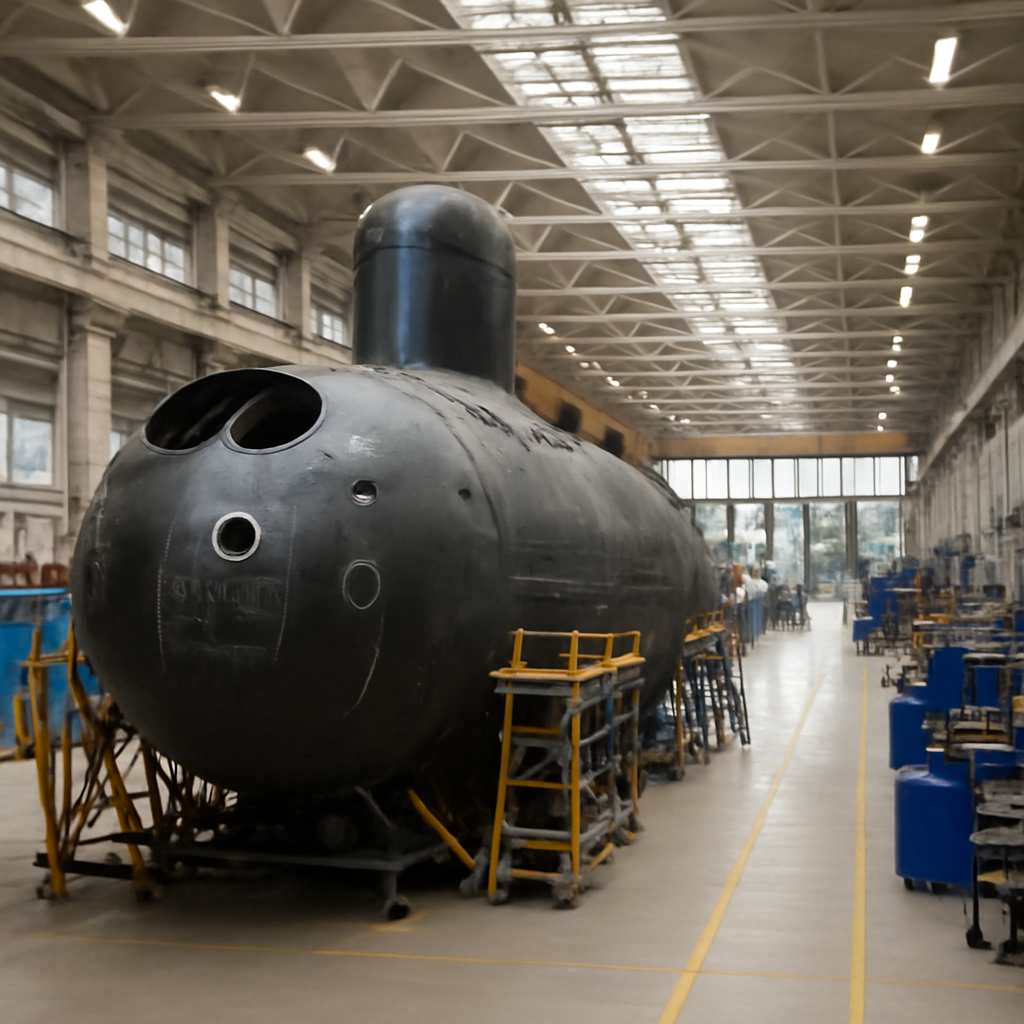
Anduril announced plans to build a two-million-square-foot facility in Baltimore, branded Arsenal-2, intended to manufacture complex components for Virginia class nuclear-powered attack submarines. The company said the plant will produce items such as torpedo tubes and spherical air flasks, and—eventually—could manufacture full ship sections including bows and sterns. Anduril described Arsenal-2 as "purpose-built" for "high-volume, high-precision production of undersea naval capabilities," with a layout optimized to reduce staging bottlenecks and a 1,200-foot graving dock plus multimodal road and rail access to support movement of large components.
Funding, contracts, and industrial software
The $6.6 billion figure cited by the White House combines a $3.7 billion private investment by Anduril to build and staff the site and a Navy contract "worth up to $2.9 billion" to produce components, according to the announcement. Anduril said ArsenalOS, its industrial software platform, will be the digital backbone for the yard—integrating fabrication workflows, inspection protocols, material movement, digital work instructions, embedded quality controls, and real-time production visibility.

Audit-ready is a season. It shouldn't be.
Evidence in spreadsheets, controls drifting between audits, frameworks multiplying on flat headcount. Nubivance runs continuous compliance on Rapid7 Cyber GRC - SOC 2, HIPAA, ISO 27001, PCI, CMMC.
End the scrambleProduction timing, testing, and the Orange County head start
Anduril plans an interim step before Arsenal-2 is operational: a 160,000-square-foot facility in Orange County, California, designed to support SUBSAFE-qualified production qualification efforts and give Anduril a "two-year operational head start" to validate manufacturing methods, workflows, and quality systems. The company said the Orange County site will prototype and produce test assets and critical maritime components—including torpedo tubes—while training an early workforce on standards that will scale at Arsenal-2. However, an industry official told TWZ that there is no schedule yet for when Anduril-produced components will be certified and placed on submarines: "it will be years before the first Anduril-produced components are placed on a submarine," and "it’s really not possible to put a time stamp on it."
Virginia class program pressures: production rates, VPM, and AUKUS
The Navy currently has 26 Virginia class submarines, with two more expected to be commissioned next spring, a senior administration official said. According to a Congressional Research Service report cited in the announcement, the program has not reached the planned production rate of two boats per year in practice; since 2022 production has been "limited by shipyard and supplier firm workforce and supply chain challenges to about 1.1 to 1.2 boats per year," creating a backlog of procured but unbuilt boats. The Navy still needs another 31 vessels to meet its plan for 59 Virginia class boats, the announcement noted.
The report and officials highlighted multiple drivers of the drop in production: workforce challenges, first-time quality, material and supplier delays, and lead-ship issues tied to the Virginia Payload Module (VPM). The VPM is described as an 84-foot hull extension containing four large vertical tubes intended to launch Tomahawk cruise missiles, IRCPS hypersonic missiles, and other payloads. The announcement also observed that AUKUS commitments will add strain: Australia is set to receive one new-build Virginia class boat and two transferred from the U.S. fleet under the 2021 trilateral deal. In May, Chief of Naval Operations Adm. Daryl Caudle told Congress the Navy would meet a two-boat-a-year delivery rate by 2032.
Workforce and economic claims: hours, jobs, and regional reach
Officials claimed Arsenal-2 could add roughly 9 million hours of labor per year—an "equivalent of about a 15% increase" in labor hours that would be "directly translatable to Virginia class submarine production," according to a senior administration official who spoke on condition of anonymity. Anduril projected that the project "will create 3,100 direct jobs and support more than 11,000 indirect jobs," drive $2 billion in annual economic output, and generate an estimated $312 million in wages each year. An industry official emphasized the available labor pool around Baltimore, saying that within a one-hour radius "there are millions and millions of people who could potentially contribute and work at this shipyard."
What this means for technologists, policymakers, and shipbuilders
- Technologists and quality engineers: They will need to validate production workflows and SUBSAFE-qualified processes at the Orange County site and later at Arsenal-2, and to integrate ArsenalOS with fabrication, inspection, and documentation standards required for certification.
- Policymakers and defense planners: They will monitor whether the combination of private investment, Navy contracts, and the proposed increase in labor hours materially alleviates the backlog that CRS and officials say stems from workforce and supply-chain limits.
- Existing submarine builders and shipyards: General Dynamics Electric Boat and Huntington Ingalls Industries’ Newport News Shipbuilding are the intended recipients of Anduril-produced components; they will need to coordinate certification, delivery timing, and integration of externally produced torpedo tubes and other assemblies into ongoing construction schedules.
Anduril framed Arsenal-2 as a rapid-scaling industrial response to a constrained Virginia class production enterprise, but the company and industry officials repeatedly acknowledged that certification, workforce training, and testing mean "it will be years" before parts appear on submarines. As one industry official put it, the shared goal is "to go as fast as possible while keeping the bar of safety as high as it needs to be," leaving a central question for the coming years: can new private yards, interim prototyping sites, and digital production systems shorten a backlog that the CRS and Navy officials say was years in the making?
Source: TWZ — Anduril Dives Into Submarine Construction With New Baltimore Plant