"This framework aims to do the same thing as the recent US disclosure of on-orbit space control weapons: deterring space threats," said Clayton Swope, deputy director of the Center for Strategic and International Studies’ Aerospace Security Project.
Council Decision 2026/2195: collective responses now on the table
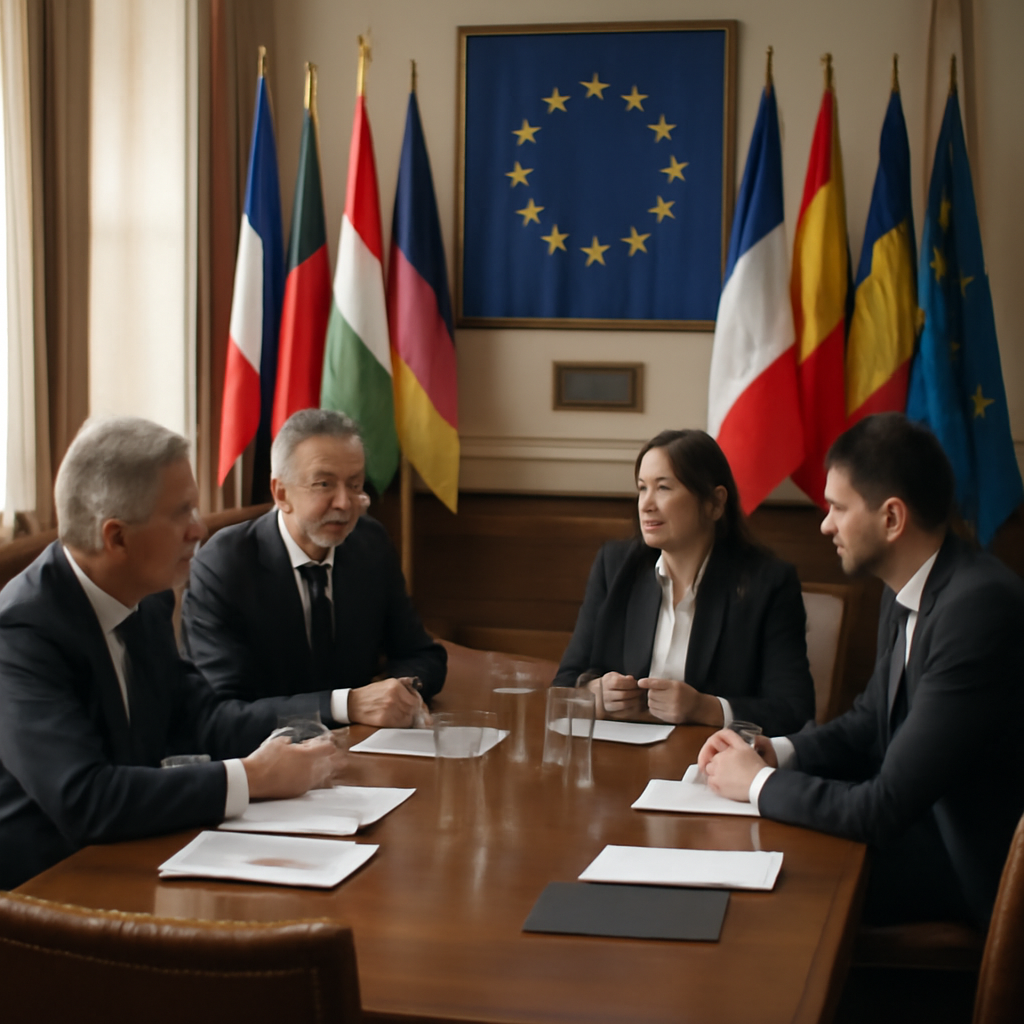
On Sept. 23 the EU’s Council of Ministers adopted Council Decision 2026/2195, a measure that for the first time gives the 27 member states formal authority to mount a collective response — political, economic or even military — to threats against any member’s satellites and related terrestrial infrastructure. The decision explicitly expands the circumstances under which the EU can act, empowering joint action in response to threats to the security of the EU, the security of Member States, or both, even when those threats are not directly linked to EU-owned space assets, according to an EU fact sheet.
Broader remit for the Space Threat Response Architecture
The decision updates and broadens the EU’s Space Threat Response Architecture created in 2021. That earlier architecture empowered the EU to respond to threats against jointly owned or operated satellite systems such as Galileo and the Copernicus remote sensing constellation. The new decision adapts that framework to the current threat environment by adding a wider set of covered disruptions, including cyber-attacks, espionage and possible interruptions to supply chains, ground stations or other elements of space-based infrastructure, the fact sheet states.

Audit-ready is a season. It shouldn't be.
Evidence in spreadsheets, controls drifting between audits, frameworks multiplying on flat headcount. Nubivance runs continuous compliance on Rapid7 Cyber GRC - SOC 2, HIPAA, ISO 27001, PCI, CMMC.
End the scrambleEnhanced authority for the High Representative
Alongside the expanded scope, the decision enhances the ability of the High Representative for Foreign Affairs and Security Policy to act. The text gives the High Representative the capacity to take unilateral action if an urgent response is required, shortening the timeline for EU-level diplomacy and measures when time is of the essence.
How analysts interpret the move: deterrence and strategic autonomy
Analysts interviewed in the reporting read the decision as both a deterrence measure and a step toward greater EU strategic autonomy in space. Michael Gleason of The Aerospace Corporation’s Center for Space Policy and Strategy summarized the practical effect: "if a member state says that they want the EU to help them respond, then the EU could make a decision to do so." Xavier Pasco, senior researcher at France’s Foundation for Strategic Research, linked the decision to the EU’s 2023 framework space security and defense strategy, saying the 2023 strategy initiated a common threat picture and urged member states to consider joint action, while the new decision focuses "more on the role the EU would play in more direct strategies for protection, threat identification, etc."
At the same time, analysts stressed limits. The decision is primarily an enabling document: it does not itself add military capabilities to member states’ arsenals and does not guarantee political will to escalate to military responses. Swope underlined that tension, asking rhetorically whether Europe’s collective teeth can "ramp up the consequences enough to produce a different result" — and noting that "whether from one country or 27, Russia seems happy to ignore diplomatic naming and shaming."
What this means for Austria, Cyprus, Ireland and Malta, and for NATO members
The decision carries particular significance for the four EU members that are not NATO members: Austria, Cyprus, Ireland and Malta. Those four are not covered by NATO’s Article 5 mutual defense pact; the Council decision provides a distinct EU pathway for collective response should their space assets or related infrastructure be threatened. For member states that belong to both the EU and NATO, the new EU mechanism offers an alternative route for action if NATO does not choose to respond.
The Council Decision marks a clear institutional choice: treating space threats as collective European security problems that may justify collective measures. Whether it will deter hostile behavior or instead require deeper investments in capabilities and political consensus remains an open question — one the EU will begin to answer as member states exercise the expanded authorities and the High Representative uses the new unilateral tools for urgent cases.
https://breakingdefense.com/2026/10/eu-deepens-collective-space-security-with-mutual-defense-pact/