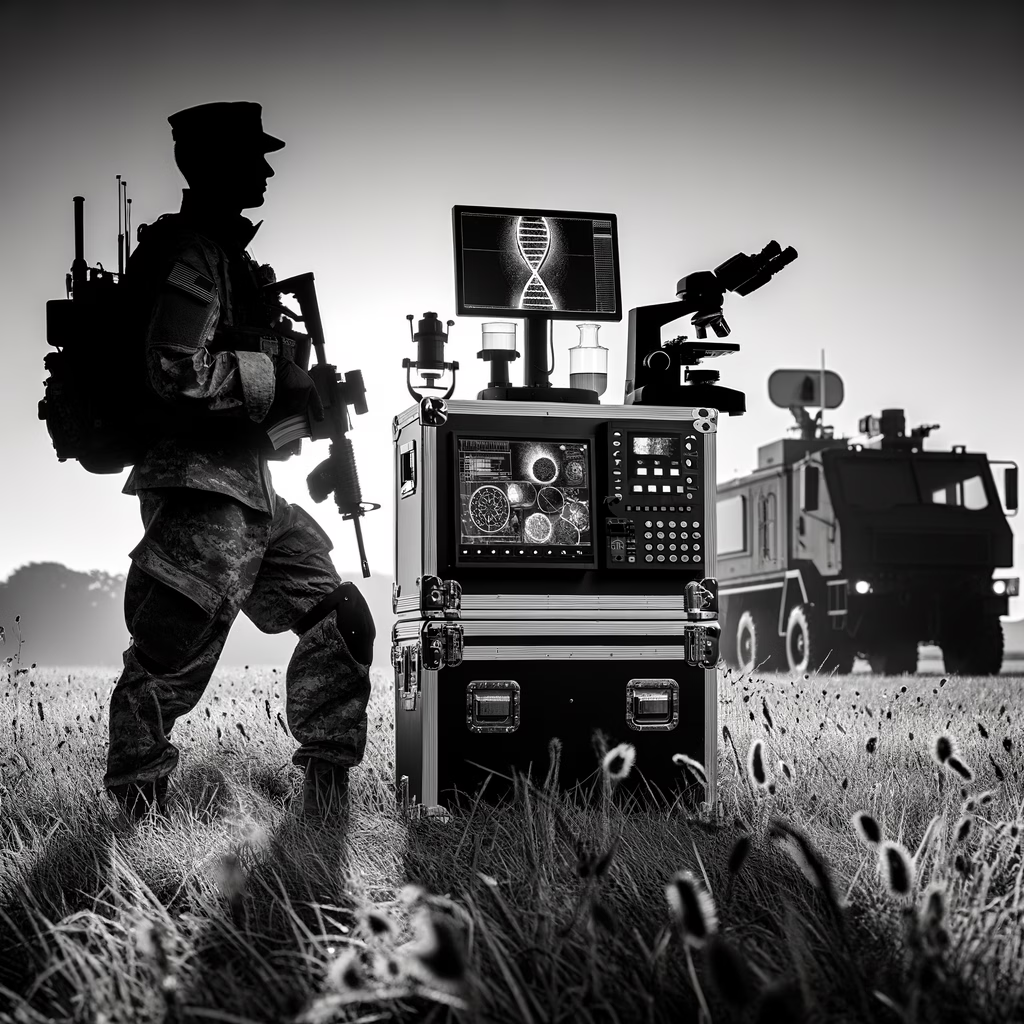
Can a squad of Marines in the middle of a patrol become a mobile crime lab — and should they? That question sits at the heart of the Marine Corps’ latest effort to update its portable forensics lab kit with new technology intended to identify potential enemy suspects more quickly in austere environments.
The move is pragmatic: battlefield forensics can turn fragments of evidence into actionable intelligence, helping commanders link insurgent attacks, uncover networks, and, in some cases, attribute wrongdoing to specific individuals. The Marine Corps has been refreshing its expeditionary capabilities and, according to reporting by Military.com, has begun fielding improved portable forensics equipment to support those aims.
What constitutes a “portable forensics lab” has evolved. No longer limited to chemistry swabs and fingerprint cards, modern kits bundle an array of compact sensors, ruggedized computing, imaging tools and biometric readers designed to operate in forward areas. The goal is to reduce the time between evidence collection and identification so that investigators and commanders can make informed decisions without waiting weeks for a shore-based lab to process samples.
Operationally, that speed matters. Faster identification can shorten the window for suspects to escape, provide corroborating records that improve prosecutorial outcomes, and help distinguish hostile actors from innocent civilians — a distinction with important tactical and political consequences in counterinsurgency and populated environments.
Technologists see obvious utility. Portable devices that bring laboratory-grade analysis closer to the point of contact can multiply the value of scarce investigative teams and feed intelligence systems with richer, more timely data. For developers, the challenge is shrinking instruments while maintaining accuracy, ensuring robust power and data connectivity, and securing outputs against tampering or compromise.
From a user perspective — the Marines who will carry and operate these kits — practicality is paramount. The gear must be light enough to be transported on patrol, rugged enough to survive weather and rough handling, and intuitive enough for trained Marines and investigators to use under pressure. Equally important is training: forensic methods require strict adherence to procedures to preserve chain-of-custody and ensure evidence remains admissible.
Policymakers and legal advisers raise a separate set of considerations. Rapid, field-based identification tools can blur lines between intelligence collection and criminal evidence gathering. Questions about data governance, privacy, and the legal standards applied to forensic results in theater are not purely academic: mishandled evidence or misapplied biometric matches can have serious consequences for individuals and for broader mission legitimacy.
There is also a technical-vulnerability calculus. As the Marine Corps upgrades its kits, adversaries will adapt. Simple countermeasures — destroying potential evidence, contaminating scenes, or using biometric obfuscation techniques — can reduce the utility of field forensics. More sophisticated foes might seek to corrupt databases or spoof sensors, which places a premium on cybersecurity and verification protocols.
Implementation carries logistical trade-offs. Distributed forensics increases the number of nodes that must be supplied, maintained and updated. It raises questions of interoperability — both within the joint force and with coalition partners — and of data sharing across agencies with different classification rules and legal authorities. Those are nontrivial hurdles when seconds can matter and when evidence may cross lines between tactical intelligence, law enforcement, and public affairs.
Critics worry about mission creep. Tools designed to identify enemy combatants could be repurposed in ways that touch on civil liberties or peacetime policing, especially when technologies like rapid DNA analysis and facial recognition mature. Historical experience suggests that once fielded, capabilities seldom remain confined to their original mission sets without explicit policy and oversight mechanisms.
Supporters counter that responsible deployment — combined with clear rules of engagement, recorded procedures for handling and storing data, and external oversight where appropriate — can mitigate risks while preserving powerful operational benefits. They emphasize that forensic discipline, not just technology, is the primary safeguard against mistake or misuse.
Looking ahead, the most consequential questions are as much about people and processes as they are about hardware. How will the Corps train investigators under expeditionary timelines? How will it certify and validate field results against laboratory standards? Who will own the forensic data, and how will access be controlled and audited? Answers will determine whether upgraded portable labs become force multipliers or sources of new friction.
The Marine Corps’ modernization of its portable forensics kit reflects a broader trend in military operations: bringing specialized capabilities closer to the point of need. The advantages are clear — speed, relevance, and the capacity to convert small pieces of evidence into strategic insight. But without disciplined procedures, legal guardrails, and attention to adversarial adaptation, the speed of science risks outpacing the prudence of policy.
If the Corps succeeds, forward units will gain a sharper, more lawful edge in identifying threats. If it fails to couple technology with training and oversight, mistakes could be amplified where they matter most. Ultimately, the question is not whether to put better tools in the hands of Marines, but how to do so in a way that preserves accuracy, accountability and the trust of the populations in which they operate — and how to ensure that expedience never outpaces ethics.
Source: https://www.military.com/defensetech/2019/03/22/csi-usmc-marines-get-upgraded-portable-forensics-labs.html