USCG Commissions First Polar Icebreaker in 25 Years
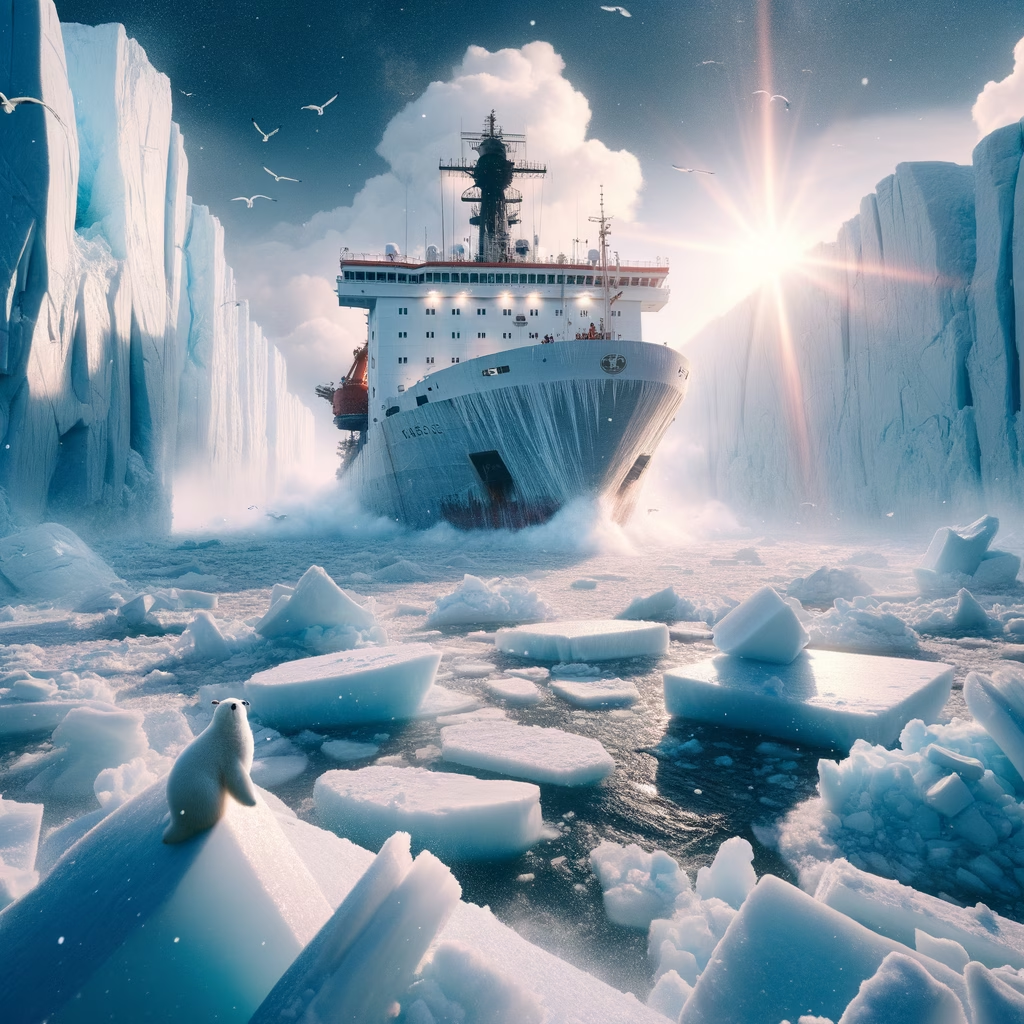
Who will keep watch where the horizon is mostly white and the rules are still being written by ice and weather? On August 10, the United States Coast Guard answered in a small but consequential way: the medium polar icebreaker USCGC Storis (WAGB-21) was commissioned at the service’s base in Juneau, Alaska. It is the first new polar icebreaker the Coast Guard has brought into service in more than a quarter century, and its arrival highlights both progress and the long road ahead.
Why one ship matters: presence, access, and capability
A single hull may seem symbolic, but capability at the poles is about more than steel and engines. It’s about presence, access, and the ability to act when the Arctic and Antarctic present both opportunity and crisis. As sea ice thins and human activity—commercial shipping, tourism, resource exploration, and scientific research—increases, the operational demands on polar-capable vessels grow in parallel. The arrival of Storis expands the U.S. inventory of ships capable of sustained operations in polar waters, joining a handful of aging platforms that for decades have carried out search-and-rescue, scientific support, logistics, law enforcement, and sovereign-presence duties.
Modern medium icebreakers bring mission flexibilities that older platforms often lack: extended underway endurance, aviation facilities for helicopters and unmanned systems, dedicated lab and berthing spaces for science teams, and updated navigation and communications suites that improve safety and interoperability with allied navies and research vessels. These are not comfort upgrades; they determine whether a cutter can escort a resupply convoy, conduct a medevac, support climate research, or lead a large environmental response.

Audit-ready is a season. It shouldn't be.
Evidence in spreadsheets, controls drifting between audits, frameworks multiplying on flat headcount. Nubivance runs continuous compliance on Rapid7 Cyber GRC - SOC 2, HIPAA, ISO 27001, PCI, CMMC.
End the scrambleStrategic stakes: geopolitics at high latitudes
There are hard strategic reasons to invest in polar capability. The polar regions are becoming more contested. Russia fields the largest Arctic fleet and has invested heavily in northern infrastructure; China, calling itself a “near-Arctic state,” is increasing scientific and commercial presence. For policymakers, an augmented U.S. icebreaking capability is a tool of deterrence and reassurance—a visible demonstration that the United States can operate where access is difficult and rapid response matters.
From a defense perspective, a cutter on station supports maritime domain awareness and serves as a coordination node with other services. Environmental response and scientific monitoring are also national-security issues: better data and faster response reduce risk and inform policy. For allied partners, U.S. presence signals commitment and helps distribute operational burdens in a challenging region.
Technology and design: the future of polar operations
Shipbuilders and technologists view Storis as a stepping-stone. Modern icebreaker design emphasizes hybrid propulsion, hull forms optimized for both icebreaking and open-water efficiency, mission modularity for research and logistics, and systems to support unmanned vehicles. These technologies not only improve performance per sortie but also reduce lifecycle costs and increase mission return—critical in an era of tight budgets and expanded mission sets.
Updated aviation facilities allow helicopters and unmanned aerial systems to extend reach for search-and-rescue, reconnaissance, and science sampling. Dedicated science spaces enable multi-disciplinary research teams to collect oceanographic, ice, and ecosystem data—data that feed global climate models and inform local adaptation strategies.
Local impacts: science, communities, and safety
For researchers and coastal communities, another ice-capable platform is practical news. Arctic science often depends on narrow seasonal windows; cutter-supported missions deliver access during those crucial periods. Indigenous and remote communities in Alaska, Greenland, and elsewhere depend on Coast Guard assets for medevacs, search and rescue, and emergency logistics when commercial services cannot operate. In many cases, an icebreaker is a lifeline that connects remote populations to medical care, supplies, and emergency response.
Limits and choices: why one ship isn’t enough
Commissioning Storis is a milestone and a reminder: it does not, by itself, close a capability gap that experts have long warned about. The United States launched a multi-ship Polar Security Cutter program to bolster heavy-icebreaking capacity, but that effort has faced familiar acquisition challenges—long timelines, complex technical requirements, and budget pressures. Critics argue that strategic intent has not always matched the funding realities necessary to build a modern fleet at scale.
There are trade-offs. Building and operating polar ships is costly. Each hull represents a long-term commitment of personnel, maintenance funds, and specialized shore support. Some policymakers prefer prioritizing multi-mission platforms and allied burden-sharing rather than a large indigenous fleet. Advocates for robust domestic capacity counter that overreliance on partners risks gaps in sovereign options during crises.
What’s next: translating a commissioning into sustained capability
The commissioning of USCGC Storis should catalyze a coherent program of acquisitions, sustained funding, crew training, shore infrastructure, and interagency planning. Without follow-through—additional hulls, trained crews, logistics hubs, and predictable budgets—the reassurance offered by a single new polar icebreaker will be ephemeral. To move the needle on U.S. presence and readiness in the polar regions, policymakers must choose between episodic attention and a long-term investment strategy that matches rising Arctic and Antarctic demands.
Ultimately, the Storis raises a clear question for the public and for leaders: will we accept incremental gains, or will we build the sustained polar capacity necessary to operate safely and assertively where climate, commerce, and geopolitics are changing fastest? The answer will shape who keeps watch where the horizon is mostly white.