"A cruise missile that is precise, resistant to electronic warfare, fast and inexpensive to produce," Defense Minister Władysław Kosiniak-Kamysz said on 6 July 2026, as Poland and Anduril moved from memorandum to mass production.
Signing in Bydgoszcz: memorandum becomes production program
Polska Grupa Zbrojeniowa (PGZ) and Anduril Industries signed a cooperative agreement on 6 July 2026 to build the surface-launched Barracuda-500M in Bydgoszcz. The ceremony was attended by Prime Minister Donald Tusk and Minister of National Defence Władysław Kosiniak-Kamysz. The deal converts an October memorandum of understanding into a production program under which PGZ and Anduril will build thousands of missiles for the Polish Armed Forces.
WZL-2 plant redirected from overhaul to production
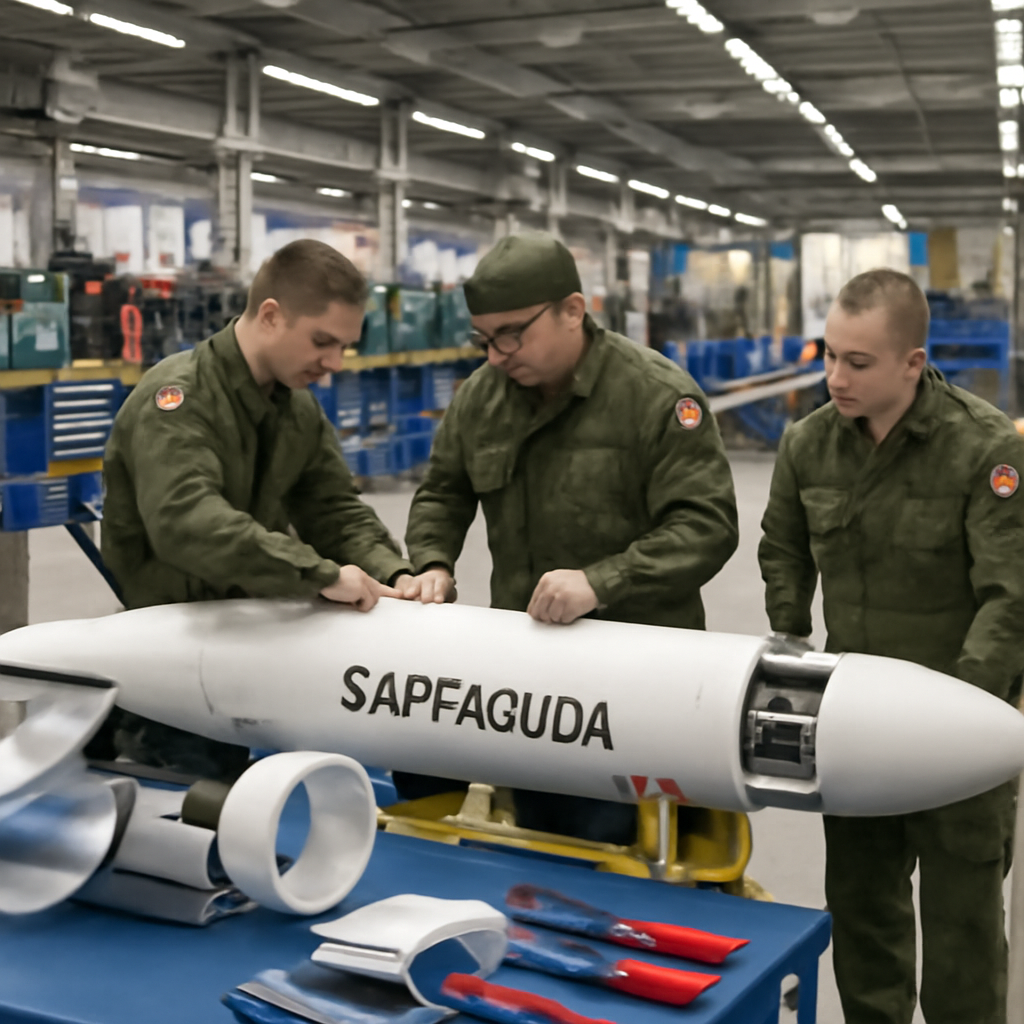
The partnership retools Wojskowe Zakłady Lotnicze Nr 2 (WZL-2), a Bydgoszcz plant that has spent decades overhauling Soviet-era aircraft. Under the agreement, WZL-2 will become one of Europe’s first large-scale production lines for low-cost, mass-produced cruise missiles — a shift from overhaul work to new autonomous-weapons manufacturing.

This site is the portfolio.
OSINTSights runs on Cloudflare Workers, D1, R2, and Vectorize, with an AI pipeline on Hetzner ARM. Nubivance designed, built, and operates it. We do the same for clients.
See what we buildThe Barracuda-500M: design, production metrics, and capability claims
Anduril unveiled the Barracuda family in September 2024 as turbojet-powered cruise missiles intended for production by the thousand. The Barracuda-500M is described as sitting between a conventional cruise missile and a one-way attack drone. Anduril lists the Barracuda-500M with a range beyond 500 nautical miles (roughly 900 kilometres) and a payload above 100 pounds.
Anduril says the missile is built with efficiency in mind: each round takes 50 percent less time to build, requires 95 percent fewer tools, and uses 50 percent fewer parts than competing weapons. The company targets a unit price of roughly $200,000 to $216,000 — between a seventh and a fifteenth of a Tomahawk or JASSM-ER, according to the company’s comparisons. Anduril also states the missile can be built from about 70 percent commercial components on a production cycle as short as 30 hours.
The rounds use Anduril’s Lattice autonomy software, which the company says lets missiles coordinate as swarms and share targeting data, a design intended to saturate air defences rather than penetrate them one shot at a time.
Poland-Anduril deal, Washington framework, and EU SAFE funding constraints
The Polish production line follows a framework agreement Washington reached with Anduril in May 2026 to scale production of the surface-launched variant. For Poland, local manufacturing is also a path into European funding: PGZ and Anduril intend to raise Polish and European content in phases toward a majority European-made product that would qualify under the European Union’s Security Action for Europe (SAFE).
SAFE is described as a €150 billion instrument that requires no more than 35 percent of a funded system’s component costs to originate outside the EU, the European Economic Area, or Ukraine. Because Anduril is a United States firm, deep production inside Poland is necessary, the partners say, to bring the Barracuda under that 35 percent cap and free European buyers from third-country restrictions on the weapon’s use or re-export.
How Poland, European buyers, and Anduril are positioned
- Poland: The agreement commits to building thousands of rounds for the Polish Armed Forces and converts a prior memorandum into a formal production program. National procurement steps remain: PGZ told reporters in November 2025 that the Barracuda-500M’s specifications were still to be determined, and formal procurement is expected to follow through national channels once requirements and localization targets are set.
- European buyers: By planning phased localization toward majority European content, PGZ and Anduril aim to make the missile eligible for SAFE funding, which limits non-EU component cost to 35 percent. That conditional path is intended to remove third-country restrictions on use or re-export for potential European purchasers.
- Anduril: The company brings a production concept focused on low-cost, high-volume manufacture — claims of 30-hour production cycles, heavy use of commercial components, and autonomous Lattice software — and follows a U.S. framework agreement from May 2026 to scale surface-launched production abroad.
Regional context: part of a wider move toward mass-produced cruise weapons
Quwa places the Barracuda deal within a broader shift in several programs toward cheap, mass-produced cruise missiles — from Pakistan’s Fatah series to Ukrainian and British efforts. Britain, the source notes, has flight-tested three low-cost deep-strike weapons for Ukraine. Poland’s WZL-2 now joins that emerging industrial pattern in Europe: replacing small inventories of scarce, expensive standoff weapons with cheaper rounds that can be fired and replenished during a prolonged conflict.
Poland’s deal converts intent into an industrial program, places WZL-2 at the center of a new manufacturing mission, and ties the missile’s future in Europe to localization thresholds baked into SAFE. Key technical and procurement details remain to be fixed through national channels, but the contract sets clear targets — thousands of missiles, a sub-$220,000 unit cost ambition, and phased European content — that will determine whether the Barracuda-500M becomes a mass-produced element of European deep-strike arsenals.