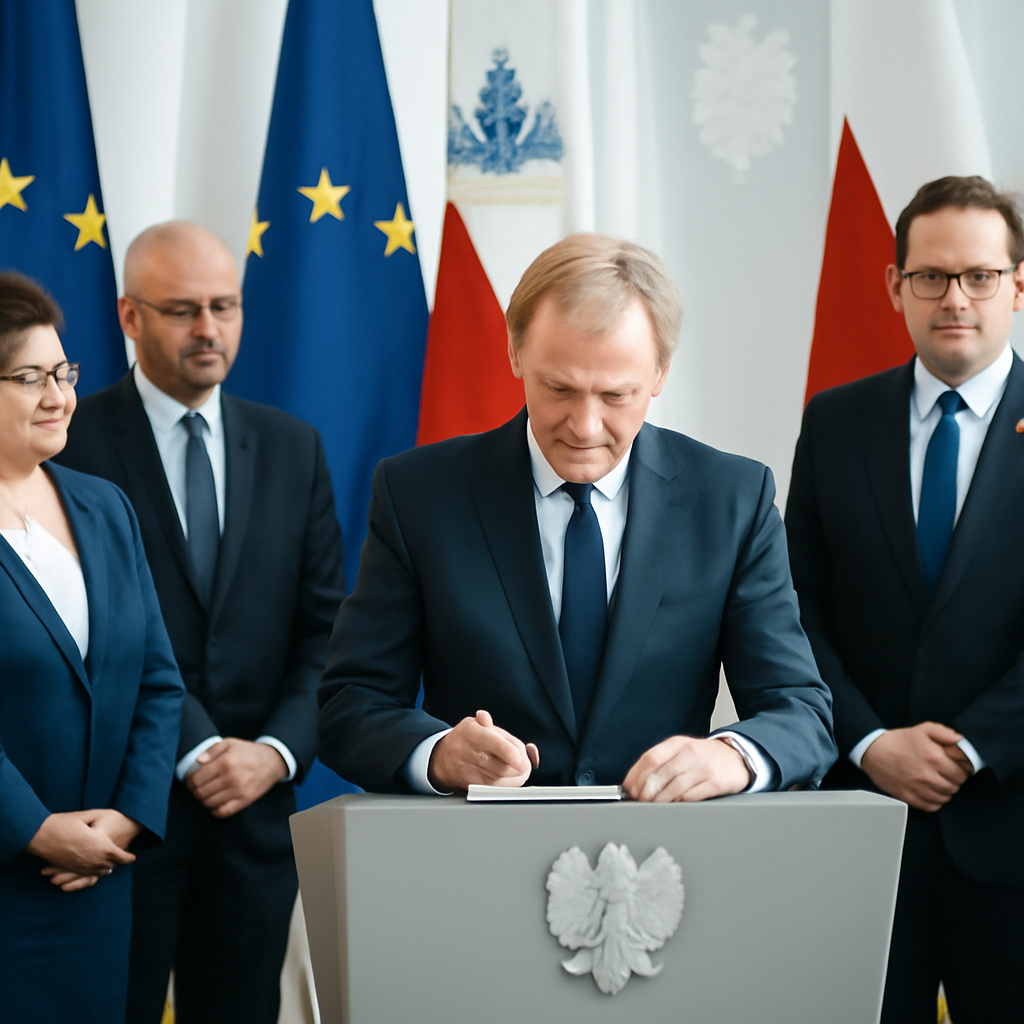
“We all hope to avoid open conflict, but we know the time and place we live in, so we want to ensure that the Polish army and the Polish defense industry will be able to meet any challenge,” Polish Prime Minister Donald Tusk said at the signing Friday, as Warsaw became the first member state to formalize access to the European Union’s Security Action for Europe (SAFE) loans.
What was signed and how much Poland will receive
Poland signed the EU SAFE instrument agreements in a ceremony attended by “a group of key leaders from both the EU and Poland,” clearing the way for Warsaw to receive €43.7 billion (reported as $51.6 billion) in defense funding by the end of the month. The signing was framed by Polish leaders as a turning point for national and European security: Tusk called it a “special moment” and argued the move reflected a wider change in EU policy toward collective defense responsibility.
How the SAFE mechanism works
SAFE, created on May 29, 2025, is based on a pair of twinned loans: the EU borrows capital on international markets and then re-lends to participating member states. The program’s structure leverages the EU’s higher credit ratings to lower borrowing costs for smaller member states. The loans carry a 45-year repayment horizon and a ten‑year grace period on principal repayment, meaning that for the first decade states are required to service only interest on the debt.

Audit-ready is a season. It shouldn't be.
Evidence in spreadsheets, controls drifting between audits, frameworks multiplying on flat headcount. Nubivance runs continuous compliance on Rapid7 Cyber GRC - SOC 2, HIPAA, ISO 27001, PCI, CMMC.
End the scrambleWhich other EU states joined SAFE
Poland is the first to sign, but the SAFE program covers a broad set of EU partners with assigned loan amounts: Romania (€16.7 billion); France and Hungary (€16.2 billion each); Italy (nearly €15 billion); Belgium (over €8.3 billion); Lithuania (€6.37 billion); Portugal (€5.84 billion); Latvia (€3.49 billion); Bulgaria (€3.26 billion); Estonia (€2.34 billion); Slovakia (€2.31 billion); Croatia (€1.7 billion); Cyprus (€1.18 billion); Finland and Spain (€1 billion each); Greece (€787 million); and Denmark (€46.8 million).
Planned projects and industrial beneficiaries in Poland
The Polish government said the SAFE funds will finance more than 120 defense-related projects, including new contracts and amendments to existing agreements, with about 40 agreements expected to be signed before the month’s end. The Polish Armaments Group (PGZ) is slated to be the principal beneficiary: the package includes $4 billion for the San anti-drone system, $278 million for construction of the Ratownik rescue vessel, and $22 million for off‑road ambulances. Other domestic firms — specifically named was the WB Group — will receive spending for ammunition, military equipment, anti-drone shields and other technologies. Officials also pointed to export opportunities for Polish firms as additional EU members access SAFE funding.
Political contest in Warsaw: the presidential veto and the “Armed Poland” workaround
Reaching the signing required navigating domestic political opposition. President Karol Nawrocki vetoed a government bill implementing SAFE and proposed an alternative he called “Polish SAFE 0%,” claiming roughly $51.5 billion could be provided from the National Bank of Poland’s profits without interest and “not constitute credit obligations until 2070.” Nawrocki argued the EU loans would threaten Polish sovereignty and said repayment would fall to today’s teenagers, asserting the loans were “incompatible with Article 4 of the EU Treaty.”
Rather than pursue new legislation in the Sejm, Prime Minister Tusk’s government chose an alternative legal route: it abandoned the Sejm-passed bill and adopted a special resolution titled “Armed Poland” (Polska Zbrojna). That resolution authorized the ministers of defense and finance to sign an agreement with the European Commission without new domestic legislation. SAFE funds will be transferred directly into an existing Armed Forces Support Fund at BGK.
Because of Nawrocki’s veto and his control over funding for some domestic security services, the government said SAFE funds will be limited to modernizing the Polish army; planned projects involving the police, the Border Guard and the State Protection Service — whose funding the president controls — will be replaced by military investments. The government also said it is working on a separate, non‑EU plan to fund those domestic security services.
What this means for the Polish military, defense industry and EU partners
- For the Polish military: The €43.7 billion is explicitly directed at army modernization under the constraints created by the presidential veto; the government expects dozens of contracts to be signed immediately to accelerate procurement.
- For the Polish defense industry (PGZ, WB Group): Large, named investments — including $4 billion for the San anti‑drone system and hundreds of millions for vessels and vehicles — give manufacturers immediate demand and potential export pathways as other SAFE recipients seek equipment.
- For EU defense cooperation: European Commission officials framed the move as part of a broader push for shared capability production; Andrius Kubilius, European Commissioner for Defence and Space, said “we need to produce much more defense equipment” and called Poland a leader in eastern flank defense.
Poland’s SAFE signing resolves a contentious domestic standoff and injects billions into army modernization and national suppliers, but it leaves open how Warsaw will fund border, police and state security services outside the EU mechanism. The next visible steps are the signing of the roughly 40 agreements the government intends to complete before month‑end and the rollout of the BGK Armed Forces Support Fund to receive and disburse the SAFE capital.