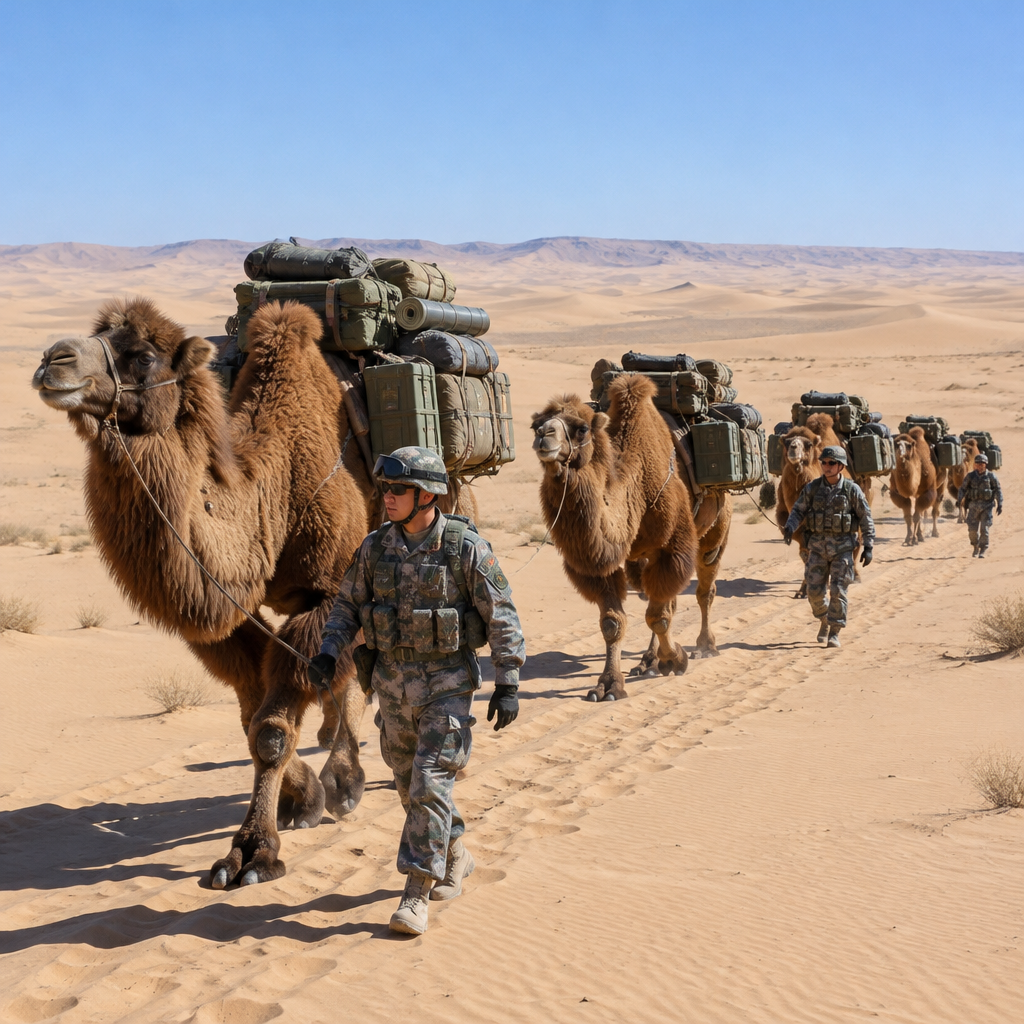
Central China TV aired a 2026 segment from Kunming that presented homing pigeons as a key node in battlefield communications — and another CCTV report showed camel detachments staged in Inner Mongolia. Those two images, aired in the same year, tell a coherent story: the People's Liberation Army is experimenting with low‑tech, terrain‑specific solutions even as it fields new formations and equipment elsewhere.
CCTV footage: camels in Inner Mongolia and a logistics requirement
The CCTV segment cited in the source places camels in Inner Mongolia and ties the animals to an explicit operational requirement: desert mobility. The blog frames this as the PLA addressing a simple problem — moving people and supplies across “vast stretches of unforgiving desert” — and notes historical precedent for camel logistics on the Silk Road. The coverage prompted the blogger to ask whether the deployment is a practical training exercise or an indicator of planning for operations along the Hexi Corridor, the historic gateway to Central Asia.
From requirement to platform: the camel as modular mobility
The source highlights a recurring internal logic: in the PLA, the operational requirement precedes platform selection. Here that calculus appears to have produced a strikingly low‑tech but fit‑for‑purpose solution. The blog uses military humor — proposing a future “Camel Combined‑Arms Brigade” and speculating about a “Type‑CML modular camel platform” — to underline a serious point: the PLA is reviving and modernizing a capability long absent from its conventional logistics toolkit, rather than inventing something wholly new.

This site is the portfolio.
OSINTSights runs on Cloudflare Workers, D1, R2, and Vectorize, with an AI pipeline on Hetzner ARM. Nubivance designed, built, and operates it. We do the same for clients.
See what we buildHoming pigeons in Kunming: a communications node in 2026
Also in 2026, the source cites a CCTV segment from Kunming showing homing pigeons being used by the Logistics Support Force as part of battlefield communications. The blog describes carrier pigeons as responsible for message delivery and symbolic continuity of the military’s “innovative spirit,” noting the apparent juxtaposition between modernizing trends and the adoption of very old methods of messaging. The image presented is of redundancy and adaptation: animals used to fill communications roles alongside other systems.
Xinjiang cavalry course: one hundred troopers and visible equipment gaps
The Xinjiang Military Command’s inaugural cavalry training course, reported in the source, involved roughly one hundred troopers in mounted saber combat and obstacle‑jumping drills tailored for border control missions. Published imagery described in the blog shows a unit with minimal armor protection — no chainmail, scale, lamellar, or improvised protection is apparent — and primary armament limited to a saber with a small hand guard. The course also reportedly omitted bows and lances. The blogger draws attention to an institutional gap: the PLA has “not conducted a truly significant cavalry charge in roughly two centuries,” a fact the source repeats as context for limited contemporary mounted‑warfare experience.
What this means for the PLA Logistics Support Force, the Xinjiang Military Command, and the China Coast Guard
- PLA Logistics Support Force — The force appears to be experimenting with alternative mobility and communications nodes (camels and homing pigeons) tailored to specific terrain. Expect more field trials and doctrinal discussion that frame animals as redundancy or as operational enablers in austere environments.
- Xinjiang Military Command — The inaugural cavalry course suggests an intent to revive mounted capabilities for border control, but imagery showing limited protective equipment and constrained armament highlights short‑term gaps between training aims and materiel readiness.
- China Coast Guard — The blog links land‑formation concepts (phalanx, Mandarin Duck formation) to proposals for boarding and close‑quarters operations at sea, indicating internal debates about translating historical formations into contemporary maritime tactics.
The PLA’s activity, as reported, reads less like a wholesale return to obsolete practices than a selective restoration and adaptation of proven, terrain‑specific tools. Camels and pigeons are being tested where mechanized platforms or digital networks show limits; cavalry training is being revived to meet specific border control needs even as equipment shortfalls persist; and historical formations are being revisited for maritime boarding scenarios. The record presented in the source leaves a clear, practical question: are these isolated experiments and symbolic gestures, or the start of a deliberate, low‑tech complement to higher‑end modernization? The answer will be visible in follow‑on exercises, procurement decisions, and whether these animal‑based capabilities move from CCTV segments to sustained operational use.