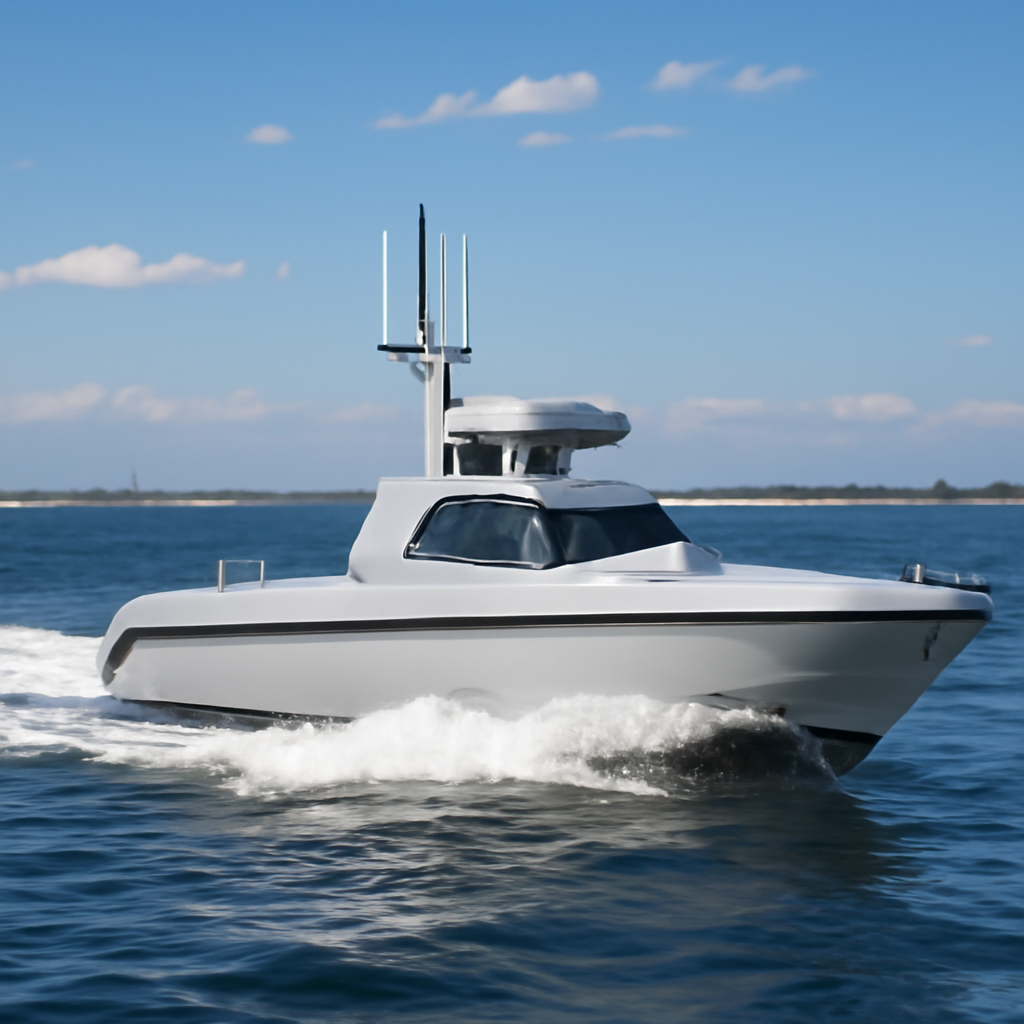
Up to $40 million in prize money and a 120-day fielding horizon: the Defense Innovation Unit (DIU) has opened Sprint 2 of the Suitable Warfighting Adaptive Payloads (SWAP)-USV challenge, seeking “mature” unmanned surface vessels the Pentagon can deploy rapidly to counter airborne threats at sea.
Sprint 2: a narrowly focused mission profile
The DIU solicitation makes the mission explicit: “Sprint 2 focuses specifically on detecting, tracking, and defeating hostile airborne threats in contested maritime environments.” Submissions must combine proven USV platforms with mission systems that provide persistent, distributed coverage against aerial threats, while doing so in a way that is economically sustainable.
To meet that aim, the solicitation asks for “mature hard-kill Counter-Air effectors and clutter-resilient sensor suites” integrated with interoperable command-and-control architectures. The DIU frames the requirement as an effort to “favorably shifting the cost-exchange ratio” by fielding affordable, scalable and persistent capability.
Operational thresholds: range, speed, and weapons capability
The solicitation sets measurable baseline performance requirements: a minimum operational range of 200 nautical miles and a sustained speed of at least 10 knots. On the lethality side, counter-air effector proposals must be able to engage Groups 1–3 unmanned aircraft systems (UAS) and rotary-wing aircraft; the ability to engage Groups 4 and 5 is described as “highly desired.”
Those thresholds narrow the candidate pool toward systems that are already mature enough to integrate sensors, effectors, and C2 suites without long development timelines.

Audit-ready is a season. It shouldn't be.
Evidence in spreadsheets, controls drifting between audits, frameworks multiplying on flat headcount. Nubivance runs continuous compliance on Rapid7 Cyber GRC - SOC 2, HIPAA, ISO 27001, PCI, CMMC.
End the scrambleCompetition timeline and prize structure
SWAP‑USV is structured as a three-sprint, 12-month competition. Sprint 1 began in July, with in-water testing expected this fall. Sprint 2 submissions are due by Nov. 30, and in-water testing for Sprint 2 is expected to begin in early 2027. Sprint 3, the final phase, is slated to begin in spring 2027 with on-water testing to be completed that summer.
- Sprints 1 and 2 each offer up to $40 million in prize money.
- Sprint 3 will offer up to $20 million.
Follow‑on funding and institutional partners
Beyond prize awards, the government has set aside additional money for procurement: DIU said $200 million is earmarked for prototype or follow-on production contracts after the competition. DIU launched the challenge in partnership with the Direct Reporting Portfolio Manager for Unmanned Systems and the Direct Reporting Portfolio Manager for Robotic and Autonomous Systems.
Those earmarked funds signal a path from demonstration to production, contingent on competition outcomes and the ability of winners to meet operational requirements during in‑water testing.
What this means for the Navy, unmanned developers, and procurement leaders
- The Navy: The solicitation notes the Navy currently relies on “expensive and exquisite platforms” to counter “low-cost, low-signature” threats such as explosive USVs and small UAS; leadership will be watching whether Sprint 2 submissions provide a distributed, persistent layer that reduces dependence on high-end ships and aircraft.
- Unmanned systems developers: Firms must present mature, integratable USVs with hard-kill counter-air effectors and clutter-resilient sensors that meet the 200‑nautical mile and 10‑knot baselines — and do so in time for Nov. 30 submission and early‑2027 sea trials.
- Procurement and program offices: With $200 million earmarked for post-competition contracts and prize pools totaling up to $100 million across the three sprints, acquisition officials will need to evaluate not only technical performance in water trials but also production scalability and cost-effectiveness.
DIU’s framing — that “the current force packages lack sufficient persistent, distributed capability to search for, track, and defeat these threats at an economically sustainable cost” — sets a clear metric for success: deliverable systems that shift the cost-exchange ratio in favor of defenders. The competition’s next hard dates are the Nov. 30 submission deadline and the start of Sprint 2 in-water testing in early 2027; whether competing teams can meet the solicitation’s maturity and integration demands will determine if the DIU’s prize model produces deployable options and triggers the planned $200 million in follow-on spending.