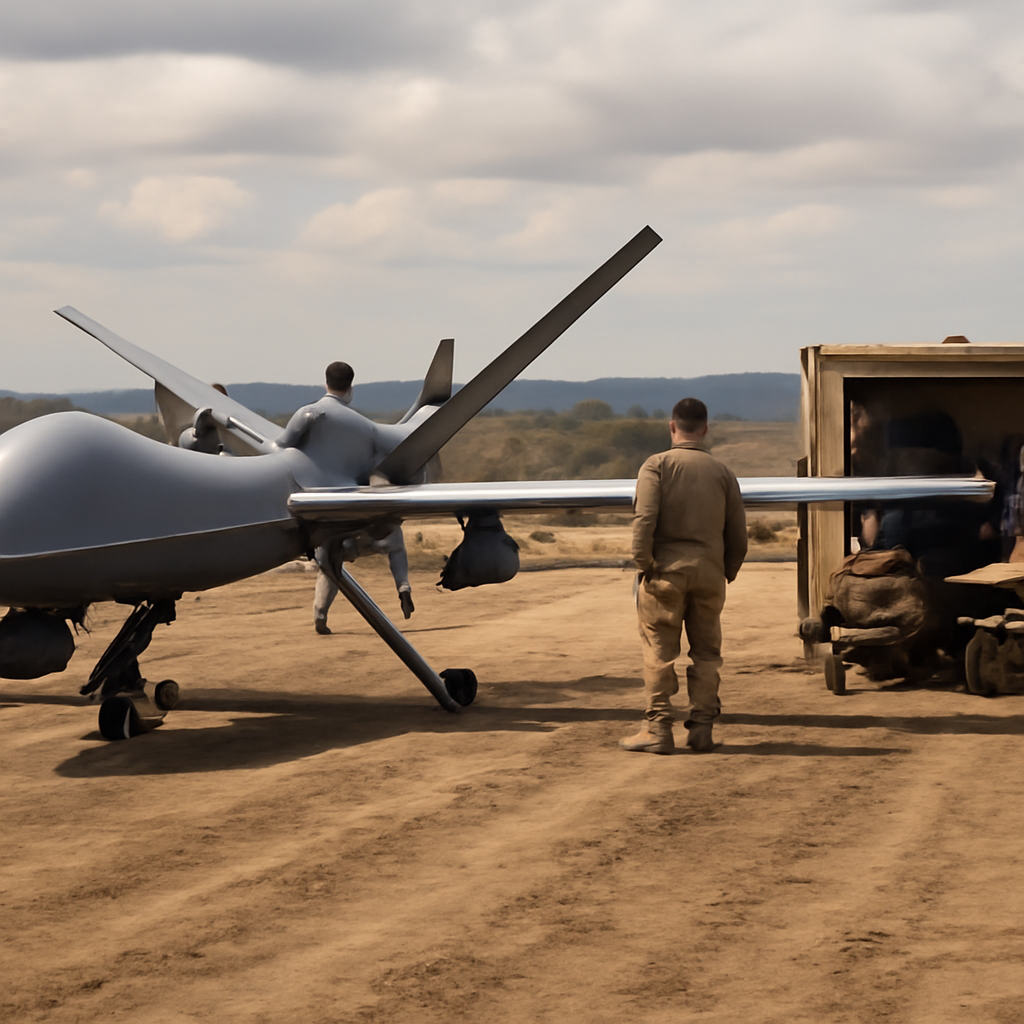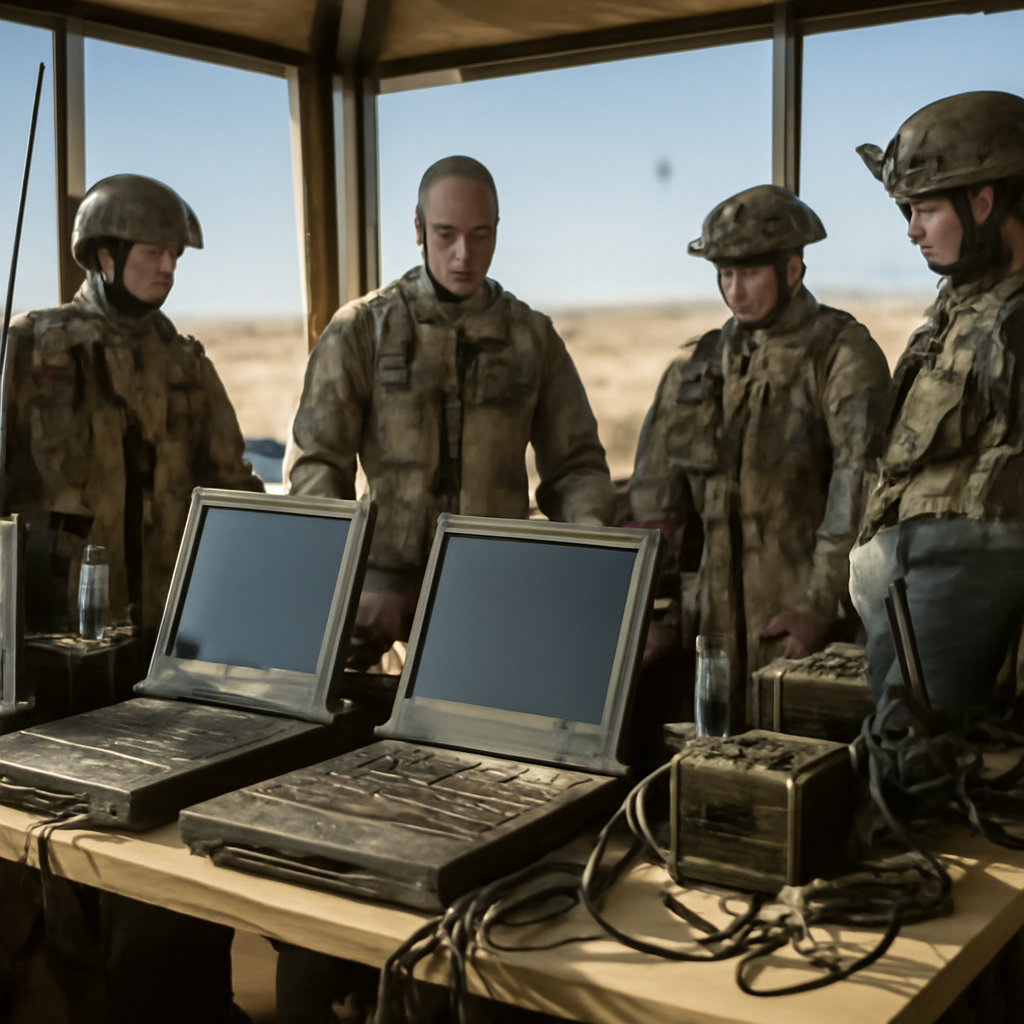
Gradient Aerospace revealed its “Atlas” perception stack alongside the Swift and Shark interceptors at Indus RAS Expo 2026.
Gradient Aerospace’s public reveal and what it signals
The appearance of Gradient Aerospace’s Atlas perception stack, shown together with the Swift and Shark interceptors, is an explicit example of the new private-sector capability described in the source material. That company’s exhibit at Indus RAS Expo 2026 illustrates a private firm delivering both sensing/perception software and end-to-end interceptor effectors — the combination the source says at least one private firm has developed. In plain terms: a single private actor is now presenting both the “brain” (perception and networking) and the “muscle” (lightweight and heavyweight interceptors) in a single, network-enabled package.
Private-sector work on sensor-to-effector networking and automation
The source states that at least one private company is developing the sensor-to-effector networking and automation layer that programmes like Heavy Industries Taxila’s (HIT) P-905 counter-drone system depend on. Separately, at least one private firm is constructing a complete interceptor drone stack — “from both automated lightweight and heavyweight effectors to a network-enabled system integrating sensors and providing additional automation elements.” The reporting places these developments alongside a broader increase in the number of private companies entering the small-factor unmanned aerial systems (UAS) market.

This site is the portfolio.
OSINTSights runs on Cloudflare Workers, D1, R2, and Vectorize, with an AI pipeline on Hetzner ARM. Nubivance designed, built, and operates it. We do the same for clients.
See what we buildWhere private beginnings met state strategy: Integrated Dynamics, SATUMA, NESCOM, and PAC
The sequence of actors matters. In the 2000s, Pakistan’s private sector had an early, visible start in surveillance drones through firms such as Integrated Dynamics and SATUMA. From the late 2000s, however, the armed forces shifted course and “consciously chose” the National Engineering & Scientific Commission (NESCOM) to drive the military’s future drone needs. The first state-owned enterprise (SOE) to enter the drone business was Pakistan Aeronautical Complex (PAC) via the Pakistan Air Force’s licensed production of the Selex ES Falco beginning in 2010.
Quwa’s August analysis — cited in the source — notes a practical consequence of that licensing path: the Pakistan Air Force (PAF) was bound to licensing terms and the original equipment manufacturer’s (OEM) guardrails, leaving it “with limited say or capacity to carry out changes and upgrades without approval.” That phrase succinctly captures how a licensing route can constrain iterative modification, even as it brings production onshore.
The Ministry of Defence Production’s 2015–16 framing: indigenization, Scout, and Shahpar‑I
The Ministry of Defence Production (MoDP) officially recorded this wider shift in its 2015–16 report, using the language of the “indigenization of UAVs of various configurations.” The same MoDP report identified Scout and Shahpar‑I as flagship programmes. Those program names, recorded by the ministry, anchor the official narrative: state-led indigenization became the declared policy vector in the mid-2010s, and specific platforms were elevated as exemplars.
How private firms, NESCOM, and the Ministry of Defence Production are positioned
- Private firms (examples named in the source: Gradient Aerospace, Integrated Dynamics, SATUMA): The source shows private companies increasingly offering original solutions — from perception stacks to interceptor effectors — and moving into small-factor UAS at scale. These firms are positioned to supply networking and automation elements that state programmes such as HIT’s P-905 already rely upon.
- NESCOM and PAC (the armed forces’ chosen SOEs): The armed forces’ deliberate choice of NESCOM in the late 2000s and PAC’s licensed production beginning in 2010 reflect a state-side strategy to centralize and control future drone development. Those SOEs occupy a role that can limit or define how military programmes evolve, especially where licensing restricts on-the-fly changes.
- The Ministry of Defence Production: By recording an “indigenization of UAVs” in its 2015–16 report and naming Scout and Shahpar‑I as flagship programmes, the MoDP has provided the policy framing for SOE-led development even as private-sector innovation continues to advance.
There is a clear tension in the record laid out by the source: private companies are now producing integrated perception-to-effector systems and entering the small-UAS market in growing numbers, while the state apparatus — via NESCOM, PAC, and the MoDP’s indigenization policy — has increasingly driven military drone development. The facts the source provides leave one concrete question: how the Ministry, the SOEs it champions, and the rapidly maturing private firms will reconcile overlapping capabilities and roles in practice.