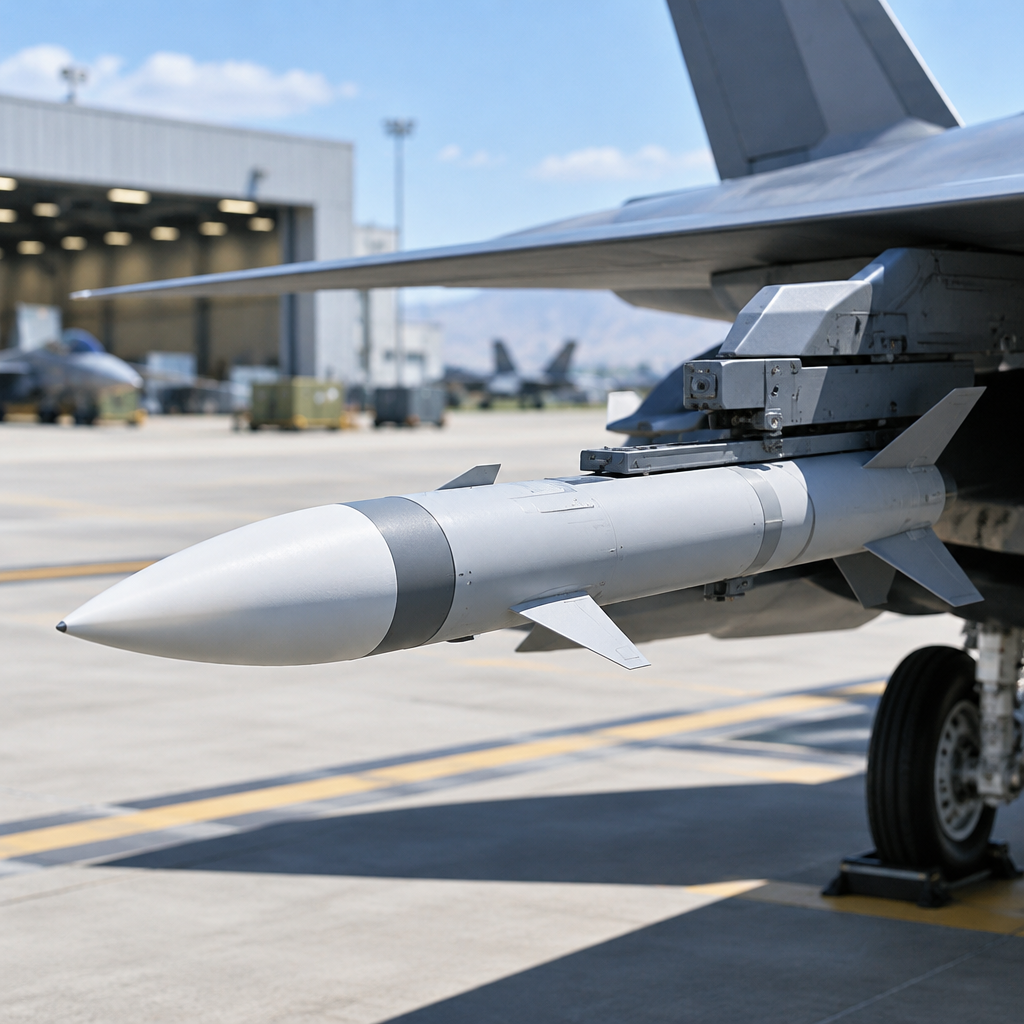
On 03 November 2026, the Pakistan Air Force (PAF) announced that it successfully test-fired its first indigenously developed air-to-air missile (AAM), the Fa’az.
The announcement and what Pakistan has claimed
The PAF said the Fa’az was successfully test-fired on 03 November 2026 and that the missile is an indigenously developed air-to-air weapon. The Fa’az was first revealed publicly in 2023 and its November 2026 test reignited debate over the missile’s configuration, performance and origins.
Physical similarities to the SD-10A and the China question
Open-source comparisons note clear external similarities between the Fa’az and the SD-10A, one of the PAF’s established AAMs. The Fa’az’s reported length and diameter are nearly identical to the SD-10A, a detail that has driven analysts to draw links to China—Pakistan’s closest defence partner. China’s recent sales of dual-use capabilities to Pakistan, such as imaging satellites, has further sharpened that line of inquiry.

This site is the portfolio.
OSINTSights runs on Cloudflare Workers, D1, R2, and Vectorize, with an AI pipeline on Hetzner ARM. Nubivance designed, built, and operates it. We do the same for clients.
See what we buildAnalyst claims and a flagged but unconfirmed component
Douglas Barrie, senior fellow for military aerospace at the International Institute for Strategic Studies (IISS), told The War Zone that China may have supplied the Fa’az’s imaging infrared (IIR) seeker. Barrie expressly flagged that possibility as unconfirmed. The suggestion has not been substantiated with precedent about the past work of the named Pakistani original equipment manufacturer (OEM) responsible for the Fa’az—Air Weapons Complex (AWC).
AWC’s role, NESCOM oversight, and indigenous engineering capacity
Air Weapons Complex is a bureau of the National Engineering & Scientific Commission (NESCOM), the Pakistani defence OEM charged with research, design, development and manufacture of complex weapon systems. Within Pakistan’s defence-industrial landscape, AWC is among entities tasked with creating original solutions. The source stresses that while AWC can and does use foreign technology—through licensing or reverse-engineering—and has foreign suppliers for critical inputs, its programs increasingly draw on indigenously developed subsystems and inputs. That capability, the source argues, enables AWC to build variants of systems and, in some cases, offer those solutions for export.
Supply chains, sanctions, and what U.S. export controls signal
The source notes that successive direct and indirect U.S. sanctions and export controls affecting AWC’s ability to procure dual-use machining and instrumentation equipment indicate the Pakistani bureau undertakes substantial testing and production work (or, at minimum, seeks to). Those U.S. measures are presented in the source as circumstantial evidence that AWC pursues serious manufacturing and systems-integration activity rather than being purely a design house.
What this means for the Pakistan Air Force, Western analysts, and AWC/NESCOM
- The Pakistan Air Force: The PAF’s announcement frames the Fa’az as an indigenous capability—an outcome that, if fielded, would expand its options for air-to-air engagements with a domestically produced missile.
- Western analysts and media outlets: Analysts have focused on physical similarities to the SD-10A and raised the possibility of Chinese-origin components such as IIR seekers; those leads remain under investigation and, in at least one case, were explicitly described as unconfirmed.
- AWC and NESCOM: According to the source, AWC’s recent work blends domestically developed subsystems with foreign inputs and supplier channels, giving the bureau technical foundation to produce variants and pursue export opportunities despite external procurement constraints.
The Fa’az announcement is straightforward: a test-fire publicized by the PAF and a claim of indigenous development. The deeper story, as laid out in the source material, is a more complex interplay of domestic engineering, foreign suppliers and partners, and external trade-controls that have shaped AWC’s capabilities and choices. The provenance of particular components—most notably the imaging infrared seeker—was raised by an expert but remains unconfirmed in open sources cited here. That combination of a declared indigenous prototype and unresolved supply-chain questions makes the Fa’az a useful case study in how modern weapons programs can proceed through blended domestic work and international inputs.