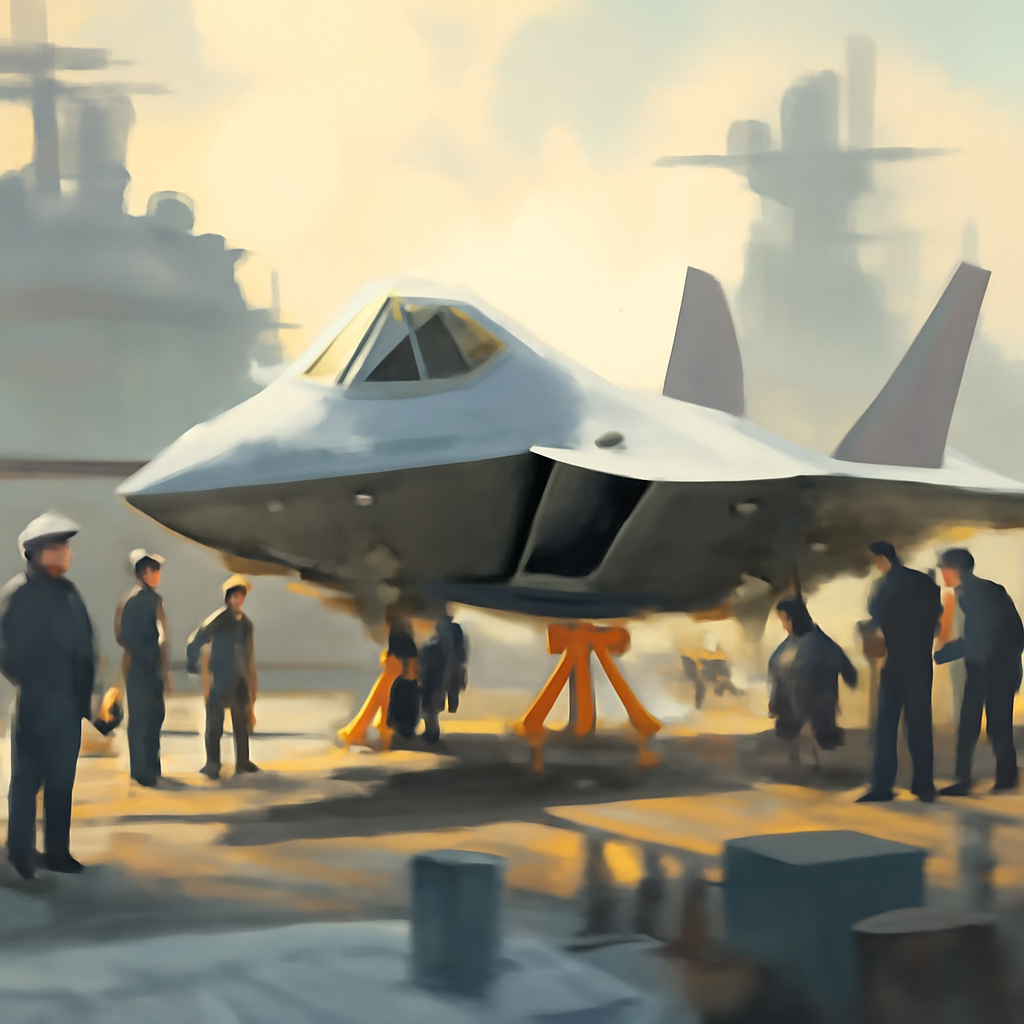
"We have recently started work on a navalized version of Hürjet," TUSAŞ General Manager Mehmet Demiroğlu told attendees at the Turkish Naval Expo. The remark frames a wider calculation: Ankara's naval trainer project could become, for Pakistan, a route to build a genuine next-generation workhorse fighter while seeding domestic industrial capability.
Mehmet Demiroğlu and TUSAŞ's naval design work
Last week, Demiroğlu said design work on a naval variant of the Hürjet is underway and cautioned that sea operations impose "significantly more demanding" requirements than land-based operations and will likely require "a more powerful engine." Turkish reporting quoted him describing the effort as a "long-term project" that may yield "a completely different platform from Hürjet." Quwa's reporting and earlier commentary by the same author flagged in 2022 that the naval training requirement could drive development of a heavier single‑engine fighter derived from Hürjet.
Naval Hürjet as more than a trainer: subsystems and engine options
Quwa outlines how the Naval Hürjet could evolve beyond a navalized trainer into a light‑to‑medium multirole fighter. The analysis notes scope to reuse KAAN subsystems — for example, Aselsan radar and avionics — and parts of MMU digital engineering work to cut development costs. The piece also identifies engine pathways: TUSAŞ Engine Industries' TF‑35000 (listed as 35,000 lbf and offering 155.6 kN of thrust) could enable an F‑16‑sized fighter; alternatives include a twin‑engine layout with the TF‑10000 or selection of the GE F414 (which Quwa notes would be bound by ITAR). Reworking the EJ200 or developing another engine are also mentioned as options if an ITAR‑free route is prioritized.

This site is the portfolio.
OSINTSights runs on Cloudflare Workers, D1, R2, and Vectorize, with an AI pipeline on Hetzner ARM. Nubivance designed, built, and operates it. We do the same for clients.
See what we buildProject PFX, the JF‑17 legacy, and Pakistan's strategic choices
Project PFX was revealed in 2024 as a two‑part program: upgrades to JF‑17s (including a Block‑4 or "PFX Alpha") and, in parallel, a "state‑of‑the‑art next‑generation national fighter aircraft." Quwa describes the program's second element as nebulous — termed "vaporware" in the report — and argues most current PFX work focuses on JF‑17 upgrade paths and potential Block‑4 variants. The analysis stresses two constraints: Pakistan does not "own the full platform" of the JF‑17 (development was commissioned to Chengdu Aircraft Corporation), and much of the know‑how and tooling for JF‑17 iterations resides with AVIC and CAC. Quwa therefore presents a strategic trade-off: continue incremental JF‑17 development with Chinese partners or pursue a new program that builds indigenous upstream design and industrial capability.
Industrial pathway: TA‑P, NASTP, NESCOM and the TF‑35000 opportunity
Quwa proposes routing a revised PFX through Turkish Aerospace Pakistan (TA‑P): keep design ownership at TUSAŞ while devolving airframe workshare, facilities, and workforce development to TA‑P in Pakistan. That structure aims to concentrate airframe manufacturing in Pakistan while leveraging state organizations for subsystems and munitions — National Aerospace & Science Technology Park (NASTP) for OEM‑level coordination and the National Engineering and Scientific Commission (NESCOM) for weapons. The report argues the TF‑35000 could be a common powerplant across a future fighter and the KAAN, spreading development costs and giving both the Pakistan Air Force and the Turkish Navy a viable fighter option. Quwa also frames the pathway as marketable: a lighter, ITAR‑free fighter could be positioned to buyers in Southeast Asia, the Middle East, North Africa and Sub‑Saharan Africa.
What this means for the PAF, TUSAŞ, and Pakistan's defence industrial base
- Pakistan Air Force (PAF): The PAF could use the Naval Hürjet path to pursue a medium‑weight, exportable successor to the JF‑17 while designing for operational realities such as motorway operations, simplified maintenance, and reduced sortie downtime — requirements Quwa suggests should inform a successor's design.
- TUSAŞ and TEI: TUSAŞ could leverage naval Hürjet work to reuse KAAN subsystems and promote the TF‑35000 across platforms, improving economies of scale and offering a non‑ITAR option if partners like the PAF commit early.
- Pakistani industry (TA‑P, NASTP, NESCOM, PAC): Routing development through TA‑P while assigning subsystems and munitions work to NASTP and NESCOM could build upstream capability in alloys, composites and avionics, addressing a shortfall Quwa attributes to the JF‑17 path where upstream inputs remained foreign.
Conclusion: a generational choice with a long horizon
Quwa frames the opportunity bluntly: Pakistan can accept the limits of incremental JF‑17 evolution or use a Turkish partnership to craft a new, partially indigenous fighter that aligns industrial and operational goals. The report places a realistic timetable on that choice — production and support would reach past 2040 — and highlights practical decision points: engine selection (TF‑35000 versus foreign engines), whether to structure development through TA‑P, and how much design ownership Pakistan seeks. If AHQ commits to a patient, industry‑led route, Quwa argues, the Hürjet trajectory offers a rare opening to convert a stalled "next fighter" concept into decades of domestic aerospace work.