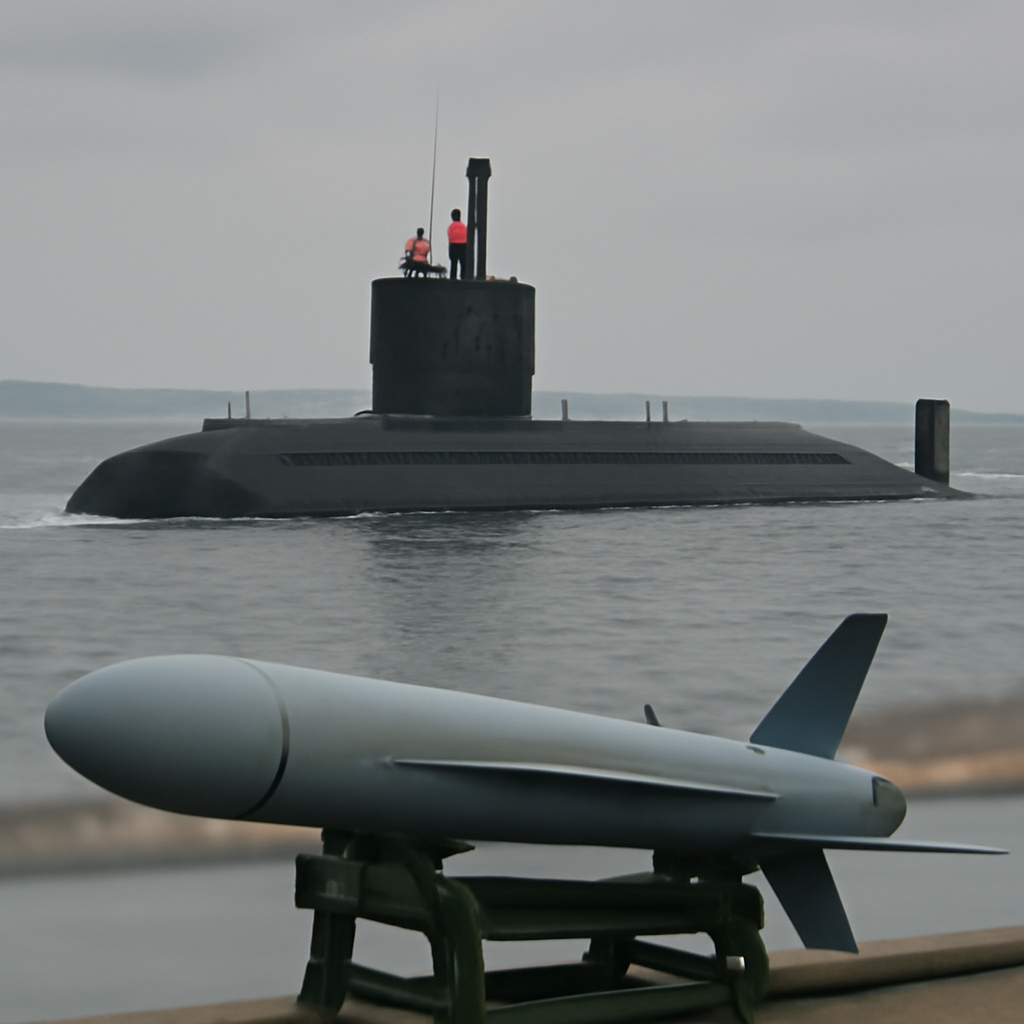
At 2,800 tons and 76 metres in length, the Hangor-class is the largest submarine the Pakistan Navy has ever operated.
Design and baseline specifications
The Hangor-class is a conventionally powered, air‑independent propulsion (AIP) submarine built by China for the Pakistan Navy (PN). It is based on China Shipbuilding & Offshore International Co. Ltd’s (CSOC) S26 export design, itself derived from the PLAN’s Type 039A/B Yuan-class. Karachi Shipyard & Engineering Works (KSEW) displayed a scale mock‑up and specifications at IDEAS 2018, listing 2,800 tons displacement, 76 m length, a draught of 6.2 m and a surfaced speed of 10 knots. CSOC’s S26 baseline data — referenced in exhibition materials including IDEX 2017 — lists a diving depth of 300 m, 17 knots maximum submerged speed and an endurance up to 65 days when alternating between diesel‑electric and AIP modes; the Hangor’s heavier displacement (about 250 tons more than the S26 baseline) and slightly shorter hull have not been officially explained.
Propulsion choice: Stirling AIP and acoustic trade‑offs
The Hangor uses a Stirling‑cycle AIP system that burns a carbon fuel with stored liquid oxygen to generate electricity and power the boat without atmospheric air. That design enables extended submerged operations — the S26T variant’s published figures include a 20‑day AIP‑only endurance at low speed — by reducing the need to snorkel for battery recharge. Pakistan’s Khalid‑class boats already use the French MESMA closed‑cycle system, which relies on ethanol and oxygen combustion. The Stirling approach introduces more moving parts than MESMA and than fuel‑cell AIP, potentially increasing a mechanical acoustic signature. Quwa’s reporting and a May 2026 discussion on Defence Uncut note that the Hangor’s double‑hull construction, inherited from the Yuan lineage, provides acoustic insulation intended to mitigate that risk.

This site is the portfolio.
OSINTSights runs on Cloudflare Workers, D1, R2, and Vectorize, with an AI pipeline on Hetzner ARM. Nubivance designed, built, and operates it. We do the same for clients.
See what we buildWeapons fit: torpedo tubes, SLCMs, ASCMs and torpedoes
The Hangor retains six torpedo tubes — likely 533 mm — configured for heavyweight torpedoes, anti‑ship cruise missiles (ASCM), and submarine‑launched cruise missiles (SLCM). Open evidence narrows likely loadouts without PN confirmation: Babur 3 is the expected SLCM, following ISPR announcements of successful underwater mobile‑platform tests in January 2017 (range stated as 450 km) and a follow‑up in March 2018 showing horizontal ejection through torpedo tubes. For the ASCM role, the CM‑708UNB (an export YJ‑82 family variant) is a plausible candidate, mirroring the Thailand S26T contract that included the CM‑708 as part of its package. For heavyweight torpedoes, the Yu‑6 or an export derivative aligns with the Yuan‑class precedent. Pakistan is also developing local submarine subsystems — an automated deployment and retrieval system (ADRS) and electronic support measures (ESM) — that Quwa identifies in Global Industrial and Defence Solutions’ product roadmap.
Production run, schedule slippages, and costs
Pakistan ordered eight Hangor‑class boats in April 2015. Under the contract, four are built at Wuchang Shipbuilding’s Shuangliu Base in Wuhan and four at KSEW under a transfer‑of‑technology (ToT) arrangement. Production milestones for the Chinese‑built batch: PNS/M Hangor launched for sea trials April 2024 and was commissioned at Sanya, China, in May 2026 with President Asif Ali Zardari and Chief of the Naval Staff Admiral Naveed Ashraf present; PNS/M Shushuk launched March 2025; PNS/M Mangro launched August 2025; PNS/M Ghazi launched December 2025. The PN’s Director General of Public Relations said all four Chinese boats entered “final stages of being handed over” by late 2025. KSEW‑built units trail the schedule: steel cutting for the fifth boat took place in December 2021 and the keel laying for the sixth occurred in February 2025, with Quwa assessing KSEW delivery realistically pushed into the early 2030s. Financially, reporting in 2015 by the Financial Times placed the overall deal at $4–5 billion; separate S26T contracts for Thailand imply a baseline per‑unit S26 price near $347 million, with Hangor‑specific modifications and the ToT element expected to raise per‑unit costs.
What this means for the Pakistan Navy, KSEW, and the Indian Navy
- Pakistan Navy: The Hangor is intended to shift PN posture toward longer‑endurance, open‑ocean A2/AD operations. If all eight boats enter service, the PN would field at least 11 AIP‑equipped submarines (including Khalid‑class units), enabling a sustained patrol posture of three to four boats at sea while others cycle maintenance and crew rest.
- KSEW and Pakistan’s shipbuilding base: The ToT for four locally built boats and installation of a Ship Lift & Transfer System (SLTS) at KSEW represent an industrial stepwise gain — building experience from Agosta 90B assembly (PNS/M Hamza) toward potential indigenous designs and future programs such as SWATS.
- Indian Navy (regional comparator): The Hangor is substantially larger than India’s Kalvari/Scorpène boats (2,800 tons vs 1,775 tons). The Hangor is expected to field a submarine‑launched land‑attack capability via Babur 3 — a capability the Kalvari class does not currently possess — which changes the operational calculations for blue‑water submarine deployments in the Arabian Sea.
The Hangor program closes a decade of disruption — cancelled Western deals, an engine substitution after MTU export restrictions, and pandemic delays — but leaves a clear set of next questions: whether the four KSEW units can meet an early‑2030s timeline, how the PN will absorb and sustain a suddenly much larger AIP force, and how the declared separation between conventional platforms and any future sea‑based nuclear deterrent will shape supplier relationships and future designs.