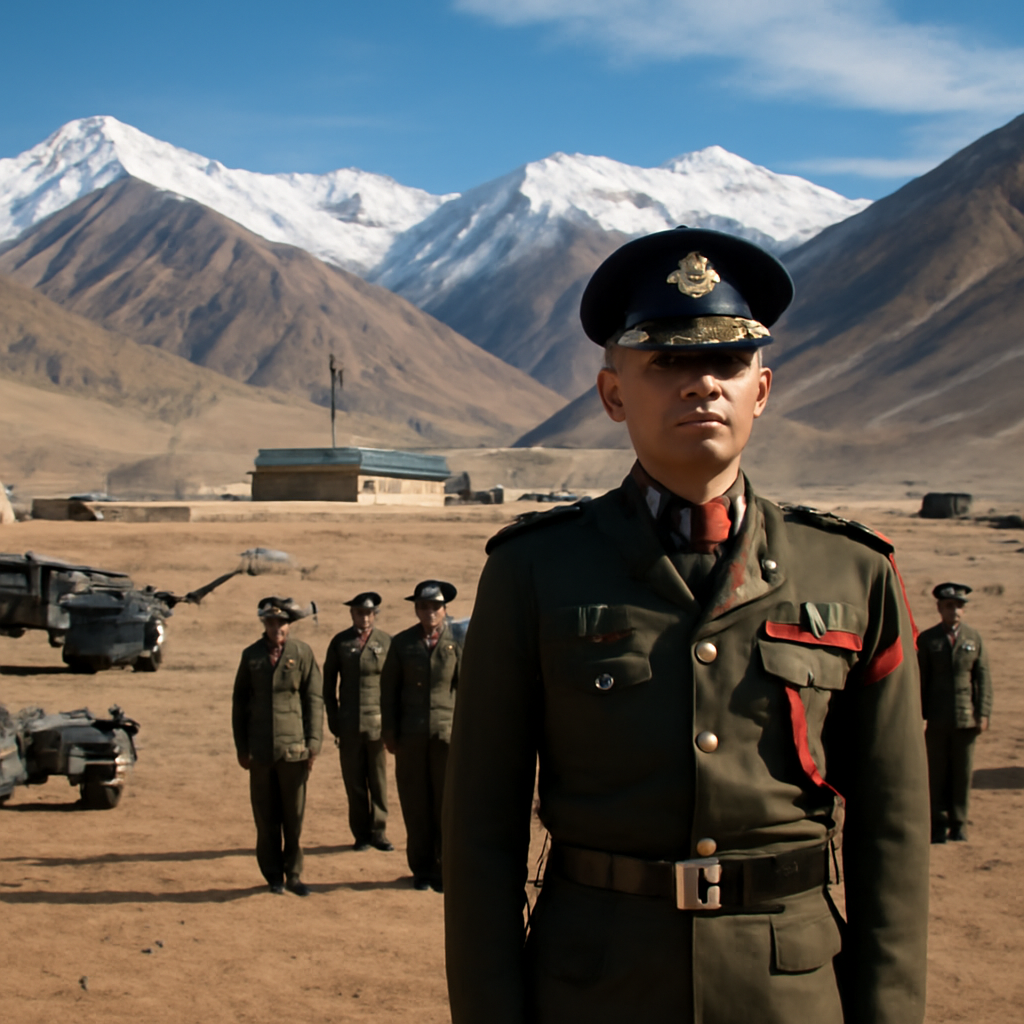
On 01 July 2026 the Indian Army stood up its first five Integrated Battle Groups (IBGs), placing six major generals in command of the new formations and establishing a dedicated Fire Support Group (FSG) under the Panagarh-based 17 Mountain Strike Corps.
17 Mountain Strike Corps as the IBG pilot
The 17 Mountain Strike Corps—primarily oriented toward the China-facing front—will pilot India’s IBG model before the concept is extended across the rest of the Army. The newly raised IBGs are described as self-contained, combined-arms formations of roughly 5,000 troops: larger than a brigade but smaller than a division. The Corps also received a dedicated FSG, controlled at a major-general level, to provide pooled long-range artillery, rocket systems, precision-strike assets and ISTAR support on call to the IBGs.
IBG design, command and rapid mobilization
The IBG concept fuses infantry, armour, artillery, air defence, logistics and engineers within a standing formation rather than pulling those elements together only after hostilities begin. Each IBG is commanded by a major general and paired with a Chief Operations Officer at the one-star brigadier rank to bind planning, intelligence and fire support. That arrangement is intended to let the commander concentrate on the fight and to move the formation within 24–48 hours—compared with mobilization that previously could take weeks at the corps level.

Audit-ready is a season. It shouldn't be.
Evidence in spreadsheets, controls drifting between audits, frameworks multiplying on flat headcount. Nubivance runs continuous compliance on Rapid7 Cyber GRC - SOC 2, HIPAA, ISO 27001, PCI, CMMC.
End the scrambleFrom Operation Parakram to the ‘Decade of Transformation’
The IBG concept traces to India’s post-Operation Parakram planning, when nearly three weeks were required to mobilize heavy strike corps after the December 2001 parliament attack. Defence planners framed a faster warfighting concept—frequently discussed under the label ‘Cold Start’—to assemble smaller, more responsive forces capable of rapid cross-border action. India publicly signalled the doctrinal shift by 2017 and later described a broader restructuring as its ‘Decade of Transformation’: moving from large, static formations toward agile, network‑enabled, technology‑centric forces designed for limited, rapid offensive action. Quwa’s analysis links the IBGs not only to outpacing mobilization timelines but to an intent to control the pace and initial geometry of escalation—for example, pairing large-scale air offensives with ground-holding IBGs in what the source frames as a possible ‘Sindoor 2.0’ scenario.
Pakistan’s existing building blocks: materiel and formations
Pakistan has been assembling many of the materiel and organizational elements that could underpin a mirror capability, even if it has not yet fully reorganized them into cross-integrated combined-arms formations. Relevant pieces include:
- Army Rocket Force Command (ARFC): a higher-echelon precision-strike rocket force that, while strategic in placement, could supply guided munitions for tactical Army needs—Quwa notes a May 2025 example where the Pakistan Army used a Fatah-1 GMLRS to target an Indian brigade headquarters.
- Light Commando Battalions (LCBs): fielded since the 2010s for air assault, counter‑insurgency and high-readiness tasks; Quwa notes they are better equipped than standard infantry and suitable for low‑intensity infiltration roles.
- Rudra brigades: roughly 3,000‑personnel, self‑sufficient combined-arms brigades that integrate infantry, mechanized and armoured units, artillery, engineers and air defence under one brigade commander.
- Shaktibaan regiments and Divyastra batteries: reworked artillery regiments that unite howitzers with drones, cyber and electronic warfare elements, and Divyastra loitering‑munitions/one‑way attack (OWA) capabilities tied into ISTAR and EW nets.
- Digital and space systems: the Pakistan Air Force’s Space Command is building a persistent imaging capability via a multi‑modal satellite constellation, and the Pakistan Army is developing an Integrated Battlefield Management System (IBFMS) to sit above armour and artillery BMS layers (Rehbar and PAKFIRE) to disseminate ISTAR data from sensors to shooters.
Quwa also notes Pakistan is procuring EW systems, OWAs including long‑range jet‑powered loitering munitions, guided rockets and guided shells, while identifying a shortfall in air‑assault transport helicopters.
The Chief of Defence Forces and cross‑service integration
Quwa points to the formation of the Chief of Defence Forces (CDF) role as the institutional enabler that could convert Pakistan’s disparate capabilities into unified combined‑arms groups (CAGs). The report identifies two principal dynamics: risks that the CDF could erode tri‑service autonomy or be perceived as an Army power consolidation; and the potential for the CDF to coordinate ‘unified sub‑commands’—such as Space Command and the ARFC—so their resources support tri‑service operations. Under that model, the CDF could direct the creation and employment of CAGs composed of LCBs, rotary aviation, guided artillery, drones and OWAs, armour, air defence and EW, with the CDF holding final authority for deployment.
What this means for the Pakistan Army, the Pakistan Air Force, and national security planners
- Pakistan Army: has many of the elements—LCBs, Rudra brigades, Shaktibaan/Divyastra, IBFMS and procuring guided effects—to build CAGs; the key remaining step is reorganizing and allocating those systems into cross‑integrated formations.
- Pakistan Air Force: Space Command’s persistent imaging and ISTAR will be critical if PAF assets are to support fast‑moving, ground‑based combined‑arms manoeuvres and to coordinate with ARFC strikes.
- National security planners: Quwa notes the May 2025 conflict demonstrated that nuclear deterrence did not prevent Indian conventional offensive action, strengthening the case inside Pakistan for heavier conventional capabilities and for institutional structures—like the CDF—to coordinate them.
Quwa’s assessment concludes that Pakistan already possesses many of the materiel and systems required to mirror India’s IBGs; the remaining steps are organizational and command‑level. In the author’s view, turning those pieces into fully operational combined‑arms groups under unified command appears to be a matter of “when,” not “if.”
Source: Quwa — India Raises Its First Integrated Battle Groups – Pakistan Will Need Its Own