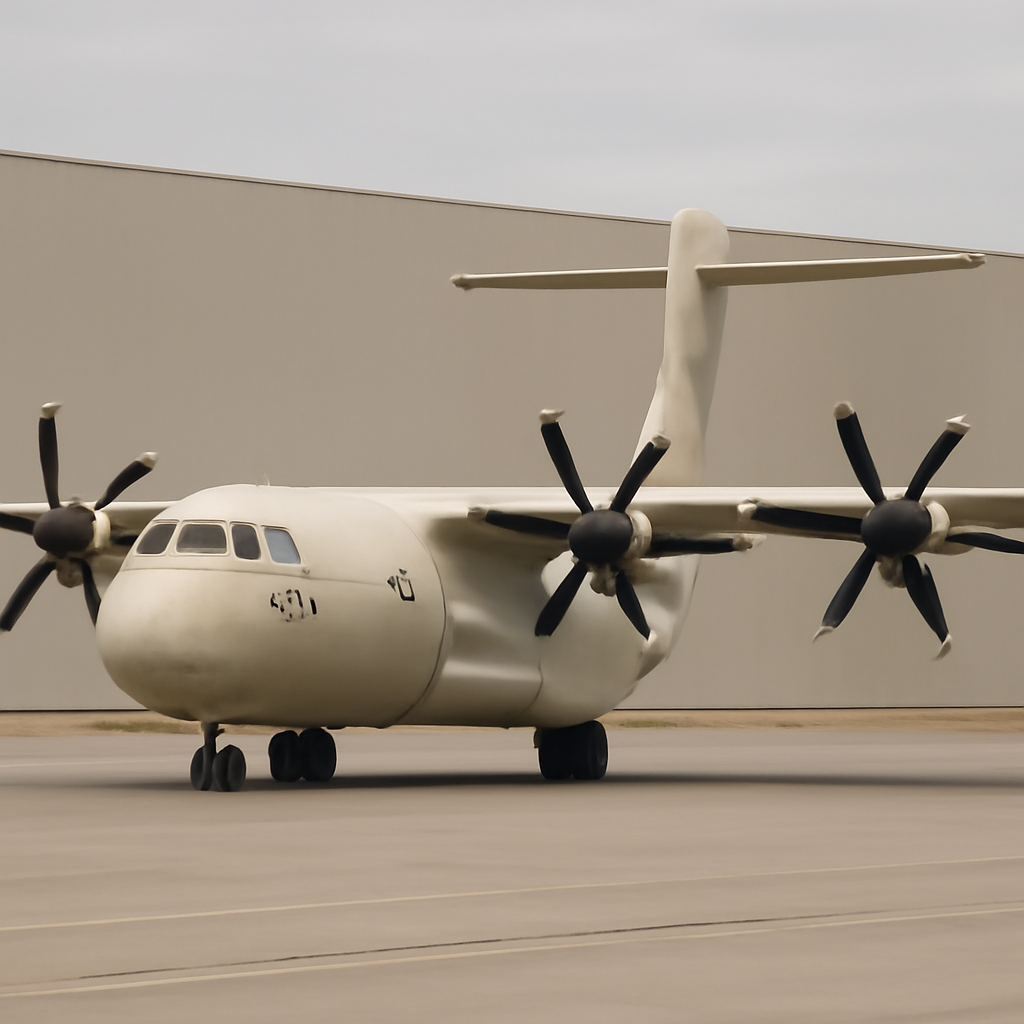
Prototype serial "15001" — a small number painted on the nose — has reshaped what analysts now call China’s new medium tactical airlifter: the Y-15.
Shaanxi Aircraft Corporation and the program identity
Work on the four-turboprop transport has been attributed to Shaanxi Aircraft Corporation (SAC). The design was long discussed under the “Y-30” label after a model appeared at the 2014 Zhuhai Airshow. New imagery and the prototype’s apparent serial number now support the Y-15 designation, a change increasingly reflected in open-source reporting. Flight-test imagery first appeared in December 2025, and reporting indicates work resumed at SAC in 2023 after a quieter period.
Configuration: airframe, engines, and test instrumentation
The Y-15 prototype shows a high-mounted, comparatively straight high-lift wing with substantial winglets, a T-tail, a relatively broad fuselage with a rear loading ramp, and heavy-duty landing gear — features that together point to a tactical transport optimized for short-field and rough-runway operations. The aircraft has four turboprop engines driving six-blade, high-efficiency propellers. Those engines are understood to be WJ-10 turboprops producing roughly 6,800 horsepower each, significantly less than the TP400‑D6 used on the A400M (about 11,000 horsepower per engine).
On the prototype a long air-data boom projects from the nose; the boom is standard for developmental flight-test instrumentation used to collect precise air-pressure, temperature and airflow data. Previous reports that identified that feature as an inflight refueling probe are incorrect: the prototype currently has no refueling probe fitted, though the source notes that capability could be added later.

The cyber insurance questionnaire just landed. Now what?
SOC 2, HIPAA, insurance renewals - someone has to own security strategy. Nubivance provides fractional CISO leadership without the full-time salary.
Get a security leadPerformance estimates and size comparisons
Publicly available estimates remain provisional while testing continues. Unconfirmed figures have suggested a payload around 30 metric tons, a number the source cautions should be treated carefully. For context cited in the reporting, the Y-9 is generally credited with a payload of roughly 25 tons, while the C-130J-30 is in the roughly 21-ton range. Despite a visual similarity to the Airbus A400M — notably in the broad fuselage and four‑engine turboprop layout — the Y-15 is assessed to sit in a different weight and performance class and more naturally counter the C-130J and China’s Y-9 than the A400M.
Open-source observers also assess the Y-15 will have a larger internal cargo space than the Y-9, with greater height and width to accommodate bulkier loads, reinforcing its tactical role rather than strategic heavy lift.
Operational roles for the PLAAF and likely missions
The reporting connects the Y-15 to an operational niche: replacing older Y-8-family transports and, ultimately, supplementing or replacing the Y-9 for tactical missions. Andreas Rupprecht, an expert on Chinese aviation and a contributor to the reporting site, said he expected the Y-15 to replace the Y-9 because the Y-9 “does not consider adequate for the tactical transport role, on account of its small cargo hold and underpowered engines.”
Key mission sets emphasized in the material include operations from relatively austere airfields, movement of troops, vehicles and supplies into locations impractical for larger jets like the Y-20, airborne assault and airdrop missions, and rapid reinforcement of remote regions including island outposts and places such as Tibet. The rear loading ramp and heavy landing gear support those tactical and short-field requirements.
Export prospects and international signals
The source anticipates an export drive for the Y-15, noting it would be “immune to the tight export restrictions that typically apply to comparable Western designs.” The reporting also highlights ongoing foreign interest in Chinese turboprops: the Y-9 continues to win orders and was recently bought by Kazakhstan — a detail underscoring the differing capabilities and market positions of the Y-9 and larger Western transports such as the A400M.
With flight testing now apparently ramping up, the next major questions will be how closely its eventual performance matches the estimates surrounding it, and how quickly China moves from a single prototype to a production fleet.
Original reporting: https://www.twz.com/air/our-best-look-at-chinas-new-y-15-turboprop-airlifter