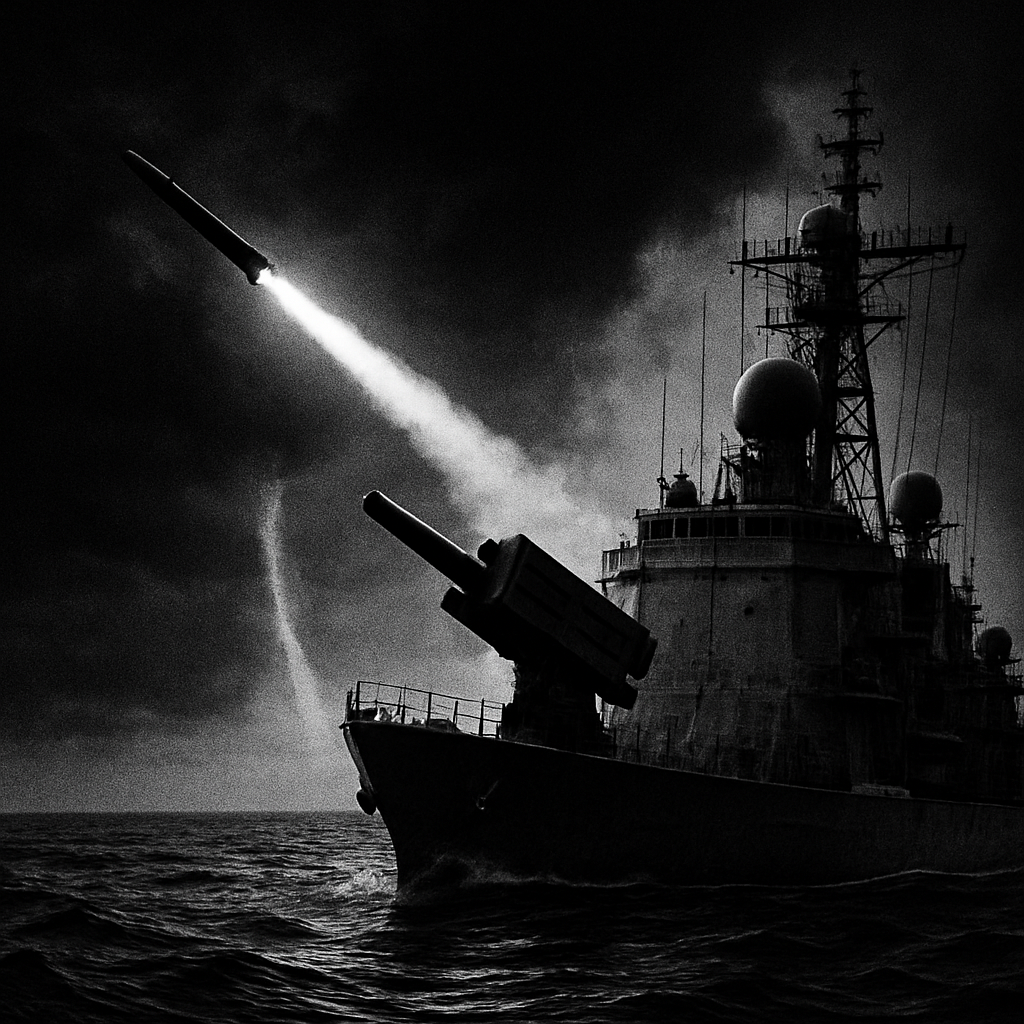
"accurately engaged its target with high speed at extended range," the Pakistan Navy said after an April 15, 2026 firing that the service described as an indigenously developed ship‑launched anti‑ship ballistic missile (ASBM).
What happened on April 15, 2026
On April 15, the Pakistan Navy (PN) conducted a live firing of what it called an indigenously developed ship‑launched anti‑ship ballistic missile, a test witnessed by Chief of the Naval Staff Admiral Naveed Ashraf alongside senior scientists and engineers, the PN reported. Naval News carried the service’s description that the missile "accurately engaged its target with high speed at extended range." The Associated Press via the Washington Post also reported the event the following day.
The missile: SMASH, the P282 designation, and family links
The missile in the footage appears to be a sub‑variant of the system branded as SMASH; Pakistan’s GIDS is now openly identifying that line as the P282. The P282 designation predates the SMASH branding: in October 2020 then‑CNS Admiral Zafar Mahmood Abbasi described the program as a "hypersonic ship‑launched anti‑ship/land‑attack ballistic missile" during his farewell address. Quwa’s reporting on GIDS’ display at the World Defense Show (WDS) 2026 noted GIDS cited terminal speeds exceeding Mach 2 and described the missile as using a quasi‑ballistic trajectory. Those descriptions position SMASH as a short‑range ballistic weapon optimized for maritime attack rather than sustained atmospheric hypersonic cruise.
The SMASH/P282 also appears to share a common core architecture with other domestically developed systems: the Fatah‑2 guided rocket and the Abdali Weapon System. According to the available reporting, these systems use a broadly similar single‑stage solid rocket motor and similar airframe design, suggesting Pakistan is leveraging a common propulsion and structural baseline across multiple roles — land‑strike (Fatah‑2), anti‑ship (SMASH), and strategic (Abdali).

Audit-ready is a season. It shouldn't be.
Evidence in spreadsheets, controls drifting between audits, frameworks multiplying on flat headcount. Nubivance runs continuous compliance on Rapid7 Cyber GRC - SOC 2, HIPAA, ISO 27001, PCI, CMMC.
End the scrambleLaunch platform: a Babur‑class (MILGEM) corvette — and why that matters
TurDef, a Turkish defence publication, identified the launch platform in released footage as a Babur‑class (MILGEM) corvette, noting visual cues such as the IFF antenna, a SMASH 200/25 remote weapon station, and the placement of an antenna near an exhaust. If that identification is correct, it would mark the first known ASBM firing from a corvette‑class platform. The timing is notable: the test came 11 days after the PN inducted PNS Khaibar (F‑282), the second Babur‑class corvette, on April 4, 2026.
Operational limits: why "extended range" is only one piece of the puzzle
The PN described the April test as "extended range" compared with an earlier SMASH test in November 2025, when a firing from a Zulfiquar‑class (F‑22P) frigate was cited with a domestic range of 350 km. The available reporting does not specify how much range was added or whether the change was achieved through a new motor, revised propellant, lighter payload, or other factors.
More fundamentally, anti‑ship employment places heavy demands on targeting. An anti‑ship ballistic missile needs a capable terminal seeker and reliable mid‑course targeting support to locate, track, and strike moving surface targets. The practical reach of a longer‑ranged SMASH will depend on pairing the missile with timely and accurate intelligence, surveillance, target acquisition, and reconnaissance (ISTAR). The reporting notes Pakistan has been investing in satellite, radar, ELINT, and airborne surveillance capacity, and frames the missile as one element within a layered maritime strike architecture rather than a standalone game‑changer.
What this means for the Pakistan Navy, policymakers, and technologists
- Pakistan Navy: The firing signals a push toward a more varied anti‑ship strike mix — combining subsonic cruise missiles (RGM‑84 Harpoon, C‑802A, Harbah), a limited supersonic‑cruise capability (CM‑302 aboard Tughril‑class Type 054A/P frigates), and ballistic approaches via SMASH/P282. Operationalizing that mix will require resolving magazine depth, launch‑system compatibility, and new doctrine for mixed salvo engagements.
- Policymakers and procurement leaders: The reporting suggests a practical choice to emphasize domestically controllable lines (SMASH variants and the Harbah family) rather than large‑scale imports of expensive ramjet supersonic missiles like the CM‑302. Fiscal tradeoffs will include funding sensors, integration work, and production infrastructure as much as the missile bodies themselves.
- Technologists and surveillance operators: The main technical bottleneck is seekers, data links, and mid‑course targeting. Scaling the SMASH family requires serial production of terminal seekers and reliable ISTAR feeds to cue the missile — not only improvements to rocket motors but also systems integration across sea, air, and space sensors.
Conclusion
The April 15, 2026 test is a clear marker of an intent: Pakistan appears to be pursuing a more scalable, domestically supportable anti‑ship strike family built around common missile architecture. Turning a single successful firing into a repeatable operational capability will hinge on further tests (especially repeated use from Babur‑class corvettes), evidence of land‑based deployment for coastal denial, and signs of serial production and seeker integration. If the Pakistan Navy can scale those pieces together, this firing may stand as an early indicator of a broader shift in conventional maritime strike posture.