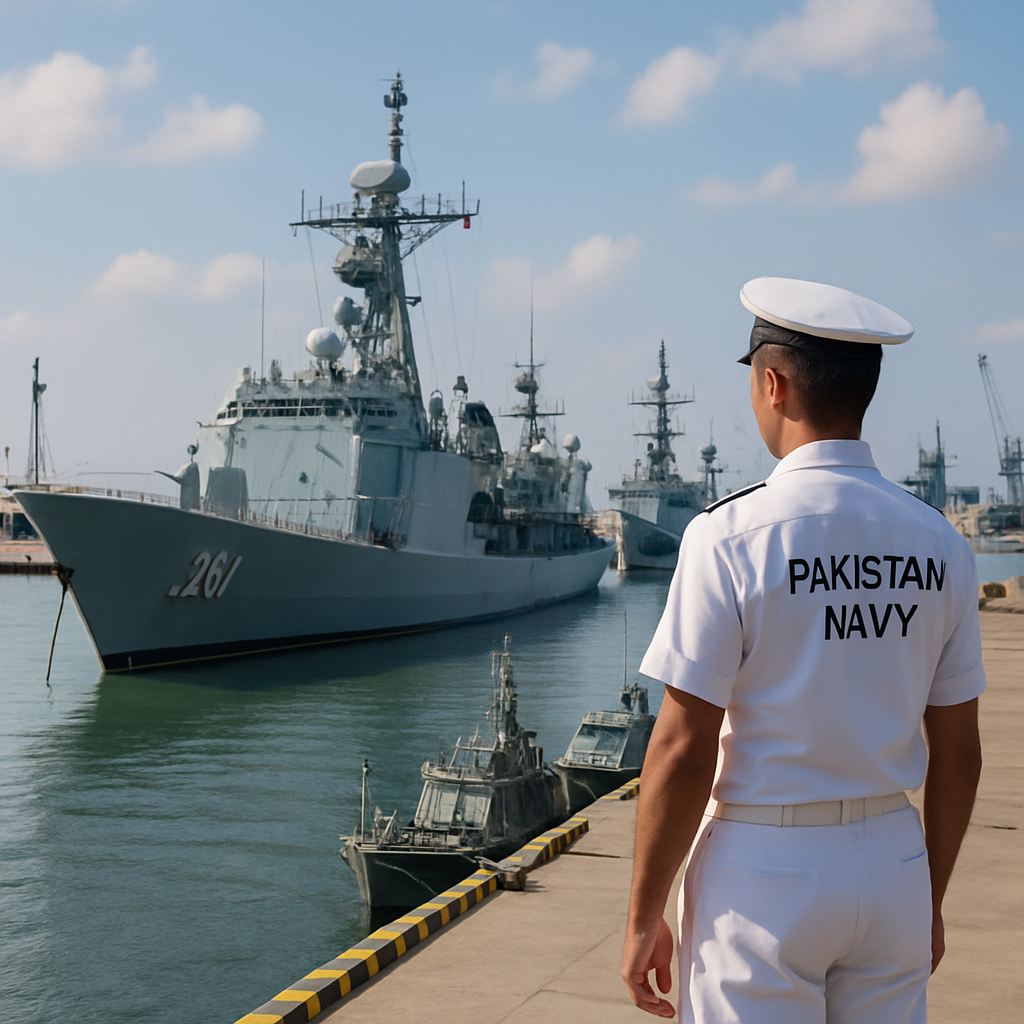
"the PN was aiming for a fleet size of over 50 ships, with 20 of those being 'major surface vessels,'" Admiral Zafar Mahmood Abbasi declared in October 2020 — a concise capsule of ambition that has driven nearly two decades of shipbuilding, procurement pivots, and doctrinal reorientation inside the Pakistan Navy (PN).
PNS Alamgir and the failed Oliver Hazard Perry plan (2008–2013)
The PN's first post‑2007 arc began conservatively: replace aging ex‑Royal Navy hulls with generationally newer but cost-conscious platforms. Central to that plan was a six‑ship Oliver Hazard Perry (FFG‑7) acquisition under the US Excess Defense Articles program. Only one hull materialized. PNS Alamgir (ex‑USS McInerney) entered service in 2010, but the United States removed the Mk.13 missile launcher and related fire‑control before transfer, leaving the ship with reduced AAW and ASuW capability. Havelsan was contracted to supply the GENESIS CMS, delivered in 2013, but the collapse of the five‑ship follow‑on due to tighter US export restrictions left the PN with a single OHP and the sunk costs of a fleet‑wide CMS plan.
Tughril and Babur: area‑wide AAW and networked warfare
The second arc (roughly 2012–2018) marked a deliberate "look East/Look West" supplier shift: China and Turkiye supplanted traditional Western sources, with Damen of the Netherlands remaining the sole Western OEM. Pakistan ordered four Tughril‑class Type 054A/P frigates from China (delivered 2020–2023) and four Babur‑class MILGEM corvettes from Turkey (contracted 2018). The Tughril introduced the fleet's first 32‑cell VLS armed with LY‑80N MR‑SAM and the CM‑302 supersonic AShM; the Babur introduced the 12‑cell VLS carrying MBDA CAMM‑ER/Albatros‑NG and a predominantly Turkish subsystem stack (Aselsan SMART‑S Mk2 radar, Havelsan ADVENT CMS, Aselsan ESM, Meteksan sonar).
Networked warfare followed: MilSoft’s Naval Information Exchange System (NIXS) and a PN tactical data‑link called Link Green, together with Havelsan ADVENT on Babur, turned platforms into a distributed sensor and effects network rather than isolated ships.

Audit-ready is a season. It shouldn't be.
Evidence in spreadsheets, controls drifting between audits, frameworks multiplying on flat headcount. Nubivance runs continuous compliance on Rapid7 Cyber GRC - SOC 2, HIPAA, ISO 27001, PCI, CMMC.
End the scrambleJinnah‑class (AS3400) and the move to indigenous IP
Turkey's MILGEM deal included a joint original‑design frigate, producing the Jinnah‑class (AS3400). Contracted at KSEW on 03 November 2025, the AS3400 is billed as Pakistan’s first indigenously designed frigate, displacing 3,300 tons with CODAG propulsion and a weapons fit emphasizing subsystem commonality with Babur: 16‑cell VLS for MBDA Albatros‑NG/CAMM‑ER, dual‑quad P282 launchers, and triple‑cell lightweight torpedo launchers. Crucially, PDW (formerly NRDI) retains full IP ownership, allowing future independent designs and domestic production — the cornerstone of the report's envisioned fourth arc toward original shipbuilding.
Yarmouk OPVs and the merchant‑navy logic
Parallel to combatant growth, the PN expanded its low‑cost surface envelope. Damen‑built Yarmouk‑class OPVs (Batch‑I OPV 2200s commissioned 2020) and larger Batch‑II OPV 2600s (PNS Hunain inducted September 2024; PNS Yamama in 2025) were acquired for maritime security, HADR, VBSS and sea policing. The economic rationale is explicit: Pakistan’s government cites $4.6 billion in annual hard‑currency outflows for sea freight and a PNSC merchant‑fleet target of 30 ships by 2026 and 60 by 2028–29. OPVs bought to commercial standards cost roughly $55–60 million apiece (rising to $75–90 million with weapons); their return was dramatic — in October 2025 PNS Yarmouk seized $972.4 million in narcotics on a CTF‑150 deployment.
Harbah, CM‑302, and P282/SMASH: a three‑profile strike mix
The PN's anti‑ship strike palette deliberately mixes flight regimes. Harbah (GIDS) supplies a subsonic dual ASCM/LACM family (export Harbah NG range 280 km; Pakistan's variant likely longer‑ranged). The CM‑302 on Tughril‑class frigates brings a supersonic‑cruising 280 km profile. And P282/SMASH is a domestically developed anti‑ship ballistic missile (ASBM) tested from a Zulfiquar‑class frigate in November 2025 (350 km) and from a Babur‑class corvette in April 2026 — the first known ASBM shot from a corvette. The result is a layered strike mix forcing defenders to cope with sea‑skimming, supersonic cruise, and ballistic trajectories simultaneously.
What this means for the Pakistan Navy, regional partners, and defense suppliers
- For the Pakistan Navy: expect continued trade‑offs between visible regional presence (OPVs, corvettes/frigates) and quieter A2/AD investments (submarines, coastal strike, acoustic networks). The Jinnah‑class IP transfer points to a longer‑term industrial pivot but will require sustained budgetary commitment.
- For regional partners and maritime security planners: Pakistan will field capable area‑air defenses and a diversified ASuW suite that complicates surface operations in the Arabian Sea; OPVs, meanwhile, improve peacetime patrol coverage and law‑enforcement reach.
- For defense suppliers and shipbuilders: Turkish and Chinese systems are already entrenched; Dutch commercial shipbuilding proved cost‑effective for OPVs. Vendors who can bridge NATO‑standard subsystems through intermediaries (as Turkey did) or offer modular, cost‑optimized options stand to gain.
The PN's trajectory from second‑hand Type 21s to networked, VLS‑armed corvettes and planned indigenous frigates is now concrete: a mixed fleet built to serve peacetime maritime security, project presence, and — if necessary — contribute to an A2/AD posture. The lingering question is fiscal: can Pakistan sustain both a wider regional role and the submarine‑centric deterrent its A2/AD logic demands? The design and IP choices in the Jinnah program suggest NHQ is attempting to keep both options open.