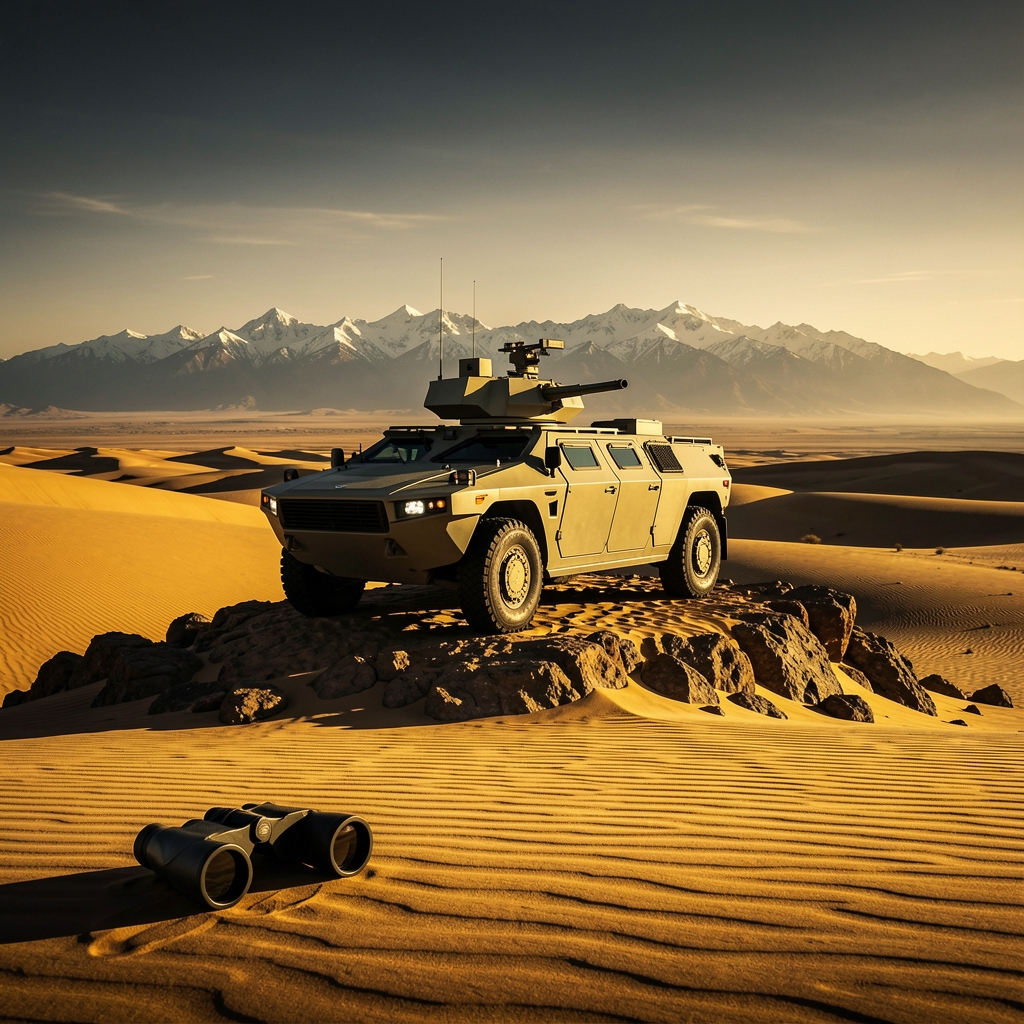
How does a military go from buying armoured vehicles off the shelf to building them at home in partnership with foreign manufacturers? Between 2007 and 2026 the Pakistan Army’s wheeled armoured vehicle posture moved precisely along that arc — from ad hoc MRAP imports to Heavy Industries Taxila (HIT)–led production partnerships with foreign original equipment manufacturers (OEMs).
Background: an incremental shift, 2007–2026
The market intelligence brief published on Quwa traces an evolution in the Pakistan Army’s light armoured vehicle (LAV) profile over the 2007–2026 period. Early in that span the Army relied on ad hoc Mine-Resistant Ambush Protected (MRAP) imports. By 2026, that posture had shifted toward production arrangements led by HIT and involving foreign OEM partners. The brief presents this progression as the dominant arc shaping the Army’s wheeled armoured inventory across the two-decade window.
What the brief examines
Quwa’s Market Retrospective centers on three interlocking elements that the report identifies as driving the program’s trajectory: supply-side constraints, domestic proposals, and institutional procurement preferences. Those three factors are presented as the key levers that shaped the Pakistan Army’s LAV inventory through 2026, influencing whether vehicles were imported, locally produced, or produced under cooperative arrangements.

Audit-ready is a season. It shouldn't be.
Evidence in spreadsheets, controls drifting between audits, frameworks multiplying on flat headcount. Nubivance runs continuous compliance on Rapid7 Cyber GRC - SOC 2, HIPAA, ISO 27001, PCI, CMMC.
End the scrambleWhy this matters
By documenting the shift from reactive imports to HIT-led partnerships, the brief highlights a change in how capability and industrial policy interact in Pakistan’s light armoured vehicle sector. Quwa frames supply-side constraints, domestic proposals, and procurement preferences as the mechanisms by which that change occurred — factors that determine not only what vehicles are fielded but how they are acquired and sustained.
Concluding question
The Quwa retrospective leaves a clear, practical question for observers: having moved past ad hoc importing toward HIT-led production partnerships, how will those same constraints and preferences shape the next decade of vehicle design, production, and sustainment?
Read the original brief on Quwa: https://quwa.org/pakistan/market-intelligence/market-retrospective-the-pakistan-armys-light-armoured-vehicle-lav-program-circa-2007-2026/