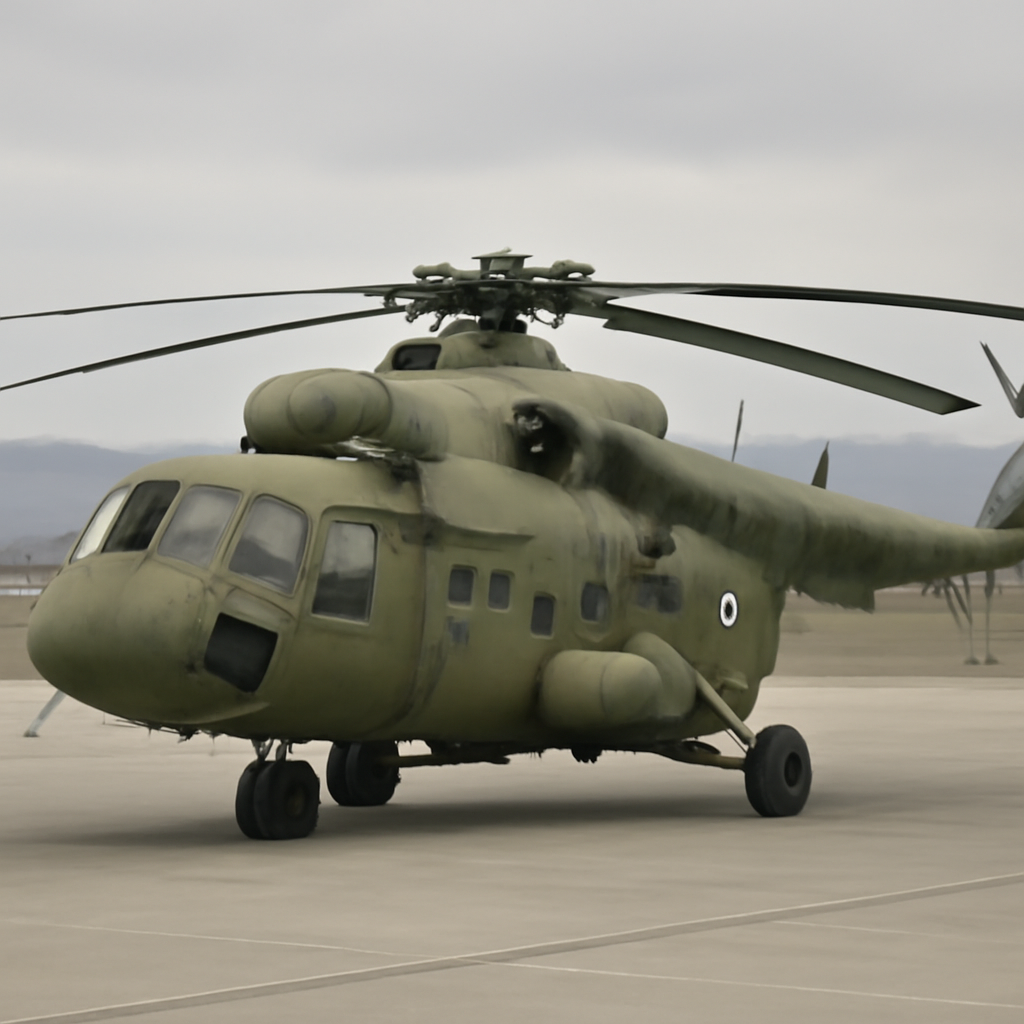
"technical fault," the Inter-Services Public Relations (ISPR) said after a Pakistan Army Aviation Corps (PAA) Mi-17 helicopter crashed near Muzaffarabad on 10 June 2026, killing all onboard during take‑off.
ISPR account and the larger question the crash raises
The short official line from ISPR left operational details undisclosed; the Quwa analysis that follows argues that speculation about this single accident is unhelpful. Instead, it frames a broader strategic question: what has General Headquarters (GHQ) planned for the Pakistan Army Aviation Corps? The piece notes that, unlike other Army arms—artillery, armour, drones, and air defence—the PAA has seen little coherent, GHQ-driven renewal since the mid‑2010s.
Aging transport and utility fleet, and an absence of a new program
Quwa documents that the bulk of the PAA’s rotary fleet relies on platforms from 20 to nearly 50 years old and highlights the striking absence of any GHQ‑led program to replace transport and utility helicopters. While the Army has invested in new platforms in other domains (the VT4 main battle tank and SH‑15 wheeled self‑propelled howitzer are cited as examples of investment), the PAA’s programs have stalled or been limited chiefly to attack helicopters. The article stresses that, aside from several AW139s for VVIP duties, there has been no meaningful traction on core PAA transport/utility procurement driven by GHQ budgets.

This site is the portfolio.
OSINTSights runs on Cloudflare Workers, D1, R2, and Vectorize, with an AI pipeline on Hetzner ARM. Nubivance designed, built, and operates it. We do the same for clients.
See what we buildThe attack‑helicopter saga: T129 ATAK, AH‑1Z, and the lone Z‑10ME‑02
The analysis traces an attack‑helicopter effort running since at least 2010. A $1.5 billion contract for 30 T129 ATAK helicopters was finalized but fell through after the United States blocked re‑export of LHTEC CTS800 engines. Earlier and parallel pursuits included the AH‑1Z and other contenders. Observers have confirmed only one Z‑10ME‑02 in PAA hands so far, equipped with capable sensors, subsystems, and munitions. The Quwa piece points out two important caveats: first, a properly inducted attack‑helicopter type would normally enter service in at least three units to cover training and initial operations; second, prior programs were structured around external or supplier‑led financing rather than up‑front GHQ budgets.
Specifically, the AH‑1Z order used US Foreign Military Financing (FMF) and Coalition Support Funds (CSF), while the T129 program relied on a flexible installment arrangement and Turkish Aerospace concessions, meaning Pakistan did not pay until delivery under that model. Remove those financing mechanisms, the analysis argues, and the attack‑helicopter story contracts to essentially a single Z‑10ME‑02—potentially an AVIC‑lent test unit rather than evidence of a committed fleet renewal.
History: two investment surges tied to external financing
The PAA’s own history and Alan Warnes’ 2013 Tangent Link survey are used to show a pattern. The first surge—late 1970s to mid‑1980s—was externally fuelled: a 1976 deal for 30 SA330 Puma helicopters followed a broader package in which "the French government connected the deal with purchase of Puma helicopters," the history records; the Corps was formally raised to absorb that acquisition. US military assistance in the 1980s supplied AH‑1F Cobras. The second surge came after 9/11: new Cobras, 26 Bell 412EPs leased by the US in 2004 (handed over formally in 2007), and additional Mi‑17s expanded troop‑transport capacity. Alan Warnes noted in 2013 that "finances seem to be the main stumbling block towards securing a deal," underlining the consistent role external funds have played in PAA expansion.
What this means for GHQ, the Pakistan Army Aviation Corps, and the Pakistan Air Force
- GHQ: The analysis urges GHQ to define an enduring purpose for the PAA if it seeks meaningful, inside‑led investment. Without a clear doctrine, the piece contends, the Corps will continue to depend on episodic, externally driven purchases.
- PAA leadership: The article recommends consolidating requirements into at most two platform families—a transport/utility type and an attack type—to create scale, logistical efficiencies, and the basis for local industry participation, depot MRO, and multi‑decade procurement plans.
- Pakistan Air Force and Pakistan Navy: Quwa suggests tri‑service standardization and coordination (noting the PN and, to a lesser extent, the PAF operate older platforms) could raise the total requirement to 150+ units and make large procurements economically and politically viable.
The Quwa piece closes on a practical doctrinal proposal: recast the PAA as a low‑altitude air‑power element that complements the Pakistan Air Force and the Army Rocket Force Command by finding and disabling warfighting nodes, providing airborne situational awareness with sensors such as SAR and mmW radars, and enabling rapid air‑assault mobility. To do so, it argues, GHQ will likely need to move beyond small, externally financed tranches toward a GHQ‑backed, scale‑driven procurement and sustainment plan that pairs a medium‑to‑heavy transport fleet with attack platforms—possibly blending crewed and uncrewed gunships.
Whether GHQ will take those doctrinal and procurement steps remains the unresolved fact left by the current record: the June 2026 Mi‑17 crash underscores both the immediate human cost and the strategic question the article poses—who within GHQ will commit to a clear role and the funding profile necessary to modernize the Corps?
https://quwa.org/pakistan-army-news/pakistan-army-aviation-a-corps-without-a-purpose/