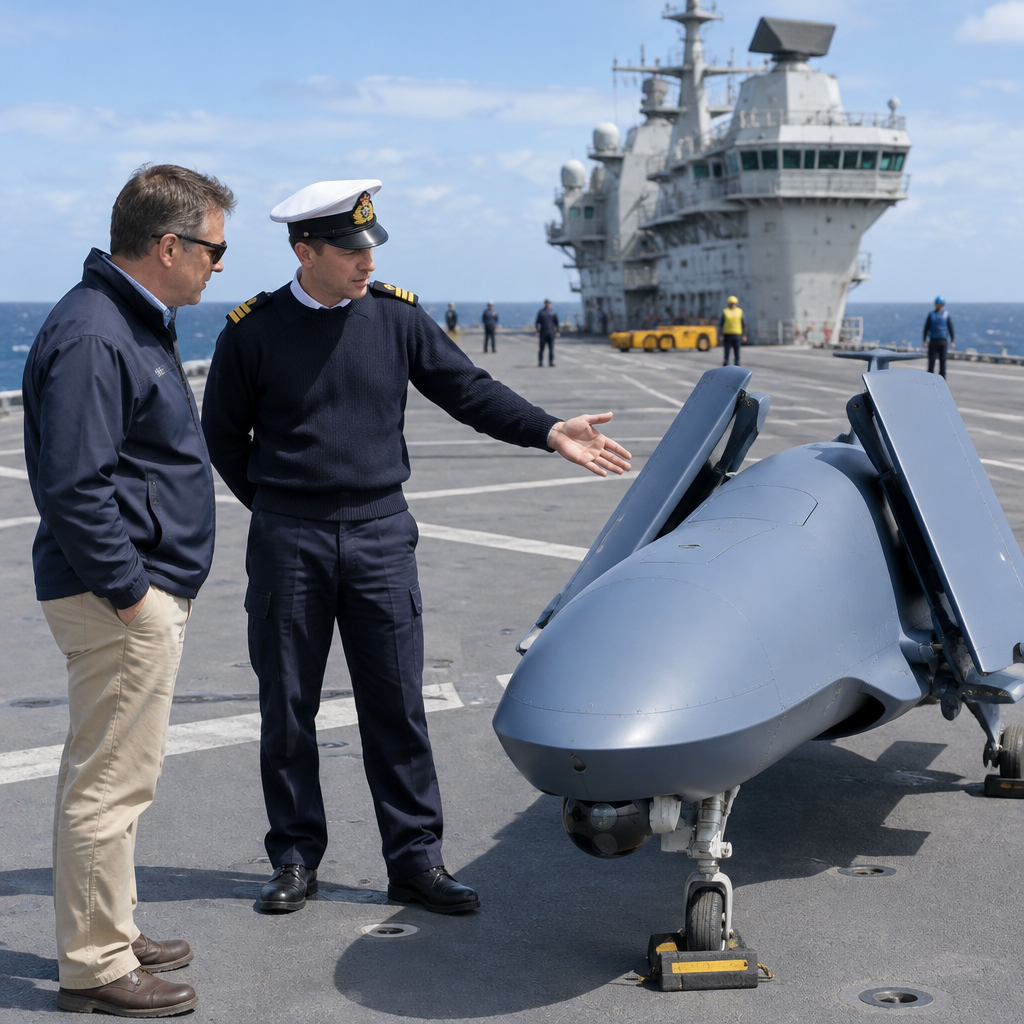
"In two days’ time, on this carrier, I will sign a statement of intent with our friends at Northrop Grumman to prepare their Talon demonstrator for trials with the Royal Navy under Project Vanquish," First Sea Lord General Sir Gwyn Jenkins declared aboard HMS Prince of Wales at the International Sea Power Conference in Norway.
First Sea Lord General Sir Gwyn Jenkins and Project Vanquish
Jenkins announced the planned agreement while speaking from HMS Prince of Wales and set a public timeline: work under the agreement is intended to lead to a demonstration in U.K. waters in 2027 that will include a launch from the carrier. He framed the effort as part of a faster, more adaptive push to build what the Royal Navy calls a Hybrid Navy, saying the service will "work with industry to get the latest technology into the hands of our people as quickly as possible" while acknowledging that "moving at pace carries some risk."
Northrop Grumman's Talon Blue (YFQ-48A)
Northrop Grumman confirmed the company will work with the Royal Navy "over the next 12 months on this future demonstration," calling a recent signing an "important step in demonstrating relevant British naval capabilities." The company publicly unveiled Talon Blue — designated YFQ-48A by the U.S. military — only this year: its first flight was announced in October 2026 and the company promoted the maiden flight as "a fully autonomous run from takeoff to landing" in a Northrop Grumman tweet.

Audit-ready is a season. It shouldn't be.
Evidence in spreadsheets, controls drifting between audits, frameworks multiplying on flat headcount. Nubivance runs continuous compliance on Rapid7 Cyber GRC - SOC 2, HIPAA, ISO 27001, PCI, CMMC.
End the scrambleQueen Elizabeth class carriers and STOVL constraints
The planned trials are shaped by the fact that the Royal Navy's two Queen Elizabeth class carriers, including HMS Prince of Wales, are short-takeoff and vertical-landing (STOVL) ships that lack catapults and arresting gear. Project Vanquish, first announced by Jenkins in September 2025, was set up to demonstrate the ability to launch and recover a so-called Tier 2 Autonomous Collaborative Platform (ACP) from a carrier "without the need for a catapult or arresting gear." In British government language, Tier 2 ACPs are defined primarily by being "attritable" — i.e., sufficiently low-cost to be employed in higher-risk environments — though Northrop Grumman has described Talon Blue as lower-cost without using the term "attritable."
Market context: U.S. CCAs, costs, and industrial positioning
Talon Blue broadly aligns in complexity with two collaborative combat aircraft currently in production for the U.S. Air Force: General Atomics' FQ-42A Vengeance and Anduril's FQ-44A Fury, which are reported to have unit costs "in the low tens of millions." Northrop Grumman has said Talon Blue grew out of lessons from its failed bid in Increment 1 of the U.S. Air Force's CCA program and sees the design as positioned for follow-on competitions. The company is also among firms contracted to develop a conceptual carrier-based CCA design for the U.S. Navy; Northrop Grumman suggested a demonstration of Talon Blue from a British carrier could provide "hints" about carrier-capable designs.
How the U.K. Royal Navy, Northrop Grumman, and the U.S. Navy should watch this
- For the Royal Navy: The demonstration under Project Vanquish is intended to show whether an uncrewed combat aircraft can "operate safely and effectively alongside the existing air wing" from a STOVL carrier — evidence the service says it needs to learn how to integrate higher degrees of autonomy into carrier operations.
- For Northrop Grumman: A successful carrier-capable demonstration for Talon Blue would advance the program's market position after its Increment 1 setback and may influence the company's role in both U.K. and U.S. carrier CCA efforts.
- For the U.S. Navy and U.S. Air Force: Observing Talon Blue's carrier adaptation could inform parallel U.S. development work; Northrop Grumman is already developing conceptual designs for the U.S. Navy and sees Talon Blue lessons feeding broader autonomy efforts.
The Royal Navy is not starting from zero in shipboard unmanned aviation. Since 2023 it has launched and recovered propeller-driven drones from Queen Elizabeth class decks, including the General Atomics Mojave and, as of this month, the Tekever AR5; the British Army is acquiring AR5s for land use to replace its Watchkeeper drones. The service has also launched smaller, one-way attack drones and jet-powered kamikaze types from trailer-mounted catapults during past operations, indicating a growing operational familiarity with uncrewed systems on large-deck carriers.
Concretely, the planned 2027 demonstration — including the stated intention to launch Talon Blue from HMS Prince of Wales — is an early but visible test of whether a jet-powered, higher-performance CCA can be adapted to STOVL carrier operations without catapults or arresting gear. If the coming year of work under the statement of intent produces a carrier-capable variant or operating concept, it will mark a practical milestone for the Royal Navy's Hybrid Navy ambitions and for Northrop Grumman's push into the expanding global market for collaborative combat aircraft.