"As the threat environment accelerates, the Department of War needs autonomous systems developed and fielded in months, not years," the Northrop Grumman press release said.
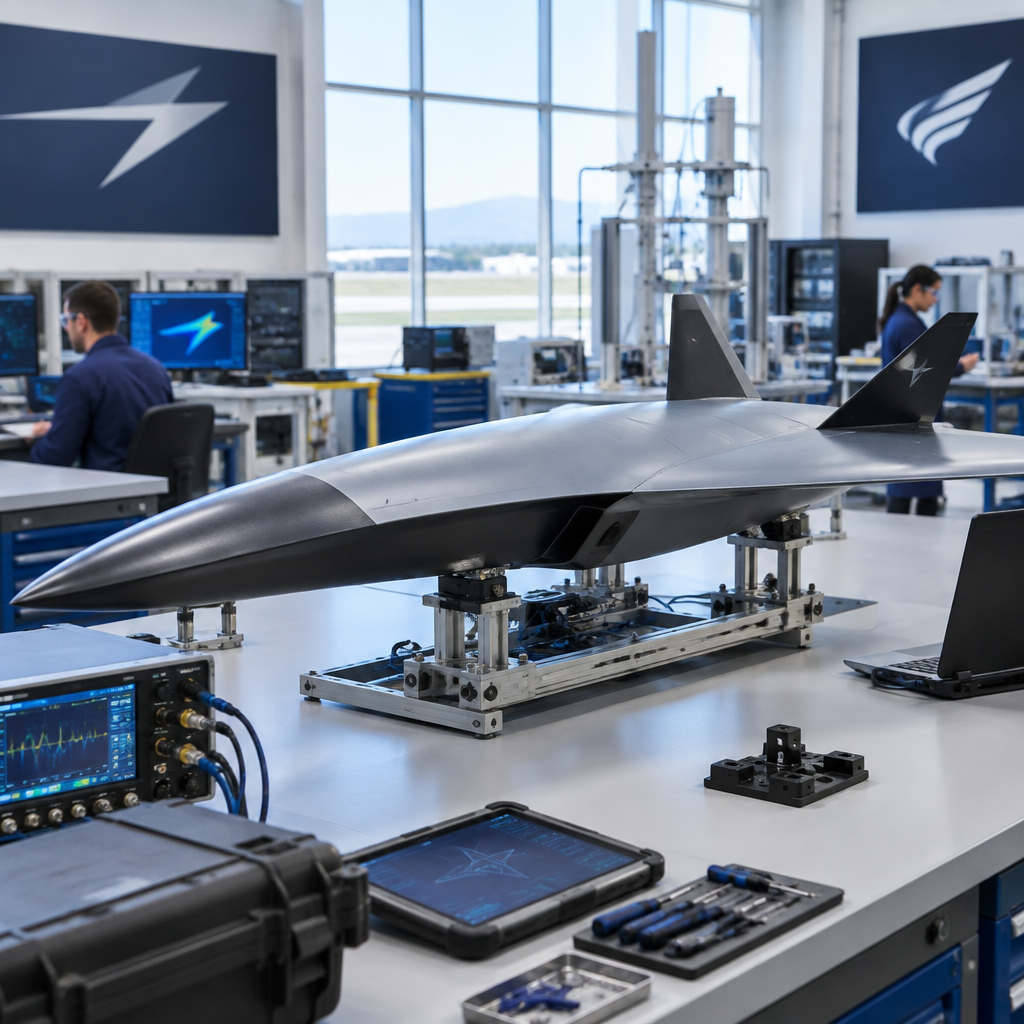
Hermeus, the high‑speed aviation startup founded in 2018, and prime contractor Northrop Grumman announced earlier today that they will partner to integrate mission systems onto Hermeus’ next‑generation unmanned high‑Mach aircraft. The companies said Northrop Grumman will supply electronic warfare systems, sensors, autonomy packages, communications, navigation, and command‑and‑control integration intended to turn Hermeus’ fast airframes into operational mission platforms.
Hermeus' Quarterhorse demonstrators and Ramjet‑X
Hermeus has flown a sequence of jet‑powered Quarterhorse demonstrator drones, advancing from an Mk 0 iron‑bird rig to flying Mk 2 variants. The delta‑winged Quarterhorse Mk 2.1 was the first of these to break the sound barrier during a test flight in May, and the company is now developing a Quarterhorse Mk 2.2 that it hopes to push beyond Mach 2.
In September, Hermeus unveiled Ramjet‑X, a smaller ramjet‑powered platform designed to be air‑launched from Quarterhorse drones. Company materials describe Ramjet‑X as a low‑cost test vehicle "engineered to break one..." and the platform has been portrayed as both a tool to accelerate high‑speed flight testing and as something that "could be adapted to operational missions." Hermeus also demonstrated that Quarterhorse Mk 2.1 could release stores at high speed during a test series supported by the Defense Innovation Unit (DIU).
Northrop Grumman's role: mission systems, EW, and autonomy
Northrop Grumman said it will provide "integrated mission systems design, development, integration, and sustainment" for Hermeus’ reusable, unmanned high‑Mach platforms. The companies framed the collaboration as a way to add sensing, communications, navigation, and command‑and‑control capability so the aircraft "can operate more intelligently and take on more complex missions" and offer "faster, more survivable options in combat."
Beyond that language, neither press release lays out detailed mission sets. Northrop Grumman’s announcement highlights the potential to add electronic warfare (EW) capabilities, but the companies did not specify whether EW would be for self‑protection, non‑kinetic attack, or both. The press release also suggested EW packages might allow the vehicle to act as a high‑speed reusable decoy.

The cyber insurance questionnaire just landed. Now what?
SOC 2, HIPAA, insurance renewals - someone has to own security strategy. Nubivance provides fractional CISO leadership without the full-time salary.
Get a security leadPropulsion and the path toward hypersonic ambitions
Hermeus has stated an ultimate goal of designing an aircraft capable of hypersonic flight. The company is developing a turbine‑based combined cycle (TBCC) propulsion system called Chimera that it intends to integrate onto a future Quarterhorse Mk 3. The TBCC concept combines turbine engines for low speeds with ramjet/scramjet modes for very high speeds — a technical approach Hermeus and DIU have emphasized as enabling reusable high‑Mach and hypersonic flight without reliance on expendable boosters.
Hermeus has also shown renderings of a planned "mission plane" described as "high‑Mach" and equipped with six underwing pylons (three under each wing) plus a centerline pylon — a configuration intended to carry stores or mission payloads if realized.
Defense Innovation Unit, HyCAT testing, and prior service programs
Development of the Quarterhorse family has been supported in part by the U.S. Air Force and the Defense Innovation Unit. Hermeus’ stores release testing was conducted under DIU’s High‑Cadence Airborne Testing Capabilities (HyCAT) effort; DIU said HyCAT brought "a technical focus on turbine‑based combined cycle [TBCC] propulsion and a pathway for dual‑use, reusable hypersonic flight aircraft."
The wider U.S. pursuit of reusable hypersonic air vehicles appears in the record cited by Hermeus: the U.S. Air Force has publicly pursued scramjet and TBCC concepts and full‑up demonstrators in recent years. The Air Force awarded Leidos a contract under the Mayhem program in 2022 to develop a prototype reusable hypersonic air vehicle intended for strike and ISR roles; that effort "ran into budget and other hurdles" and its status was "decidedly murky" as of 2024. DARPA’s Next Generation Responsive Strike (Next RS) program, which surfaced in 2024 with Air Force involvement, planned by 2025 to acquire a flying demonstrator by 2030, though public details of subsequent progress are unclear.
What this means for the U.S. Air Force, the Defense Innovation Unit, and Northrop Grumman
- U.S. Air Force: The Northrop‑Hermeus team represents another industry pathway toward the reusable high‑Mach and hypersonic concepts the service has publicly pursued; any service adoption would depend on further integration, testing, and mission‑level demonstrations.
- Defense Innovation Unit (DIU): DIU’s HyCAT work has already supported Quarterhorse testing—DIU’s role as a rapid prototyping sponsor aligns with the "high‑cadence" test philosophy Hermeus and Northrop highlight.
- Northrop Grumman: The company positions itself to move mission‑proven EW, sensing, communications, and autonomy packages into a new class of fast unmanned platforms, potentially shortening the time from demonstrator to fielded capability if tests proceed rapidly.
There is clearly work to be done before any Quarterhorse derivative becomes an operational asset: which services would fly the aircraft, the precise operational mission sets, and whether future designs will meet hypersonic thresholds remain open. What is indisputable from today’s announcements is the explicit step by Hermeus to lean on a legacy systems integrator to turn fast airframes into missionized platforms—an axis of effort that could accelerate flight testing and move high‑Mach unmanned aircraft closer to operational use.