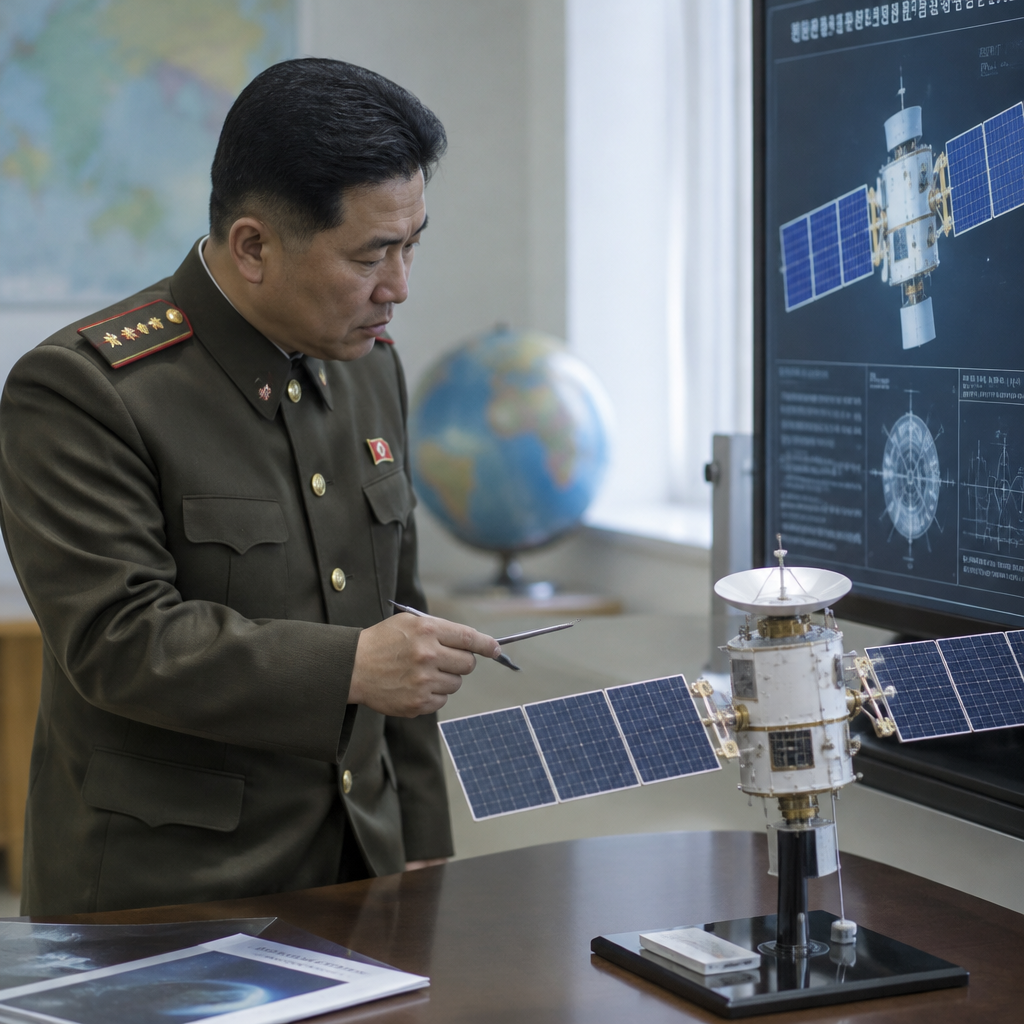
North Korea placed a Malligyong-1 surveillance satellite into orbit in November 2023.
Malligyong-1 launches and the party‑centred system
The Malligyong-1 programme offers a concrete example of how North Korea’s centralised, party‑centred defence system works in practice. After two failed launches earlier in 2023, Pyongyang achieved orbit in November of that year — demonstrating the system’s ability to mobilise resources quickly when a programme has leadership backing. At the same time, the same political and organisational structures that accelerate favoured projects can also filter or block lessons that challenge established doctrine.
Documented links to the Russia–Ukraine war
Open reporting and multilateral monitoring link North Korea to the Russia–Ukraine war in multiple, specific ways. Satellite imagery analysed by the Center for Strategic and International Studies has tracked maritime movements associated with North Korean munitions transfers to Russia since 2023. Pyongyang has acknowledged that its soldiers took part in Moscow’s Kursk operations. And the Multilateral Sanctions Monitoring Team’s report circulated to the UN Security Council in June 2025 documented military cooperation and reported assessments that Russia provided air‑defence and electromagnetic‑warfare assistance to North Korea.

Audit-ready is a season. It shouldn't be.
Evidence in spreadsheets, controls drifting between audits, frameworks multiplying on flat headcount. Nubivance runs continuous compliance on Rapid7 Cyber GRC - SOC 2, HIPAA, ISO 27001, PCI, CMMC.
End the scrambleMost likely battlefield lessons: small‑unit tactics and drone‑supported artillery
The article identifies small‑unit tactics and drone‑supported artillery as the areas where North Korea is most likely to extract immediate, usable lessons. Reported Russian training in artillery, drone and basic infantry operations, combined with Russian technical assistance, could improve reconnaissance and fire coordination for North Korea’s large artillery forces. Combat exposure in Kursk is said to have highlighted needs for greater dispersion, improved concealment and revised tactics against drone surveillance — concrete tactical adjustments that returning personnel could pass up through the system.
Hard limits: terrain, force density and the electromagnetic environment
Transferability is not automatic. The piece emphasises three structural constraints that can blunt the operational impact of battlefield experience: the Korean Peninsula’s mountainous terrain versus Ukraine’s largely flat ground; the higher density of forces on the peninsula; and different conditions for communications and electromagnetic warfare. Those differences mean that improvements observed in Ukraine — better small‑unit survival or more effective artillery targeting — would not, by themselves, prove an ability to conduct integrated multi‑domain operations on the peninsula.
What this means for Australia, the Multilateral Sanctions Monitoring Team, and allied defence planners
- Australia: The article argues that improved North Korean drone‑supported artillery or receipt of advanced Russian military technology could force the United States and its allies to commit more military resources to the peninsula, potentially constraining resources and operational flexibility for contingencies elsewhere in the Indo‑Pacific.
- The Multilateral Sanctions Monitoring Team: Australia’s participation in the team is highlighted as one practical channel for examining links between Russian assistance and North Korean capability; integrating sanctions‑monitoring evidence with open‑source intelligence and allied defence assessments is presented as a method to spot when battlefield experience begins to translate into broader military risk.
- Allied defence planners: The key task is not merely counting what North Korea sends to Russia or receives in return, but identifying which battlefield lessons Pyongyang selects and whether they are authorised, institutionalised and incorporated into training, doctrine or production across the armed forces.
The central argument is procedural rather than dramatic: battlefield exposure matters only if it is transmitted, evaluated, authorised and institutionalised. Evidence of combat participation and of Russian assistance is substantial and specific; clear public evidence that those battlefield lessons have been systemically adopted across North Korea’s armed forces is not yet present. Indicators to watch for include revised training manuals, wider adoption of drone‑supported artillery tactics, changes in weapons design and adjustments to production processes — tangible signs that isolated frontline adaptation has become institutional change.
Whether North Korea will turn experience in Ukraine into enduring capability therefore depends less on the performance of individual returnees and more on the political choices and organisational incentives inside its party‑centred system. The decisive question remains: will Pyongyang authorise and resource the selective institutionalisation of the lessons its soldiers are bringing home?