“Our customers already own and trust their detectors. A robot that learns the search from the specialists who do it, and then runs it with that same equipment, takes people out of the most dangerous moments without handing them more work,” an EOD supplier representative said.
Skylark Labs’ humanoid demonstration for an EOD supplier
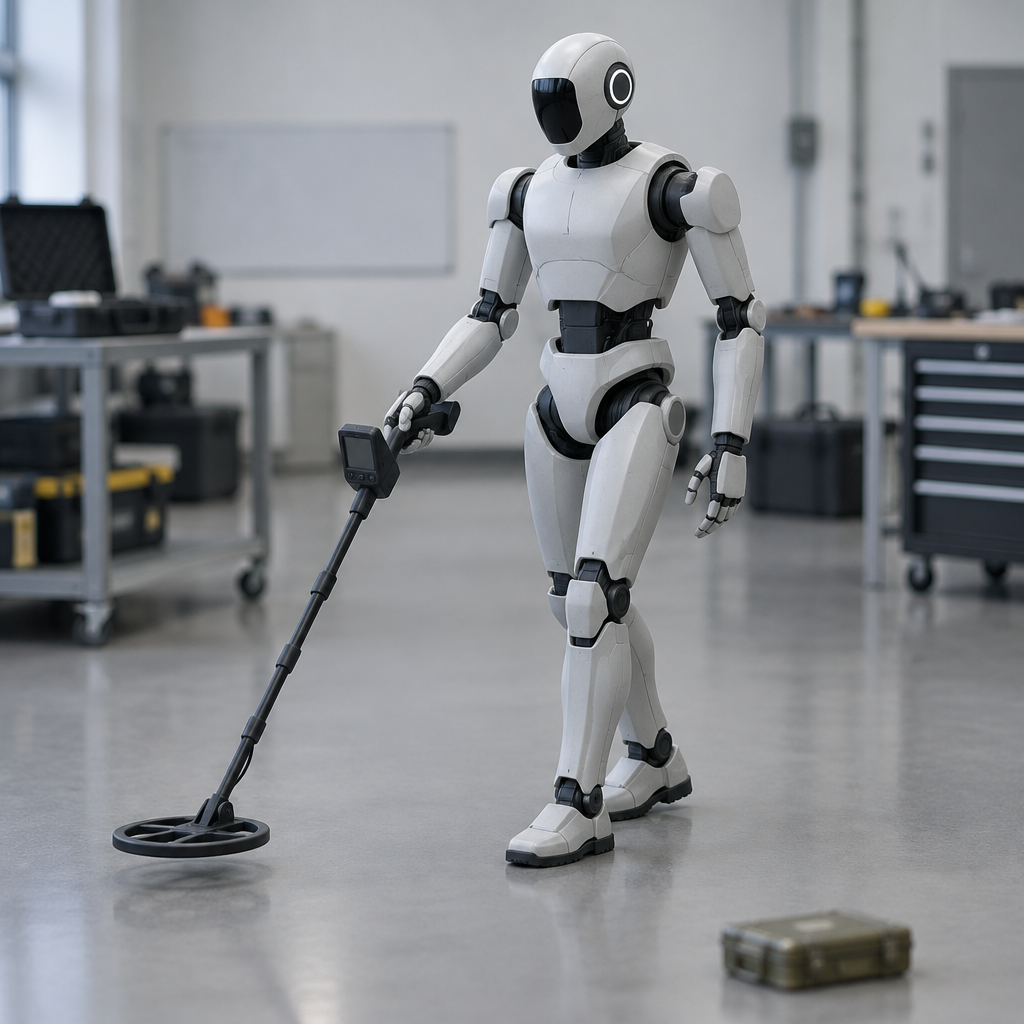
Skylark Labs demonstrated a humanoid robot that can perform a standard handheld metal-detector search under human supervision. In the experiment conducted for an explosive ordnance disposal (EOD) supplier, the robot picked up the detector, swept a designated search area, and stopped and backed off when the detector sounded. The company reports the humanoid carried out the full sequence without requiring a separate command for each step.
Skylark says the machine used visual and audio feedback to guide its actions—the detector’s beep became an input to the robot’s next move, effectively connecting what the robot sensed with what it did. Company footage shows the humanoid sweeping outdoors alongside a person performing the same search.
The demonstration positions the humanoid not as a replacement for existing tools but as a platform that can use equipment already in field inventories. The source notes that EOD teams already rely on robots: in 2022 the U.S. Air Force began fielding 170 L3Harris T7 systems, tracked machines controlled by an operator. Skylark’s approach emphasizes a humanoid form so the robot can work with tools designed for people—hands, reach, and posture that let it manipulate standard detectors without redesigning equipment.
Continual Field-Adaptive Models (CFAMs) and learning on-device
Skylark credits its learning capability to Continual Field-Adaptive Models, or CFAMs. According to the company, specialists demonstrate how to handle familiar equipment and carry out a search; the detector-search skill was taught through a few minutes of human demonstration. CFAMs are designed to keep adapting on the device as the robot works, without a separate retraining cycle.
The company reported CFAM delivered about 30% higher task success than a standard model in a real-world manipulation test. In a separate evaluation, CFAM matched a standard model’s performance using just 40% of the training data, and it learned new skills with little loss of earlier capabilities. Skylark also notes performance in new search conditions is still being tested.

This site is the portfolio.
OSINTSights runs on Cloudflare Workers, D1, R2, and Vectorize, with an AI pipeline on Hetzner ARM. Nubivance designed, built, and operates it. We do the same for clients.
See what we buildDetection support, not disposal: current limits and stated goals
Skylark and observers make clear the demonstrated system is detection support. “Physical handling and disposal remain development goals,” the source states. The humanoid’s practical value therefore depends on carrying out a defined search reliably enough that a specialist can supervise from greater separation rather than being the first person onto unswept ground.
Skylark’s founder and CEO, Amarjot Singh, framed the company’s mission: “Our mission is to enable machines—including humanoids—to independently carry out explosive ordnance disposal tasks, keeping people away from potentially lethal threats. We’re building the AI brain that allows these machines to learn efficiently and adapt to unfamiliar objects, terrain, and changing conditions, with the goal of making them reliable and effective in complex EOD operations.”
Hive framework and the plan for coordinated humanoid teams
Skylark outlines a longer-term aim of coordinated multi-robot teams. Hive, the company’s framework for coordinating multiple machines, is already deployed in oil and gas operations in the United States, India and the Middle East. Applied to EOD, Skylark says Hive could let robots divide a search area, share findings and hand off work as conditions change, with one specialist overseeing the team.
The envisioned payoff is operational: a team of humanoids could sweep, mark, and escalate encountered hazards without placing a person on the ground for each action—again, provided the machines reach the required reliability.
What this means for EOD specialists, EOD suppliers, and Skylark Labs
- EOD specialists: The demo suggests specialists could supervise detector searches from greater separation, using familiar handheld detectors while a humanoid performs the risky first passes. That supervision model depends on the humanoid reliably executing the defined sweep and responding correctly to detector alerts.
- EOD suppliers: Suppliers who already equip teams with handheld metal detectors may find a pathway to robotic augmentation without changing core detection equipment—the EOD supplier representative’s comment emphasizes that existing trust in detectors is central to adoption.
- Skylark Labs: The company must continue testing CFAMs in new search conditions and advance physical handling and disposal capabilities. Skylark’s stated measurements—30% higher task success in one test and parity with far less training data in another—are concrete milestones they will need to translate into operational reliability.
Retired U.S. Marine Corps Lt. Gen. Michael S. Groen, a member of Skylark’s Defense Advisory Board, summarized the operational logic: “The first footsteps onto unswept ground carry the greatest risk. If a machine can reduce human risk while discerning the unknown, specialized judgment is reserved for the most complex challenges.” The demonstrable next step is whether the humanoid can turn those first footsteps into a routine it will take reliably, day after day, across the messy reality of explosive hazards.