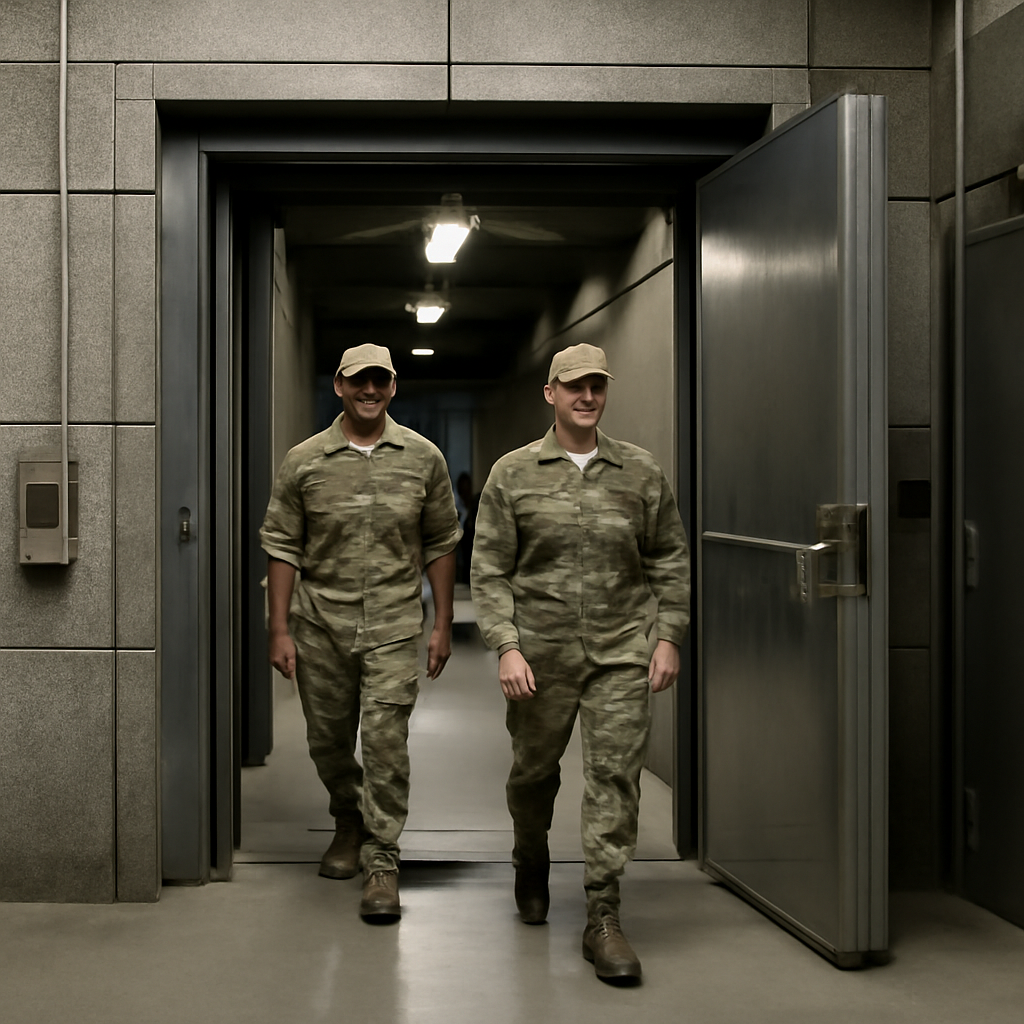
“At the interior entrance to the Cheyenne Mountain Complex headquarters for NORAD two military personnel exit the administrative area May 11, 2004 in Colorado Springs, Colorado.”
Cheyenne Mountain Complex: a concrete scene and a Cold War origin
The photograph described in the post places two military personnel at the administrative entrance of the Cheyenne Mountain Complex on May 11, 2004. The caption anchors the facility in time and place and reminds readers of its origin: the complex was constructed in 1958 during the Cold War. Those who work there do so roughly 7,000 feet inside a granite mountain — a detail that underlines the site’s intent and design.
NORAD’s responsibilities and daily reach
The caption lays out NORAD’s substantive mission in plain terms: responsibility for external air, missile and space defense. Since September 11, 2001, NORAD has monitored roughly 7,000 aircraft per day within the United States, tracking each aircraft’s flight pattern and maintaining contingencies for the U.S. President’s flights and landings. NORAD coordinates with civilian authorities and works with the Pentagon, as well as federal, state and local authorities. The post also notes that NORAD works with the Department of Homeland Security but is not part of DHS.

The cyber insurance questionnaire just landed. Now what?
SOC 2, HIPAA, insurance renewals - someone has to own security strategy. Nubivance provides fractional CISO leadership without the full-time salary.
Get a security leadStaffing: scope and the Canadian presence
The caption gives a concrete headcount and an international detail: NORAD’s staff totals 326, and Canadian military officials comprise 10–15 percent of that number. That statistic captures NORAD’s binational composition and offers a numerical sense of scale for the organization described in the image caption.
Security, survivability and hard engineering
The Cheyenne Mountain Complex is presented as more than a command post; it’s a hardened environment. Two 25-ton security doors seal the interior offices from “any type of attack,” according to the caption. The facility contains a self-sufficient survival system with independent water and air supplies — features that, along with its depth inside a granite mountain, are portrayed as deliberate measures to sustain personnel and operations under extreme conditions.
Bunker Talk’s prime directives and community moderation
The post pivots from the photograph to forum housekeeping with a block labeled “PRIME DIRECTIVES:” and a set of rules for commenters. The directives emphasize respectful political discussion, explicitly forbidding childish name-calling and personal attacks. They ban “conspiracy theory rants,” “drive-by garbage political memes,” links to “crackpot sites,” trolling and obsessive behavior about other users. Practical moderation measures are encouraged: users are told to use the mute button and to report offenders, with the clarification that reporting is not for people who merely hold different political views but for rule violations.
The tone of that guidance is procedural and behavioral: it asks community members to “stick to the facts,” to avoid “shitposting,” and to refrain from interacting with people they do not like. In short, the post combines a photograph of a hardened military command with a plain-spoken code of conduct for an online audience.
Closing observation
The juxtaposition in the post is striking: an image and description of a deeply fortified, mission-focused military installation — complete with exact figures for staff, depth and equipment — placed beside a forum’s rules for civil conversation. Both elements are concerned with protection and continuity: one protects national command and control through engineering and binational cooperation; the other protects an online community through rules and moderation. The caption’s specifics — construction in 1958, monitoring 7,000 aircraft per day since September 11, 2001, 326 total staff with a 10–15 percent Canadian component, and heavy physical protections inside the mountain — leave the reader with a clear, factual image of both the place and the posture behind it.



