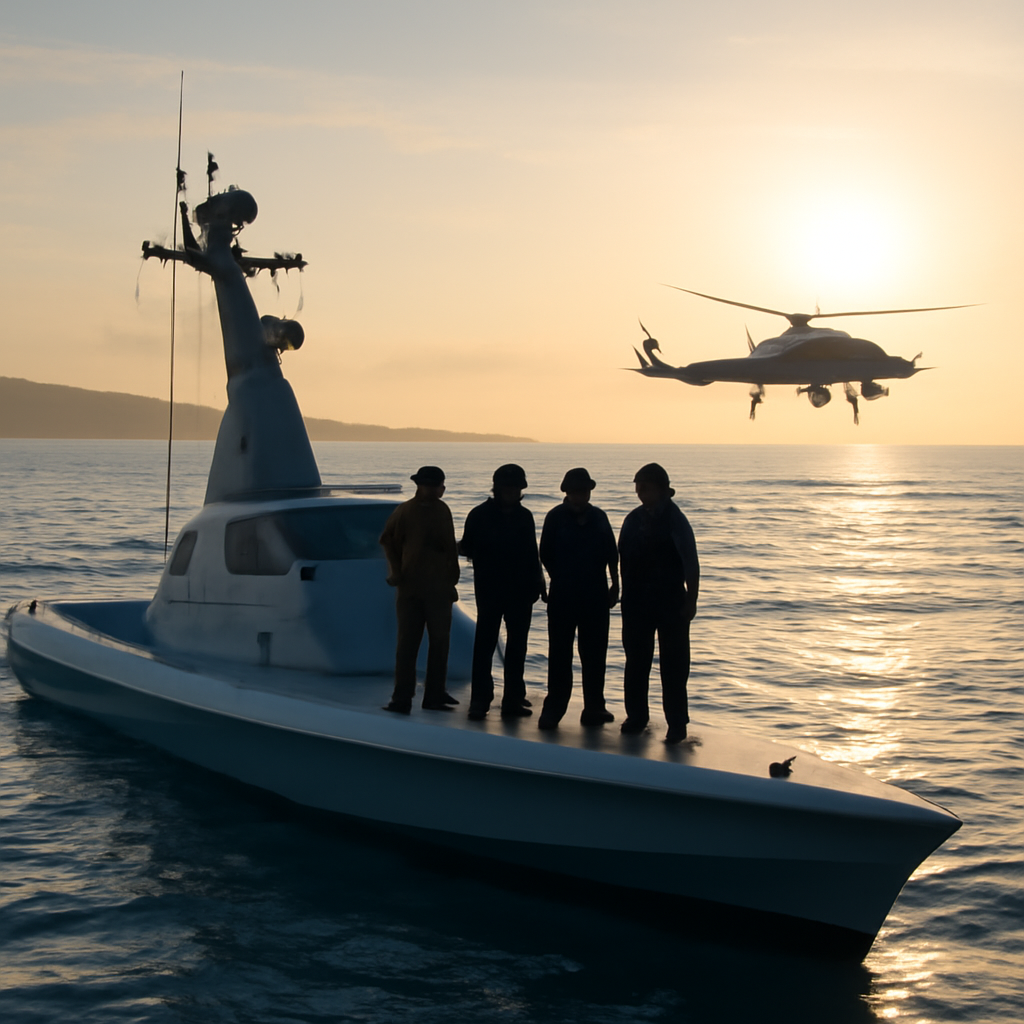
“Looking ahead, we will continue to apply lessons learned as we increase our operational capabilities through ‘manned-unmanned teaming’ concepts,” Cooper told Defense One in 2023.
What unfolded: a helicopter downed, an unmanned boat deployed
An AH-64 Apache went down around 7:30 p.m. ET near the coast of Oman while “patrolling international waters,” U.S. Central Command officials said in a Tuesday news release. Roughly two hours later, a Corsair unmanned surface vessel operated by 5th Fleet’s drone-focused Task Force 59 arrived on the scene, Capt. Tim Hawkins, a CENTCOM spokesperson, said.
The Corsair picked up the Army helicopter’s crew members, transported them to another location on the water, and they were then retrieved by a helicopter for further transport. The crew members are currently in stable condition, Hawkins said. U.S. Naval Forces Central Command, the 82nd Airborne Division, and unnamed Air Force and Navy units also participated in the rescue, the release said.
The Corsair and Task Force 59: capability in practice
The Corsair is a 24-foot robot boat made by Texas-based defense tech firm Saronic. Task Force 59 began operating the boats in March. The unit is part of a broader, half-decade effort under 5th Fleet to integrate artificial intelligence and unmanned systems into Middle East waters; that area of responsibility includes the Suez Canal, the Strait of Bab al Mandeb, and the Strait of Hormuz, the latter of which the release said remains mostly closed to commercial shipping as the U.S. war in Iran stretches into more than 100 days.
Task Force 59 has adopted a mostly contractor-owned and -operated acquisition model to field a wide variety of drones used during exercises in the region, the release said. The rescue marks, according to available reporting, an apparent first for the U.S. military: a drone boat conducting a at-sea recovery of personnel from a downed aircraft.

Audit-ready is a season. It shouldn't be.
Evidence in spreadsheets, controls drifting between audits, frameworks multiplying on flat headcount. Nubivance runs continuous compliance on Rapid7 Cyber GRC - SOC 2, HIPAA, ISO 27001, PCI, CMMC.
End the scrambleWhat military officials are investigating
CENTCOM said it is not immediately clear what led the Apache to be “lost at sea,” and Hawkins told Defense One the cause of Tuesday’s Apache rescue is under investigation. Citing U.S. officials, CNN reported that the helicopter was hit by an Iranian Shahed drone. President Donald Trump said on social media that “the Iranians shot down one of our highly sophisticated Apache Helicopters” and added the U.S. must “respond to this attack.”
The incident arrives amid other recent Apache problems. Since March, there have been at least three stateside Apache mishaps and one sudden landing overseas. Defense One previously reported that the Army was investigating a transmission problem on some of its AH-64E model helicopters; an April internal memo reviewed by Defense One warned that crew members can “experience an internal failure resulting in loss of accessory gearbox drive, which can result in loss of tail rotor thrust, electrical power, and hydraulics.” Service officials declined to say how many helicopters were affected by the transmission problem.
How Task Force 59, Army aviation, and CENTCOM are likely to respond
- Task Force 59 and Saronic (drone-boat operators): The unit will use the episode to validate operational concepts for unmanned surface vessels in contested waters, demonstrating a rescue mission that the force has been preparing for since March. The release notes the unit’s contractor-heavy acquisition approach and its emphasis on manned-unmanned teaming.
- Army aviation and maintenance authorities: The Army’s aviation community — already investigating transmission problems on the AH-64E — will watch this incident closely as the service continues its inquiry into what caused the helicopter to be lost at sea and whether maintenance, design, or external strike factors played a role.
- CENTCOM and 5th Fleet operational commanders: CENTCOM is overseeing the investigation; the incident reinforces the operational utility of unmanned surface vessels in the 5th Fleet’s AOR, which includes chokepoints such as the Strait of Hormuz and areas affected by ongoing hostilities described in the release.
Conclusion
The rescue combined an unmanned surface vessel operated by Task Force 59, traditional aviation assets, and multiple services in a coordinated retrieval that left the downed crew in stable condition. CENTCOM has opened an investigation into the cause of the loss, and the episode will inform both the Army’s review of Apache vulnerabilities and the Navy’s continued experimentation with contractor-operated unmanned systems. For now, the single concrete facts are the timeline, the involvement of a 24-foot Corsair robot boat made by Saronic, and the public pronouncements that frame the event; the questions about cause and broader implications remain in official hands as investigators work.