Can a beam of light change the calculus of naval defense when it still struggles to reach and quickly neutralize targets? The answer may be less about headline-grabbing destruction and more about adding another defensive instrument to a crowded deck of options.
What happened
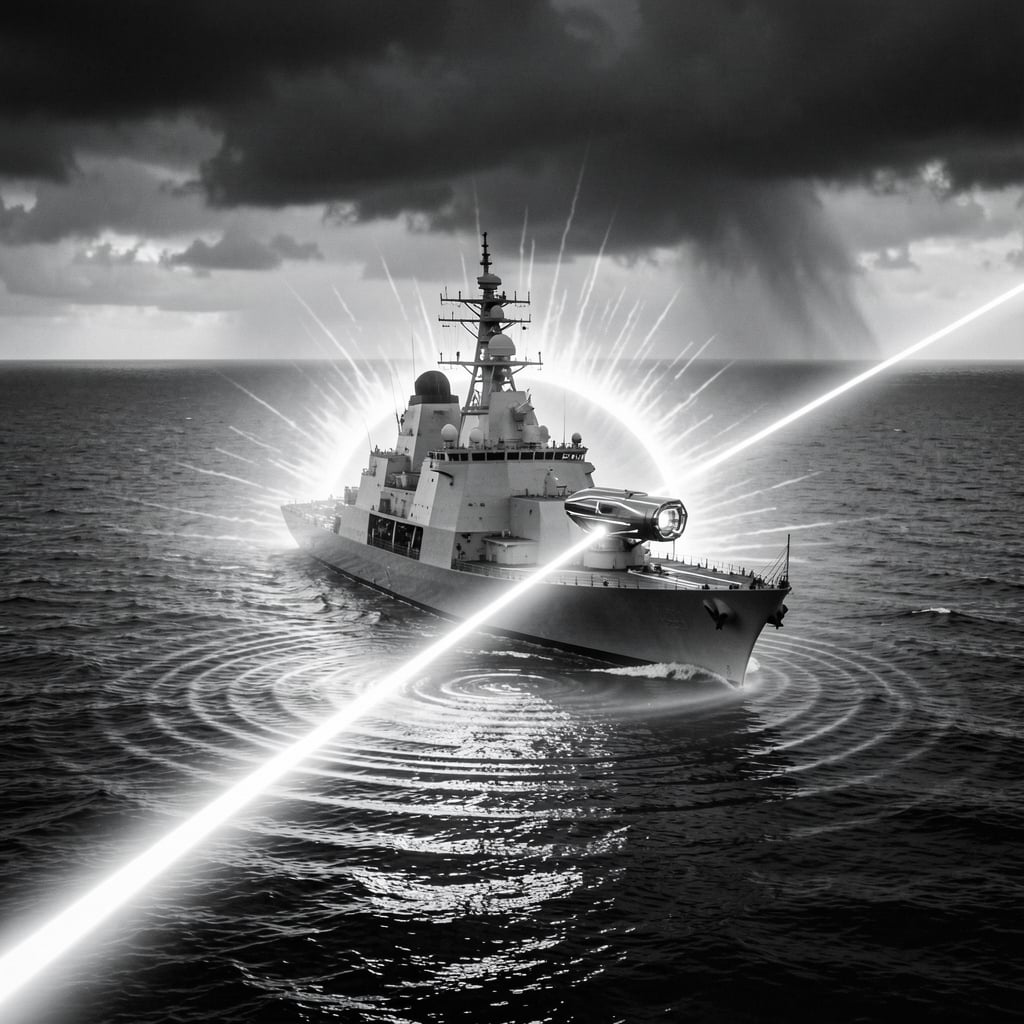
According to a report published on The War Zone, the U.S. Navy fired a LOCUST laser system from the supercarrier USS George H.W. Bush. The report frames the event as an operational employment of a shipboard laser capability intended to counter unmanned aerial threats.
Technical limits and capabilities
The same account notes a crucial caveat: lasers remain very limited in their range and how fast they can down targets. Those limits define the envelope in which a weapon like LOCUST can be effective — short-distance engagements and scenarios where engagement speed and dwell time can be managed. At the same time, the report stresses that even with those constraints, lasers can still be an important layer in a warship’s defenses.

Audit-ready is a season. It shouldn't be.
Evidence in spreadsheets, controls drifting between audits, frameworks multiplying on flat headcount. Nubivance runs continuous compliance on Rapid7 Cyber GRC - SOC 2, HIPAA, ISO 27001, PCI, CMMC.
End the scrambleWhy this matters
-
Operational layering: The deployment of a laser from a carrier suggests a deliberate move to integrate directed-energy systems alongside existing kinetic and electronic measures. Even if lasers cannot provide long-range or instantaneous defeat of threats, they can supplement other systems to create a composite defensive posture.
-
Employment constraints: The acknowledged limits in range and speed mean planners must fit laser use into specific tactical roles — for instance, as a last-mile option, for low-signature or low-cost targets, or in situations where repeated engagements at short range are acceptable.
-
Signal value: Fielding a directed-energy system on a large warship carries a demonstrative intent. Whether primarily practical, experimental, or symbolic, the operation reported by The War Zone signals attention to the technology and an intent to test integration on frontline platforms.
Perspectives to watch
-
Technologists will focus on incremental improvements that address the two limits named — range and defeat speed — and on integration challenges when pairing lasers with other ship systems.
-
Policymakers and planners will weigh the role of such systems in fleet architecture: whether they are niche supplements, cost-saving measures against low-cost threats, or stepping stones toward broader adoption as technical hurdles are reduced.
-
Operators and users aboard ships will evaluate how reliably a laser can be brought to bear in cluttered, contested environments and how its use affects tactics, logistics, and maintenance.
-
Potential adversaries and analysts will observe whether the capability changes threat calculations, particularly for low-cost or saturating unmanned systems that might be vulnerable to repeated short-range engagements.
The report, and the simple technical assessment it contains, underscores a pragmatic reality: directed-energy weapons are not yet a panacea, but they are a developing tool that can alter defensive mixes in specific ways. The central question now is not whether lasers work in principle, but how they will be positioned among the many instruments that protect a carrier strike group. Will that positioning prove decisive, incremental, or merely experimental? The Navy’s reported use of LOCUST aboard the USS George H.W. Bush takes that question from theory into practice.