What the Navy is asking for
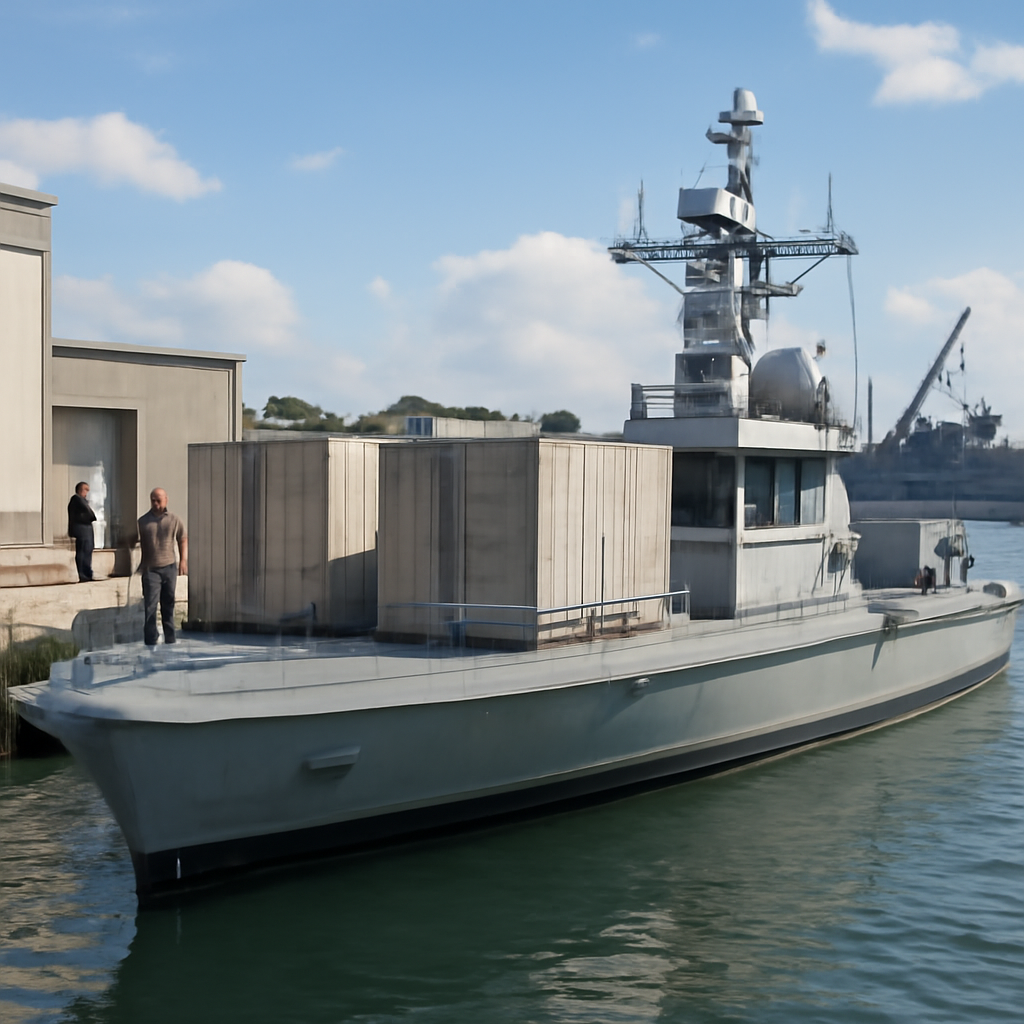
The Navy’s Phase II solicitation for medium unmanned surface vessels (MUSV) lays out specific, measurable requirements for platforms it will consider for its maritime autonomous systems marketplace. According to the notice, vessels must be capable of at least 10 days of unmanned operations, accommodate a payload capacity of at least two standard 20-foot shipping containers, and be no longer than 90 meters.
The notice invites parties with expertise in “innovative solutions to complex problems, vessel construction, autonomy, perception systems, and general maritime experience” to submit proposals. Vendors will be evaluated on platform maturity, open-architecture autonomy compatibility, endurance, payload integration capacity, and rapid-production scalability.
Notably, the solicitation updates the Navy’s prior guidance from earlier this year, which advised designs should hold at least two 40-foot shipping containers. The Phase II notice instead specifies the two 20-foot container baseline.
How platforms will be tested at sea
Successful proposals will proceed to a sea demonstration where the Navy will put candidate vessels through performance checks. The solicitation specifies evaluations of sustained speed, maneuverability, and fuel burn, among other criteria. These demonstrations are intended to validate claimed endurance and payload-integration capabilities under operational conditions.
Approved platforms from those demonstrations will then be listed on the Navy’s maritime marketplace, enabling the Pentagon to select already-vetted systems rather than restart full procurement cycles for each purchase.

The cyber insurance questionnaire just landed. Now what?
SOC 2, HIPAA, insurance renewals - someone has to own security strategy. Nubivance provides fractional CISO leadership without the full-time salary.
Get a security leadThe MUSV Marketplace and a different procurement model
The solicitation is part of a broader effort the Navy announced in March to create an MUSV Marketplace. Navy officials described that marketplace as the first iteration of a recurrent platform marketplace designed to acquire production-ready, mission-capable platforms already available. The solicitation reiterates that the marketplace’s purpose is to “rapidly configure and issue funded delivery orders for vetted maritime autonomous systems without redundant procurement cycles.”
The notice frames the marketplace as both an acquisition shortcut and a mechanism to keep offerings current: “This open call will allow new entrants to compete and existing vendors to submit updated product blocks and modular payload configurations,” the Navy said.
Who the solicitation is inviting: new entrants and incumbents
The Navy’s language intentionally opens the door to a broad set of providers. The notice explicitly invites “interested parties” with maritime and autonomy expertise and emphasizes the opportunity for new entrants to compete alongside existing vendors. Existing suppliers are likewise encouraged to submit updated product blocks and modular payload configurations for re-evaluation and marketplace listing.
Vendors that can demonstrate platform maturity, compatibility with an open-architecture autonomy environment, endurance consistent with the 10-day requirement, and the ability to integrate significant payloads while scaling production rapidly are the ones the solicitation places front and center.
What this means for Pentagon procurement teams, Navy officials, and vendors
- Pentagon procurement teams: The solicitation aims to give acquisition authorities pre-vetted, production-ready platforms that can be purchased through funded delivery orders—reducing the need for repetitive, platform-by-platform procurements.
- Navy officials: By requiring sea demonstrations and setting clear evaluation metrics—speed, maneuverability, fuel burn, endurance, and payload capacity—the Navy is prioritizing measurable field performance before platforms are accepted onto the marketplace.
- Vendors and new entrants: The Navy’s call for open-architecture compatibility and rapid-production scalability signals that companies will need to show both technical interoperability and the ability to move from prototype to production quickly to be competitive.
The solicitation, posted Sept. 23, marks a concrete next step in the Navy’s stated plan to operationalize MUSV capability through a recurring marketplace. The immediate tangible milestones are clear: vendors submit proposals, selected platforms demonstrate performance at sea, and successful systems are listed for rapid purchase through the maritime marketplace. The question the Navy has put to industry is direct—can suppliers deliver mature, interoperable, container-capable vessels that meet the endurance and production expectations spelled out in the notice?
Source: Breaking Defense — Navy launches Phase II for medium robo-ship project, seeks ‘innovative solutions’