“The Italian crews intercepted the unmanned aircraft, neutralizing it in compliance with the operational procedures established by the Alliance,” the Italian Ministry of Defense wrote on X.
The interception at Šiauliai Air Base
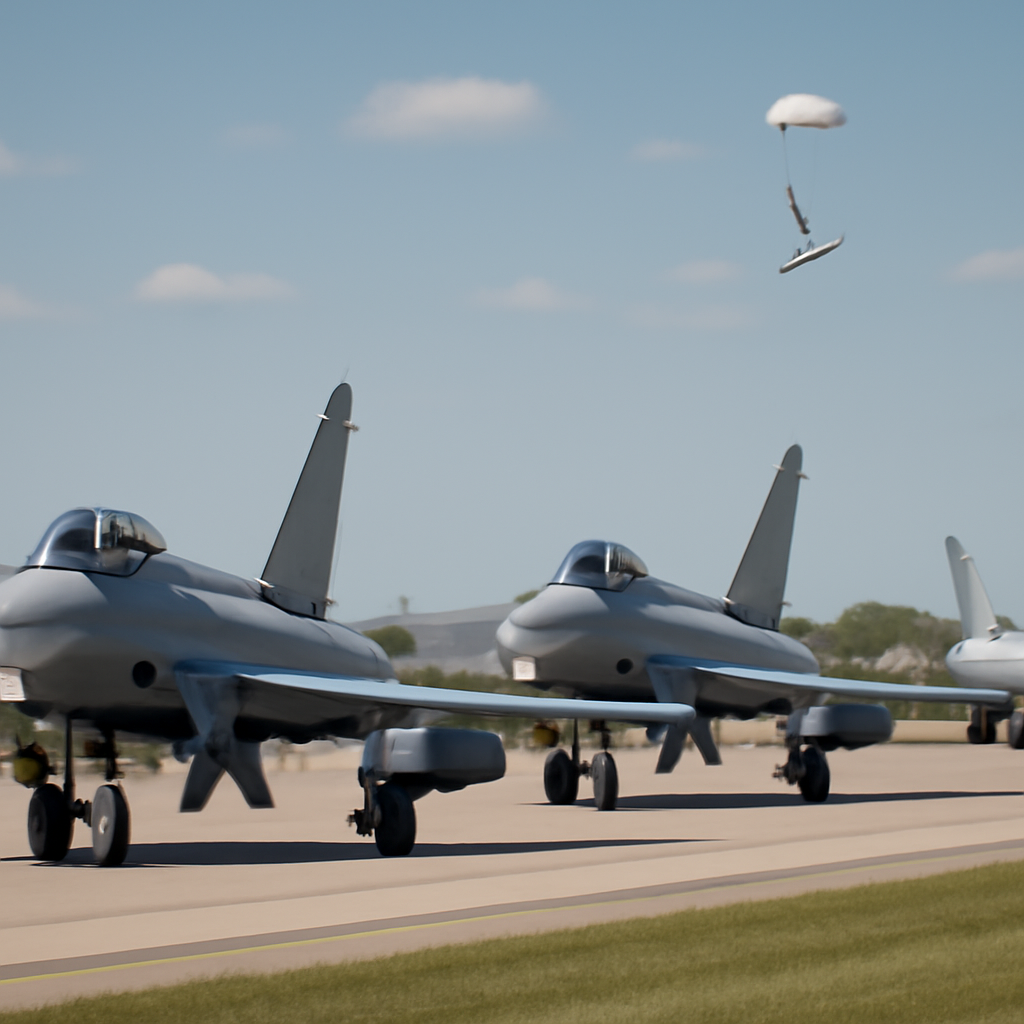
A little after midnight, Italian Eurofighter F-2000 jets assigned to NATO’s Baltic Task Force scrambled from Šiauliai Air Base in northern Lithuania and shot down an unidentified drone that had violated Lithuanian airspace, the Lithuanian Armed Forces reported. Lithuanian officials later said the unmanned aircraft was carrying an explosive device, a fact confirmed late Tuesday by Defense Minister Robertas Kaunas. The ministry framed the action as following Alliance operational procedures; the specific weapon system used to bring the drone down was not disclosed.
A repeated pattern: a second Italian interception in 30 days
The overnight shoot-down was the second such response by Italian air crews in a month. On Aug. 14, personnel operating under NATO’s Baltic Air Policing mission also deployed from Šiauliai and shot down an unidentified drone that had violated Latvian airspace, the Italian Ministry of Defense said. Both incidents involved Italian Eurofighter units operating from the same base and underscore a recurrent pattern of UAV incursions in the Baltic region.

This site is the portfolio.
OSINTSights runs on Cloudflare Workers, D1, R2, and Vectorize, with an AI pipeline on Hetzner ARM. Nubivance designed, built, and operates it. We do the same for clients.
See what we buildWeapons choices and the APKWS procurement notice
Officials did not say which armament the Italian pilots used in Lithuania, but the wider discussion about how to defeat low-cost unmanned aerial vehicles is now part of procurement debates. On Aug. 21, the U.S. State Department approved a possible Foreign Military Sale worth $364 million to Italy for 5,031 Advanced Precision Kill Weapon System (APKWS) II guidance systems and related equipment manufactured by BAE Systems. The package, while not yet the subject of a formal contract, was described as offering a less expensive option for neutralizing low-cost drones than firing high-end missiles such as AMRAAM.
The APKWS has attracted attention after the United Kingdom announced in May that it had integrated the kit onto the Eurofighter and was using it in operations in the Middle East against inexpensive drones—an operational precedent cited in discussions about cost-effective options for Eurofighter operators facing swarm and one-way attack unmanned systems.
Air defense gaps and the “cost curve” debate
At a United States Air Forces Europe roundtable hosted by the Air & Space Forces Association, Lt. Gen. Jason Hinds framed the tactical problem plainly: currently “we only have short-range air defense systems that in some part of the nations, like near Romania and some parts of the Baltics,” able to act against one-way attack drone or cruise missile attacks. He added that using aircraft at all to intercept drones is “not putting us on the right side of the cost curve,” highlighting the tension between available defenses and the expense of employing high-end fighter aircraft against low-cost threats.
Vilnius, Brussels and Moscow: public statements and broader context
Lithuanian authorities did not publicly assign responsibility for the incursion, but they reportedly suspect the drone entered Lithuanian airspace from Belarus. The interception comes against a backdrop of repeated balloon and drone intrusions that prompted Lithuania to declare a state of emergency in December. The BBC, citing unnamed officials, reported that in 2025 roughly 600 balloons linked to smuggling and nearly 200 drones crossed into Vilnius’ airspace.
European-level reaction included comments by Ursula von der Leyen, president of the EU Commission, who cited the overnight incursion on X and characterized it as part of “reckless and dangerous Russian behaviour.” “These are not isolated incidents. They are part of a broader pattern of Russian aggression and provocation against Europe, testing our readiness and our resolve,” she wrote. The source also notes a pattern of ground incidents in Europe that some European officials have alleged were deliberate provocations by Russia; the Kremlin has said those accusations are baseless and constitute provocations itself.
What this means for the Italian Air Force, Lithuanian authorities, and NATO planners
- Italian Air Force: The repeated use of Eurofighters to intercept low-cost drones underscores an operational imperative to consider lower-cost munition options and integrations—such as the APKWS kits referenced in the approved possible FMS—to improve the cost-efficiency of drone neutralization.
- Lithuanian authorities: The confirmation that an explosive device was aboard the drone reinforces the security rationale for continued air policing, the state of emergency declared last winter, and ongoing monitoring of incursions suspected to originate from neighboring airspace.
- NATO planners: Lt. Gen. Hinds’ remarks point to enduring short-range air-defense gaps in parts of Europe; using fighters against inexpensive unmanned threats raises questions about sustainability and about balancing air policing with investments in ground-based, cost-effective counter-UAV systems.
The facts recorded so far are straightforward: an unidentified drone entered Lithuanian airspace shortly after midnight, Italian Eurofighters from Šiauliai shot it down in line with NATO procedures, and Lithuanian officials say the drone carried an explosive device. What remains unsettled in the public record is who launched the drone and precisely how it was engaged. In the near term, the incident will be measured against recent procurements, tactical adaptations such as APKWS integration on Eurofighters, and the operational trade-offs Lt. Gen. Hinds highlighted between aircraft responses and defensive systems on the ground.