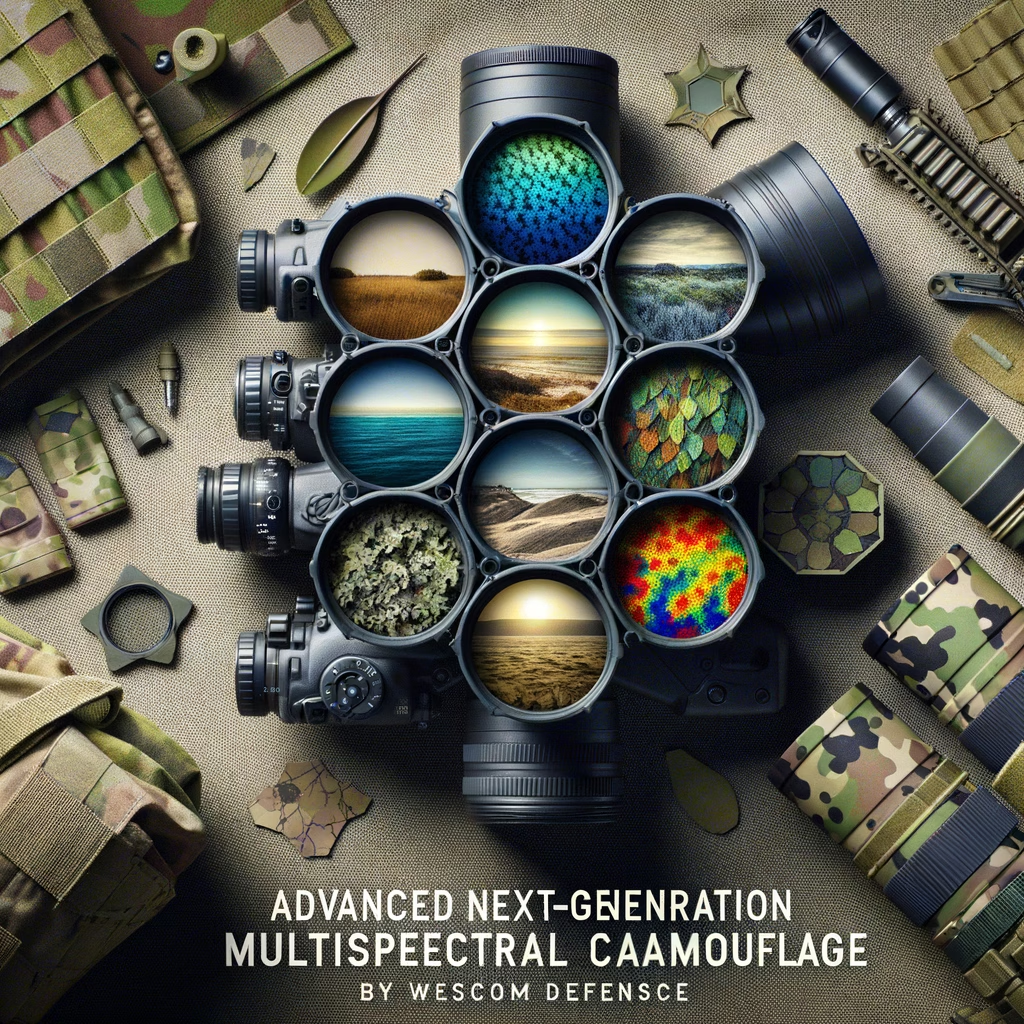
In an era where battlefield invisibility can determine the outcome of conflicts, the unveiling of a new multispectral camouflage system raises pressing questions: how far can technology go to conceal forces, and what are the strategic implications for future warfare? Wescom Defence’s introduction of the ATMIS Multispectral Camouflage (ATMIS MSC) portfolio at DSEI 2025 in London offers a compelling response to these challenges, promising enhanced concealment capabilities across multiple spectra to give armed forces a crucial tactical edge.
Multispectral camouflage is not merely about blending into the visible environment; it involves masking signatures across infrared, thermal, radar, and even ultraviolet bands. This sophistication addresses the increasingly sophisticated surveillance technologies employed by adversaries. The ATMIS MSC system, developed originally by BCB International and now under Wescom Group following its acquisition earlier in 2025, exemplifies this next-generation approach.
BCB International’s legacy in military textiles is well-established, particularly their expertise in protective gear and camouflage solutions. Wescom Defence’s acquisition has infused this expertise with fresh innovation and resources, culminating in the ATMIS MSC portfolio. According to Wescom’s spokesperson at the DSEI event, the system represents “a leap forward in multispectral concealment, designed to keep soldiers and assets undetectable not only to the naked eye but also to sophisticated detection technologies used by modern militaries.”
The context of the unveiling is critical. Modern battlefields, from urban environments to complex terrain, are saturated with sensor technologies — drones, thermal imaging, and radar systems — that can reveal troops long before they come into direct view. Traditional camouflage methods have struggled to keep pace, often optimized for visual concealment but vulnerable in other spectra. The ATMIS MSC suite aims to change that dynamic, providing a multi-layered defense that complicates enemy targeting and reconnaissance.
From a technological standpoint, the system integrates advanced materials science with real-time adaptability. While specific technical details remain closely guarded for security reasons, Wescom has indicated that the camouflage incorporates cutting-edge fabric treatments and coatings that absorb or reflect signals across different detection bands. Such multispectral concealment is becoming indispensable as adversaries adopt countermeasures that exploit weaknesses in visual-only camouflage.
Policymakers and defense strategists view these developments with keen interest. Lieutenant General John H. Thompson, retired and now a defense analyst at the Center for Strategic Studies, notes, “The balance of detection and concealment technologies profoundly impacts force survivability and operational success. Innovations like ATMIS MSC have the potential to redefine how armies plan deployments and counterenemy intelligence.” The implication is clear: as multispectral camouflage improves, traditional reconnaissance and targeting methods may require significant adaptation, influencing broader defense procurement and strategic policies.
For end-users—soldiers on the ground—the benefits are tangible but must be weighed against practical considerations. The durability, comfort, and ease of integration of such high-tech materials into existing uniforms and gear are crucial factors. Wescom maintains that the ATMIS MSC materials are lightweight and breathable, engineered to withstand harsh environments without imposing additional burdens on soldiers. Feedback from early field trials reportedly underscores these points, though independent assessments will be vital to validate claims.
Conversely, adversaries must contend with the rising difficulty of battlefield surveillance and targeting. The proliferation of multispectral camouflage technologies challenges reconnaissance drones and satellite imaging systems alike, potentially forcing adversaries to invest in more sophisticated sensors or alternative intelligence-gathering methods. This dynamic echoes an ongoing technological arms race, where each advancement provokes countermeasures and innovations on both sides.
Looking forward, the introduction of the ATMIS MSC portfolio represents more than a product launch—it marks an evolution in how concealment is conceptualized in modern warfare. As Wescom Defence steps into a leading role within this niche, competition among defense contractors is expected to intensify, driving further innovation in multispectral solutions. Additionally, the integration of such systems into broader military doctrine will shape tactics and operational planning for years to come.
Yet, as with any military technology, ethical and strategic questions arise. Does the enhancement of invisibility on the battlefield risk escalating conflicts by lowering the barriers to engagement? How might this influence arms control dialogues or efforts to regulate emerging military technologies? These questions underscore the complex interplay between innovation and responsibility in defense.
In a world where detection technologies advance relentlessly, the race to remain unseen takes on profound significance. Wescom Defence’s ATMIS MSC portfolio answers the call with promise and precision—but the true measure will be how armed forces integrate this next-generation multispectral camouflage into the fabric of future conflict. Ultimately, as concealment grows ever more sophisticated, one must ask: in a battlefield where no one can see clearly, what new challenges will arise for both defenders and aggressors?




