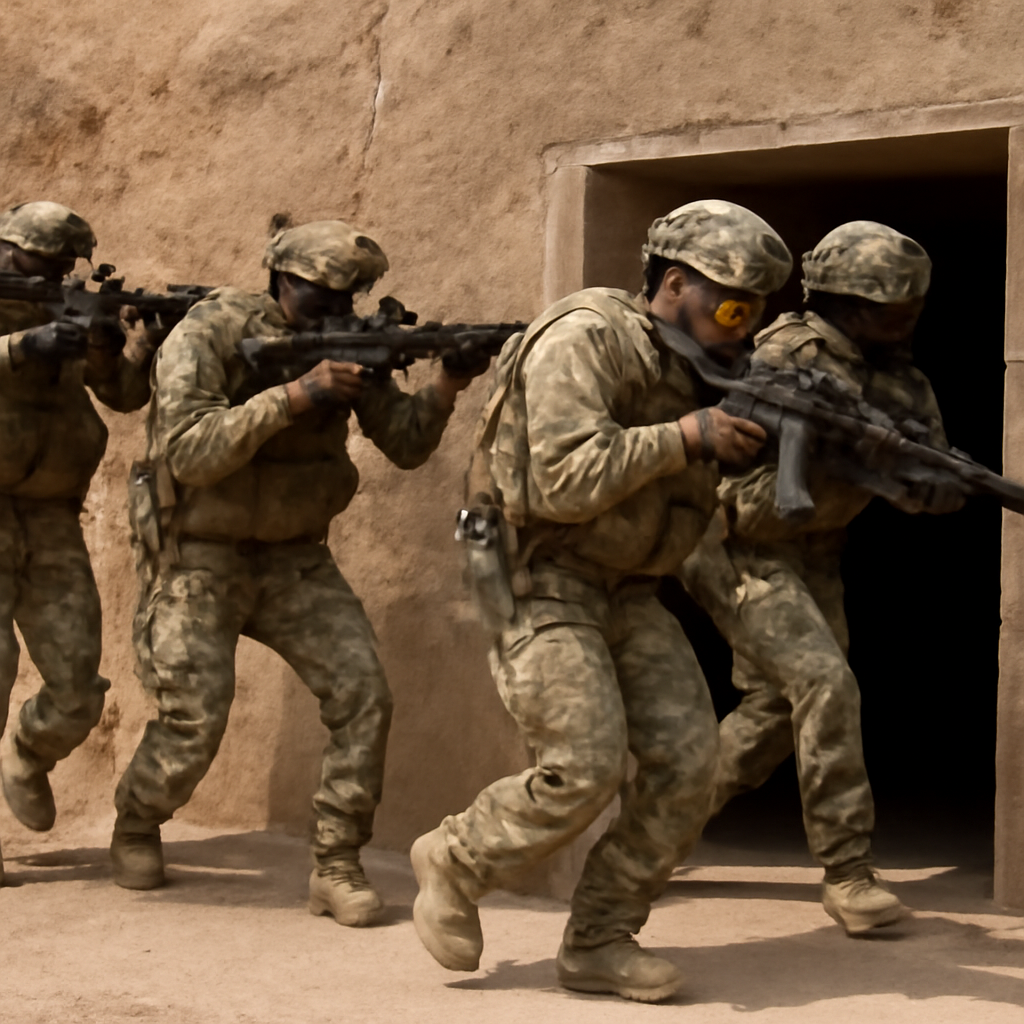
Members of the Moroccan Groupement des Forces Spéciale at Tifnit Training Base
The post centers a single, specific scene: Moroccan special operators conducting tunnel-clearing operations at Tifnit Training Base on May 13, 2026. The caption identifies the unit as the Groupement des Forces Spéciale and frames the activity as part of a Joint Combined Exchange Training (JCET). The language in the post describes the tunnels as those “used by opposition forces,” establishing the immediate training scenario and the tactical focus—clearing subterranean positions used by adversaries.
Joint Combined Exchange Training (JCETs) and their stated purpose
The article reproduces the JCET framing directly: “JCETs bolster regional security and improve threat response by building shared readiness and fostering collaborative relationships.” That sentence sets the training’s stated objectives—regional security, threat-response improvement, shared readiness, and collaborative ties—and places the Moroccan exercise within a broader programmatic mission rather than as an isolated drill.

Audit-ready is a season. It shouldn't be.
Evidence in spreadsheets, controls drifting between audits, frameworks multiplying on flat headcount. Nubivance runs continuous compliance on Rapid7 Cyber GRC - SOC 2, HIPAA, ISO 27001, PCI, CMMC.
End the scrambleThe image credit: U.S. Air Force photo by Staff Sgt. Enrique Barcelo
The photograph accompanying the caption is credited to Staff Sgt. Enrique Barcelo of the U.S. Air Force. The combination of a dated, geolocated caption (May 13, 2026; Tifnit Training Base, Morocco) and a named military photographer anchors the post in a verifiable visual record. The photo credit also signals the involvement of U.S. military imagery in documenting the JCET activity described.
PRIME DIRECTIVES: rules for civil discussion in the TWZ community
The post serves a dual purpose: it is an “off-topic thread” for the “best commenting crew on the net,” and it lays out a set of community rules under the heading “PRIME DIRECTIVES.” Those directives are explicit and prescriptive. Participants are instructed to discuss politics respectfully, acknowledge that disagreement is normal, and “stick to the facts.” Several categories of content and behavior are proscribed by name: “drive-by garbage political memes,” “conspiracy theory rants,” and links to “crackpot sites” are to be removed. Trolling, “shitposting,” obsessive interactions about other users, and personal attacks are all singled out as unacceptable. The post also encourages readers to use the mute button and to report offenders, clarifying that “reporting” means flagging abusive behavior rather than reporting mere political disagreement.
What this means for Moroccan forces, U.S. training planners, and the TWZ commenting crew
- Moroccan Groupement des Forces Spéciale: The caption places their tunnel-clearing training in a regional readiness context; the unit’s publicized role in JCETs highlights a tactical focus on subterranean-threat mitigation.
- U.S. training planners and documenting units: The use of U.S. Air Force imagery and an explicit JCET framing underscores a documented, cooperative training relationship—one where visual record and messaging emphasize shared readiness and collaborative ties.
- The TWZ commenting crew: The forum’s moderators and active participants are given a compact rule set designed to preserve civil, fact-based discourse—explicit prohibitions, encouragement to mute troublesome users, and a call to report abusive behavior aim to shape the tone of discussion in this off-topic space.
The post pairs a concrete, dated image of Moroccan special forces conducting tunnel-clearing at Tifnit with a tightly worded set of community rules intended to keep discussion anchored and civil. By reproducing the U.S. Air Force caption and naming the photographer, the piece makes a specific operational moment public; by publishing a clear code of conduct, it signals how the hosting community wants that moment discussed. Both halves—the photograph and the directives—are explicit about what is being shown and how participants should talk about it.



