<p“What do you do when the cat keeps moving its toys around in the dark?” asked a Space Force official in a recent interview, using a metaphor he did not intend to make coy. The question gets at the central challenge facing U.S. space defenders: how to see, identify and respond when an increasingly skilled rival practices hide-and-seek hundreds of miles above the planet.
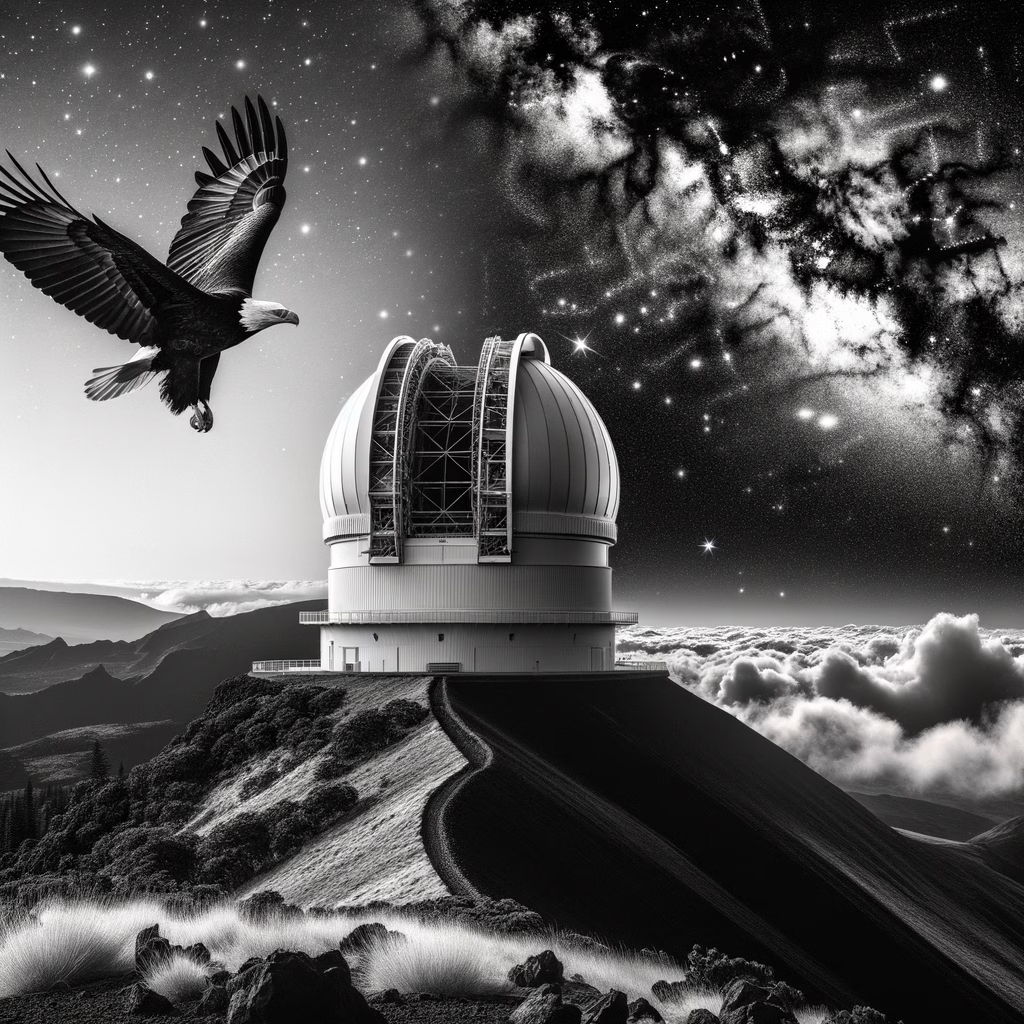
The answer, at least for now, is Maui — the volcanic skies above Haleakalā and the optical telescopes there that give the United States a uniquely clear view of the geosynchronous belt and other orbits where China has been active. In an interview with Defense One, Space Force’s Saltzman laid out what’s next for that key sensor site: upgrades, tighter integration with the Space Force’s space-domain awareness architecture, and a push to speed the flow of data from photons to decision.
Those telescopes do something radars cannot: they collect visual and infrared light, revealing fine details of objects in orbit and, importantly, the changes in behavior that can signal inspection, rendezvous-and-proximity operations, or more aggressive maneuvers. That capability matters because tracking and attribution, not raw firepower, are the currency of deterrence in space. When a satellite performs an unexpected, close approach to another nation’s asset, visual confirmation can turn ambiguity into certainty.
Background: U.S. space surveillance has always been a layered effort. Ground radars sweep LEO; hemispheric networks of sensors and partner nations contribute; and optical observatories — from California to the Canary Islands — fill in the gaps over GEO and deep-sky passes. The Maui site sits on a wind-cleansed, high-altitude slope, giving it long windows of clear seeing over the Pacific where many geostationary satellites appear to hang still. That geography, paired with large-aperture telescopes and advanced imaging systems, produces not just tracks but the kind of high-fidelity data that analysts use to attribute activity and to model intent.
Saltzman told Defense One that the Space Force is accelerating investments to keep Maui ahead of rapidly evolving threats. The plan emphasizes: / greater aperture and sensitivity in optical systems / adaptive optics and improved image processing to cut through atmospheric blur / faster, automated processing pipelines to turn images into actionable tracks / tighter fusion with other sensors and international partners to build a more resilient, distributed picture.
Technologists welcome the focus. Optical systems have benefited from advances in detector sensitivity, computational imaging and machine learning that can extract signal from scant photons. Adaptive optics — long a mainstay of astronomy to correct for atmospheric turbulence — is now practical in surveillance applications, allowing ground telescopes to resolve smaller features and follow fast maneuvers. For engineers, the Maui upgrades are a logical, cost-effective way to keep a technical edge while on-orbit sensing architectures evolve.
Policy makers see a different set of priorities. Improved sightlines reduce ambiguity, which can temper escalation in crisis. Better attribution helps policymakers decide whether an incident is a benign anomaly, a probing action, or a deliberate hostile act. But there’s a trade-off: centralized, high-value sites like Maui are tempting targets for diplomatic pressure, cyber operations, or kinetic attack. Many officials stress the need to disperse sensors and harden networks so a single outage cannot blind the nation.
Commercial operators — the satellite “users” of space — have practical reasons to care. A close approach by another nation’s satellite can threaten a commercial communications bird or a sensor payload. Clear, rapid situational awareness allows operators to maneuver or take other mitigations, decreasing collision risk and minimizing insurance exposure. Private companies are already partnering with government assets to mix commercial observation and government-grade attribution into a hybrid market for space traffic management.
And of course, how Beijing sees this matters. Chinese statements routinely emphasize that their on-orbit activities are “for peaceful purposes” and that they, too, seek a stable space environment. Yet the People’s Liberation Army has developed a set of capabilities — inspection satellites, robotic arms, small co-orbital vehicles and counter-space technologies — that increase the opacity of operations. From Beijing’s perspective, hardened U.S. surveillance is both a challenge to concealment and a potential threat; that combination encourages both creativity and caution in Chinese planning.
There are limits to what Maui alone can do. Optical telescopes cannot see through clouds or daylight glare, and they have narrow fields of view. They must be cued by other sensors to know where to look for fast-moving events. They are also vulnerable to non-kinetic attack: jamming, spoofing of timing signals, or cyber intrusions that could corrupt the data stream. Saltzman’s agenda acknowledges these constraints by emphasizing integration: Maui’s cameras are most valuable when their data is automatically fused with radar, signals intelligence, and space-based sensors that together keep an orbiting object in continuous view.
The strategic implications are stark. Superior sensing and attribution create options — diplomatic, economic, and military — short of shooting things down. But they also compress decision timelines. Faster detection reduces time to misinterpret an action as hostile, increasing the premium on clear doctrine, rules of engagement and communication channels that can be trusted by all sides to prevent inadvertent escalation.
International cooperation is part of the solution. Allies — notably Australia, the United Kingdom, Japan and others — are building or sharing sensors to create a distributed architecture less sensitive to single-point failure. Commercial players are building constellations for space domain awareness that can augment government capabilities. For diplomats and treaty writers, the question becomes how to translate visibility into norms: what behaviors are acceptable, what constitutes an unacceptable close approach, and how should states respond to dangerous or deceptive missions?
From an adversary’s angle, the United States’ reliance on high-ground optical sensors like those on Maui can be seen as a vulnerability to exploit. If a rival can blind, confuse, or overwhelm optical channels — through dazzling lasers, cyberattacks on processing chains, or by saturating sensors with decoys — it gains tactical breathing room. That possibility pushes defenders to diversify: space-based optics, multiple ground sites, and non-optical modalities that together create a resilient mosaic.
Saltzman’s comments to Defense One were more than a list of upgrades; they reflected a larger shift in posture. The United States is moving from a largely reactive, cataloging stance to one that emphasizes speed of characterization — turning a sighting into an answer quickly enough to inform policy in near-real time. That is the operational edge needed against an adversary comfortable with opacity and ambiguity.
The picture that emerges is not one of clairvoyance but of layered, pragmatic advantage. Better telescopes on Maui do not solve every problem in space security. They reduce uncertainty, and in a realm where ignorance is dangerous, that counts for a lot. As Saltzman framed it in the interview, the goal is to make concealment costly and risky, not to invite a new round of escalation.
Investments in Maui and distributed sensing are thus both defensive and strategic: defensive because they protect national and commercial assets; strategic because they shape competitors’ calculations. The risk is that technology races faster than doctrine and diplomacy, leaving policymakers with technical answers and no agreed rules to govern their use.
So where does that leave us? With better eyes on the sky, certainly, and a clearer picture of what others are doing. But improved vision begets responsibility — to secure sensors, to integrate data wisely, and to write the playbook that turns information into steady policy rather than reactive posture. In the end, seeing more may reduce surprises, but it cannot eliminate the fundamental choice: how will nations behave once their actions are known?
Source: https://www.defenseone.com/technology/2025/09/when-china-plays-orbital-hide-and-seek-mauis-telescopes-give-us-edge/408236/