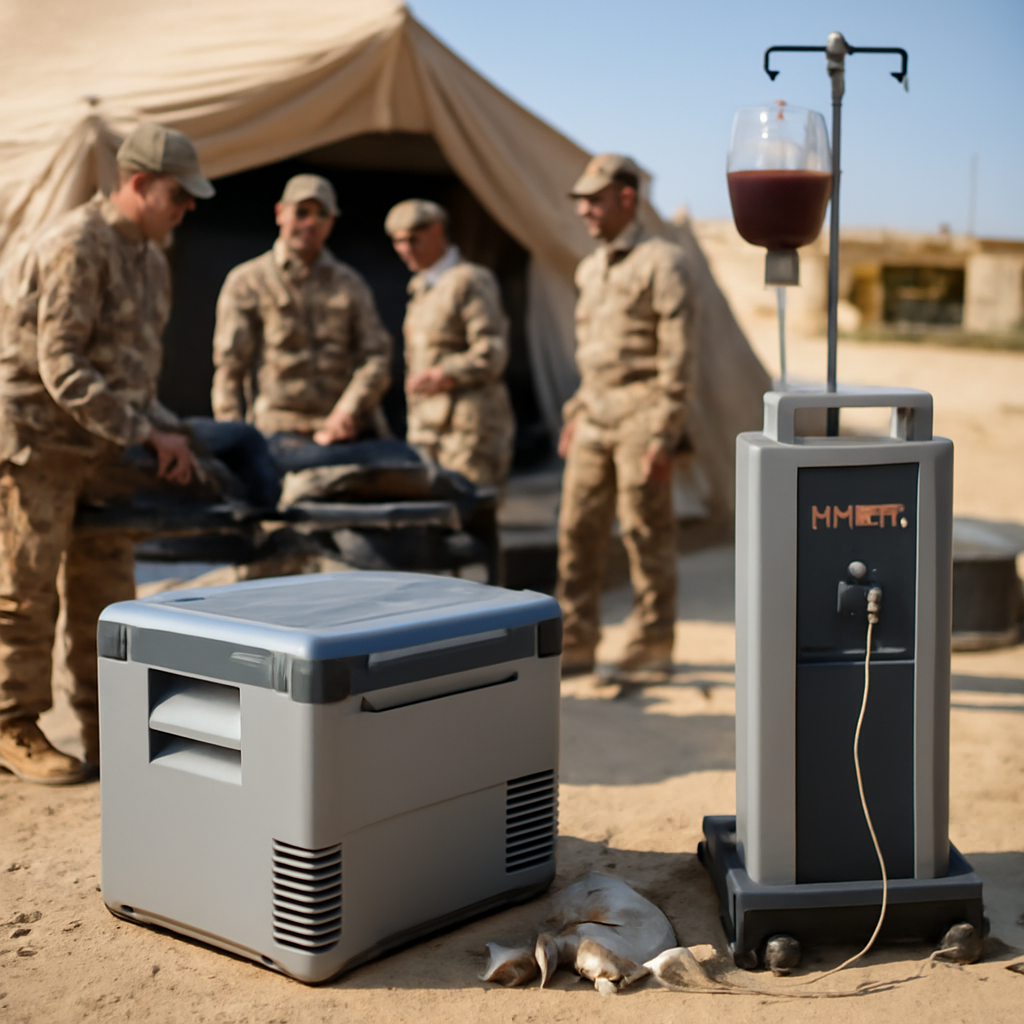
“We were told that the EMRU was instrumental to their ability to maintain a revolving blood bank to ensure that they had what they needed to be ready to care for injured service members,” said Navy Cmdr. Kyleigh Hupfl, clinic for Expeditionary Medical Systems.
EMRU and MEQU: battery-powered refrigeration and warming forward
The Marine Corps has begun fielding an Expeditionary Medical Refrigeration Unit (EMRU) and the MEQU mobile blood warmer to push transfusion capability closer to the point of injury. Both systems were deployed to U.S. Central Command this year, where a unit used them to establish a continuous mobile blood bank and returned operational notes to the Marine Corps on improvements, officials said.
The EMRU is described as a battery-powered, mobile system that maintains a cold chain for blood products, while the MEQU functions as an associated mobile blood warmer to heat blood to body temperature for transfusion. Together, the systems are intended to allow medics to preserve and administer blood without relying on heavy generators.
KOSMOS ultrasound: seeing internal bleeding in the field
To pair with forward transfusion capability, the Corps is fielding the KOSMOS point-of-care ultrasound. The device gives teams a way to assess internal bleeding at the point of care, a capability officials said is necessary so commanders can judge whether continuing hemorrhage justifies the risk of calling in a contested evacuation asset.

This site is the portfolio.
OSINTSights runs on Cloudflare Workers, D1, R2, and Vectorize, with an AI pipeline on Hetzner ARM. Nubivance designed, built, and operates it. We do the same for clients.
See what we buildSquad Power Manager medical kit variant: sustaining systems off-grid
Maintaining refrigeration, warming, and ultrasound equipment requires reliable power in distributed and austere environments. The Marine Corps is using a Marine Corps Squad Power Manager medical kit variant to keep those systems running, a configuration intended to support extended patient-care hold times without the logistics footprint of heavy generators.
“Leaving the golden hour behind”: how casualty care doctrine is shifting
Officials framed the fielding of these systems as an adaptation to a battlefield where rapid medevac to a trauma hospital can no longer be assumed. “We're leaving the golden hour behind, and we're moving toward those longer patient-care hold times,” said Col. Paul Gillikin, program manager for Combat Support systems, citing the prospect of operations against a peer competitor and the distances involved in the Pacific.
Col. Gillikin added that planners must account for “we know that we're not going to have the developed [forward operating bases], the full mobility, the Iron Mountain,” language that underlines a doctrinal shift toward sustained forward care rather than rapid evacuation.
What this means for commanders, medics, and program managers
- Commanders will get closer situational medical information to inform risk decisions. With point-of-care ultrasound and on-site transfusion capability, they can determine whether continued bleeding makes the risk of a contested evacuation necessary.
- Medics and unit medical teams can hold casualties longer and deliver blood transfusions in distributed environments. Officials emphasized that severe bleeding remains the No. 1 cause of battlefield death, making forward cold-chain and warming capacity a priority.
- Program and acquisition managers must iterate on systems based on operational feedback. A deployed unit’s notes to the Marine Corps about how to improve the mobile blood bank illustrate an ongoing feedback loop between operators and acquisition officials.
Deployment feedback and the next practical steps
Brig. Gen. Tamara Campbell, deputy commander of Portfolio Acquisition Executive Marine Corps, summarized the operational imperative: “We expect in the Marine Corps to be in distributed environments, where the evacuation will be delayed or contested,” and thus the equipment being fielded must support care at any time regardless of how long it takes to apply that care.
The practical next step already in motion is iterative improvement: a unit in U.S. Central Command established a continuous mobile blood bank using the EMRU and MEQU this year and sent recommendations back to the Marine Corps. Those observations will guide refinements to sustain refrigeration, warming, and power in dispersed, contested settings.
The fielding marks a clear shift in how the Marine Corps plans to manage battlefield trauma: move life-saving transfusion and diagnostic tools forward, power them without heavy logistical signatures, and accept that evacuation timelines will stretch. Whether the deployed improvements and returned feedback will close the gap created by longer patient-care hold times is the immediate question the Corps has begun answering in theater.
Source: Defense One — Marines fielding new tech for prolonged medical care on the battlefield