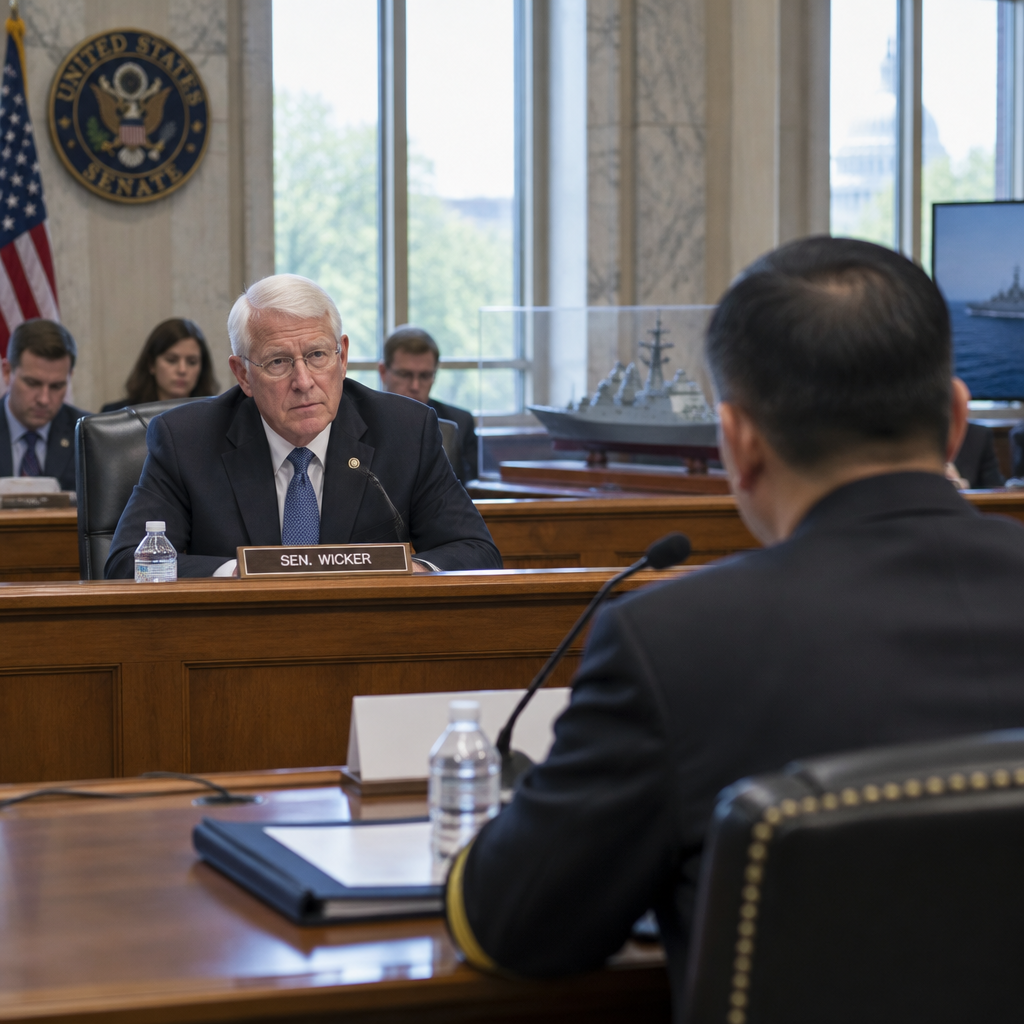
“Secretary Cao, returning to steam is a non-starter, and everybody needs to understand that,” Chairman of the Senate Armed Services Committee Sen. Roger Wicker declared at Acting Secretary of the Navy Hung Cao’s confirmation hearing, setting the tone for a session in which lawmakers from both parties pressed the Navy to resist a presidential directive to undo a key Ford‑class innovation.
Sen. Roger Wicker and bipartisan resistance
Wicker’s blunt intervention was not an outlier. Lawmakers on both sides of the aisle told Cao they were skeptical of President Donald Trump’s August National Security Presidential Memorandum directing the Navy to replace the Electromagnetic Aircraft Launch System (EMALS) and electromagnetic elevators on Ford‑class carriers with traditional steam catapults and hydraulic elevators. Critics cited by members of the Senate argued that a return to steam would add costs and complexity while reverting to older technology on a ship class designed around EMALS.
Sen. Tim Kaine, D‑Va., said he had visited the Gerald R. Ford and spoken with sailors who were “very complimentary” of EMALS. Kaine warned that reverting to steam would drive up costs with “diminished capacity,” and urged Cao to weigh the operational experience of carrier crews before moving to implement the president’s directive.
What the August memorandum would change — and where it would apply
The August memorandum from President Trump ordered that Ford‑class carriers be outfitted with steam‑powered catapults and hydraulic aircraft elevators similar to those on Nimitz‑class carriers. The instruction would apply to ships such as the Doris Miller, which is currently under construction at HII’s Newport News Shipbuilding. In the memo, the president argued that overly complex ship designs and repeated changes have contributed to shipbuilding cost increases, delays and cancellations, and called on the Navy to prioritize “proven, reliable, and affordable technologies and ship designs.”

This site is the portfolio.
OSINTSights runs on Cloudflare Workers, D1, R2, and Vectorize, with an AI pipeline on Hetzner ARM. Nubivance designed, built, and operates it. We do the same for clients.
See what we buildActing Secretary Hung Cao’s testimony and record
Cao, who has served in an acting capacity since April after the ouster of former Navy Secretary John Phelan, acknowledged during his confirmation hearing that EMALS and the electromagnetic elevators on the Ford have contributed to carrier delays. Asked whether the Navy should return to steam catapults, Cao noted the impact of those systems on the shipbuilding schedule.
President Trump announced in September that he would nominate Cao to serve as secretary of the Navy. Cao’s career record was raised during the hearing: he enlisted as a seaman recruit in 1989, graduated from the U.S. Naval Academy in 1996, and served more than 20 years as a naval officer before retiring in 2021 as a captain. Because military retirees must have been retired for at least seven years to serve as a service secretary, Cao will need waivers from both the House and Senate to be confirmed.
Cao also pledged to include Democrats in classified congressional briefings after Sen. Mike Rounds, R‑S.D., raised concerns that Democrats had been excluded from previous hearings — a point Rounds said would make approving funding and policy changes difficult.
Carrier deployments, crew strain, and congressional pushback
The hearing ranged beyond technology to the human costs of protracted deployments. Senators questioned Cao about the impact of the conflict with Iran and the aircraft carrier Abraham Lincoln’s extended deployment from November 2025 to October 2026. Lawmakers raised quality‑of‑life concerns and cited eight suicide attempts during that deployment.
Sen. Kirsten Gillibrand, D‑N.Y., pressed Cao over his characterization of those incidents as “suicide mitigations,” telling him, “I think you are minimizing what mental health strain is on these service members.” Cao responded by pointing to his own deployment experience and said he understood the strain facing sailors. Sen. Tammy Duckworth, D‑Ill., told Cao she could not vote for him because he would be “another yes man,” and Sen. Jim Banks, R‑Ind., voiced support for Cao, saying a confirmed secretary was “fundamentally important” and praising Cao’s support for Naval Support Activity Crane in Indiana.
What this means for sailors, shipbuilders, and lawmakers
- Sailors: Crews operating Ford‑class systems — cited by Kaine as “very complimentary” of EMALS — have an operational stake in whether the Navy maintains electromagnetic launch and lift systems or reverts to steam and hydraulics; senators also pressed the Navy on mental‑health and quality‑of‑life consequences tied to extended deployments such as the Abraham Lincoln’s.
- Shipbuilders and programs: HII’s Newport News Shipbuilding and the under‑construction Doris Miller are explicitly in the scope of the memorandum; lawmakers and critics argue a design shift back to steam could introduce retrofit costs, added complexity, and schedule risks for ships designed around EMALS.
- Lawmakers and the executive branch: The dispute places Cao at the intersection of a presidential direction and bipartisan congressional skepticism. Cao’s need for congressional waivers to be confirmed adds a political dimension to any decision about implementation, while promises to broaden classified briefings speak to the legislature’s leverage over funding and policy.
The confirmation hearing crystallized a broader tension: the president’s push to prioritize “proven” systems colliding with a carrier class engineered around more modern technology and with crews who report familiarity and confidence in that technology. Cao’s next moves — whether to follow the August memorandum, seek alternative compromises, or delay implementation while Congress weighs waivers and oversight — will have direct consequences for the Doris Miller’s build, Ford‑class schedules, and the sailors who must operate and live aboard those ships.