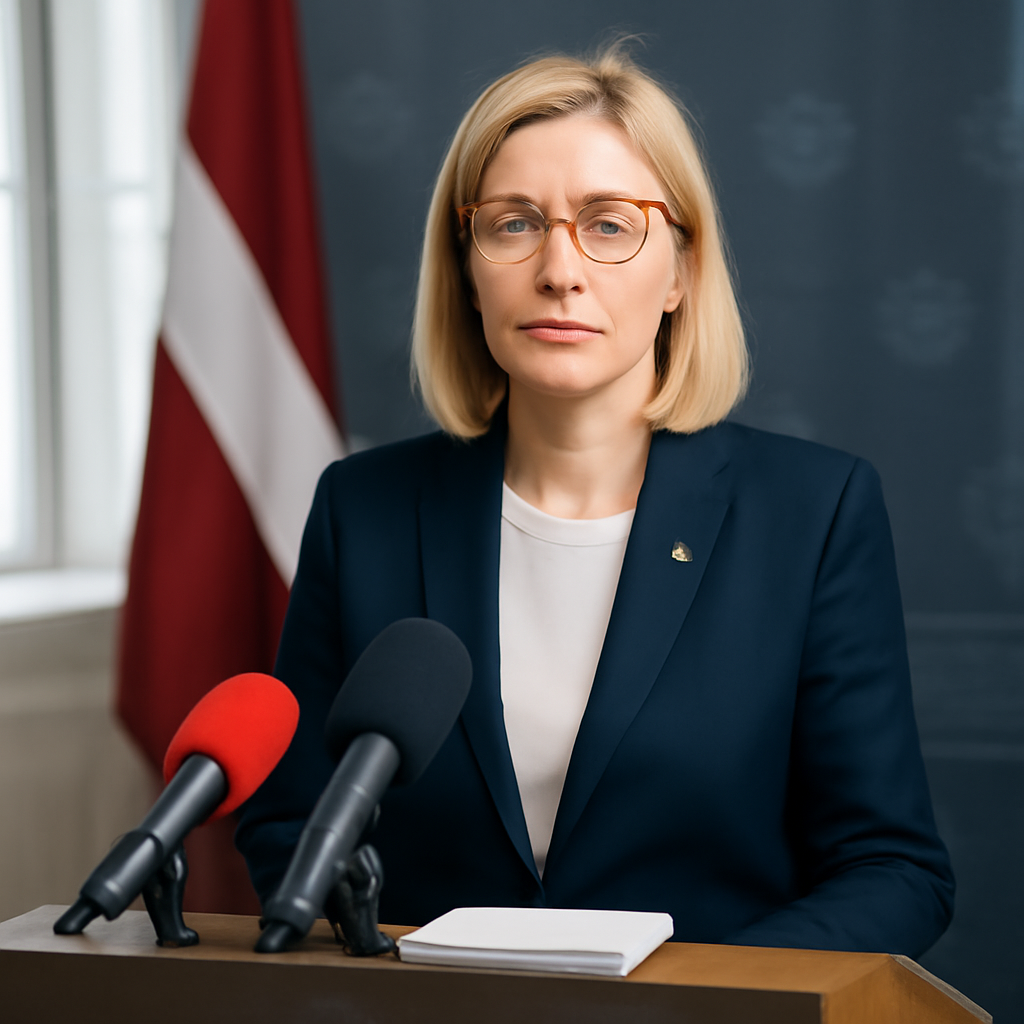
"I have made a decision — the Minister of Defense has lost [both] my and the public’s trust, and I have requested his resignation," Prime Minister Evika Siliņa told the state-funded Latvian national broadcaster LSM, a statement her office confirmed to Breaking Defense.
Evika Siliņa's demand and the extraordinary coalition meeting
Prime Minister Evika Siliņa convened an extraordinary meeting of coalition partners on Sunday and called on Defense Minister Andris Sprūds to step down, her office told Breaking Defense in an emailed statement. LSM, which was present at the media briefing, reported the prime minister's public assessment that the minister had lost both her trust and that of the public. Siliņa cited the recent poor response to drone airspace violations among her reasons for pressing for a resignation.
Andris Sprūds' resignation and his stated motive
Andris Sprūds resigned on Sunday and announced the decision at a press conference later that evening. In his remarks, Sprūds said he was stepping down "in order to protect Latvia’s army from divisive political campaigning." The resignation followed several days of public pressure and criticism over the defense ministry's handling of the recent airspace incidents.

Your town's IT department is one person. Maybe.
Ransomware crews target small municipalities because nobody's watching. Nubivance gives Maine and New Hampshire towns a security program sized to a town budget.
Protect the town officeMay 7 drone incursions and the Rēzekne oil storage hit
On May 7, several drones penetrated Latvian airspace from the direction of Russia. Two of those drones crashed into Latvian territory, and one damaged an empty oil storage facility in Rēzekne in eastern Latvia. The incident prompted immediate scrutiny of how the country's defenses detected and responded to the incoming aircraft.
Ukrainian Foreign Minister Andrii Sybiha posted on X on Sunday that the drones were of Ukrainian origin and that they flew into Latvia after "investigations found that Russian electronic warfare deliberately diverted them from their targets in Russia." The post framed the episode as involving third-party electronic interference rather than an intentional strike on Latvian territory.
Military detection failures and delayed mobile warnings
Prime Minister Siliņa singled to reporters at the media briefing that she saw "a lack of a reactive posture by defense authorities." According to reporting by LSM and Breaking Defense, military drone detection systems failed to identify the incoming aircraft, and mobile warnings to residents' phones were not sent until approximately an hour after one of the drones had already crashed. That sequence — detection gap followed by a delayed public alert — was central to the criticism that led to the minister's departure.
Siliņa also noted that the government has committed significant resources to defense, saying the sector received a "2-billion-euro budget" and that those funds came "taking away funds from other areas." She added that such investment "also requires the [defense] minister to have a greater understanding of what will be asked of him," framing the resignation as tied both to operational performance and political accountability for a high-priority budgetary area.
What this means for the prime minister, the Latvian military, and voters
- For the prime minister: Siliņa’s public call and the subsequent resignation demonstrate her willingness to hold a senior minister accountable for operational lapses, particularly in an area where she says the government has allocated substantial funds.
- For the Latvian military and defense establishment: The episode exposes gaps in drone detection and civil warning procedures that officials will likely be required to address — both to restore operational confidence and to reassure the public about civil-defense communications.
- For voters: Latvia is scheduled to hold elections in October, and the resignation — together with public criticism of response failures — may influence perceptions of government competence and crisis management in the run-up to the vote.
Andris Sprūds' departure closes one chapter in a controversy centered on defensive readiness and public alerts. It leaves several concrete tasks on the table: fix detection shortfalls, tighten warning timelines, and answer whether technical or procedural changes can prevent a repeat. The timeline to do that will be compressed by the political calendar — with elections set for October — and by public expectations set by the prime minister's stark assessment of lost trust.
Original reporting: Breaking Defense — "Latvian defense minister resigns, following lagging response to drone incursions"