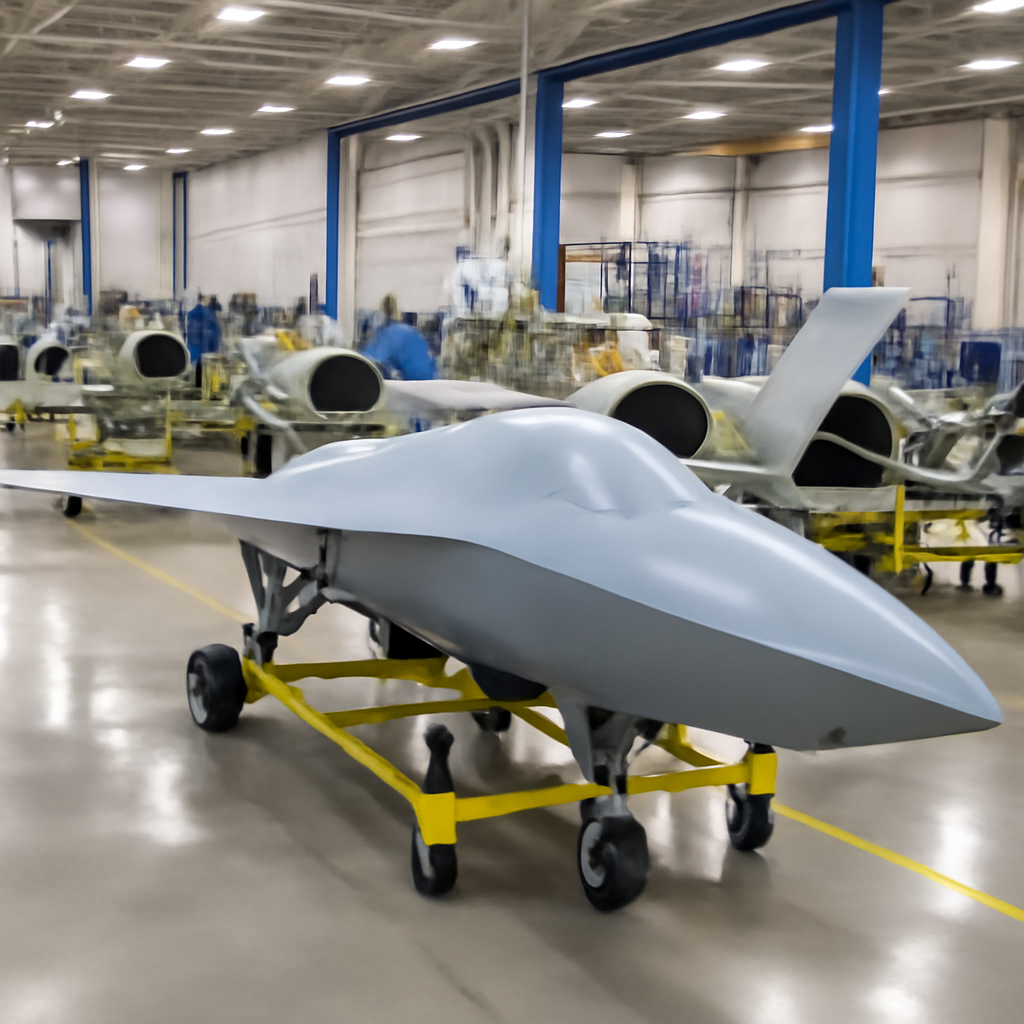
"We have several CTOL aircrafts … we’ve been working on it for about a year and a a half," said Steve Fendley, President of Kratos’ Unmanned Systems Division, as the company confirmed that landing gear-equipped XQ-58 Valkyrie drones are now in production.
Steve Fendley: CTOL production is underway, RATO remains active
Kratos has built the first landing gear-equipped (conventional takeoff and landing, CTOL) XQ-58 Valkyrie airframes and reports several more are in varying stages of construction. Fendley told TWZ that CTOL production "started on those earlier this year" and that "some are ready, and some still in the pipeline." At the same time, Kratos continues to produce the rocket-assisted takeoff (RATO) versions, which first flew in 2019 and land via parachute. The company says both types remain in active production because they answer different operational needs.
RATO versus CTOL: launch, recovery and payload trade-offs
The two primary Valkyrie configurations—RATO and CTOL—offer distinct trade-offs. RATO types provide runway independence and can be launched from static rocket-assisted systems or a special trolley; they land by parachute and use airbags for impact cushioning. That recovery method, Kratos has noted, can be time-consuming to ready for relaunch and is vulnerable to failure of the airbag system, which "can lead to significant damage." CTOL Valkyries land conventionally on runways, easing recovery and resetting for follow-on sorties, but the addition of landing gear reduces internal payload space.
Kratos’ publicly stated capacities underline the difference: RATO XQ-58s can carry up to 1,200 pounds of stores in an internal centerline bay sized for four 250-pound-class GBU-39/B Small Diameter Bombs, with additional capacity of up to 600 pounds on a hardpoint under each wing. The CTOL variant has half the internal payload capacity and the same capability to carry up to 600-pound external loads on two wing hardpoints (one under each wing). Kratos has also told TWZ that static RATO launch constraints affect maximum takeoff weight and thus range and payload, but using a trolley can raise fuel and payload capacity "in the 10s of %" versus pure static launch.

Audit-ready is a season. It shouldn't be.
Evidence in spreadsheets, controls drifting between audits, frameworks multiplying on flat headcount. Nubivance runs continuous compliance on Rapid7 Cyber GRC - SOC 2, HIPAA, ISO 27001, PCI, CMMC.
End the scrambleOperators and partnerships: U.S. services and Airbus collaboration
The U.S. Air Force was the first known XQ-58 operator and continues to use RATO Valkyries for research, development and test and evaluation activities. The U.S. Marine Corps has a handful of RATO Valkyries and has contracted for CTOL, landing gear-equipped Valkyries under its Marine Air-Ground Task Force Uncrewed Expeditionary Tactical Aircraft (MUX TACAIR) Collaborative Combat Aircraft (CCA) program; the Marines hope to receive their first CTOL deliveries in 2029. Kratos has also announced a partnership with Airbus to develop a Valkyrie variant aimed at meeting German CCA requirements, and Fendley said the company is talking to "a number of other international customers" though he would not elaborate.
Kratos’ production plans, pricing signals, and broader portfolio
Kratos aims to ramp Valkyrie production and has signaled broader growth: President and CEO Eric DeMarco said the company increased its full-year 2026 organic revenue growth forecast to approximately 18–23% year-on-year, and now includes an expectation of roughly 10% organic growth for its Unmanned Systems business based on recent contract awards including Valkyrie. Kratos hopes, over time, to gain economy-of-scale benefits—targeting an annual production rate of 40 airframes by 2028.
Price points remain unclear today. Kratos previously said RATO versions were in the roughly $4 million to $6 million range and had long-term ambitions to push unit cost toward $2 million. Beyond Valkyrie, Fendley highlighted other company programs: Tactical Firejet/Airwolf adapted into a kamikaze variant in partnership with Taiwan’s National Chung-Shan Institute of Science and Technology; renewed interest in the Mako (UTAP-22) tactical system; and ongoing classified work on projects named Apollo, Athena, and Thanatos.
How the U.S. Marine Corps, the U.S. Air Force, and procurement leaders will respond
- U.S. Marine Corps: Will be tracking CTOL production closely—its MUX TACAIR CCA buys are explicitly for landing gear-equipped Valkyries, with first deliveries hoped for in 2029, and the service is using existing RATO airframes to prepare for CTOL operations.
- U.S. Air Force: Continues to use RATO Valkyries for test and evaluation; the service will likely weigh runway-independent launch flexibility versus higher sortie rates and easier recovery offered by CTOL types when planning future experiments and operational concepts.
- Procurement leaders and international partners (e.g., Airbus/Germany): Will monitor production ramp, unit-cost trajectory, and payload trade-offs between CTOL and RATO variants as they decide on mixed fleets or configuration choices to match training, forward deployment, or maximized payload scenarios.
For now, Valkyrie production is expanding in two directions simultaneously: newer CTOL airframes that trade internal payload for runway recovery, and continued RATO builds that preserve internal capacity and launch flexibility. Flight test activities are paused after a Valkyrie crashed following "takeoff from a test-range runway," with Kratos saying the drone was in "test configuration" and not confirming whether it was a CTOL first flight. The program’s near-term indicators—production lines running, partnership activity with Airbus, a 2028 output target, and a Marine Corps delivery goal of 2029—set concrete milestones to watch as Kratos seeks both scale and broader operational adoption.