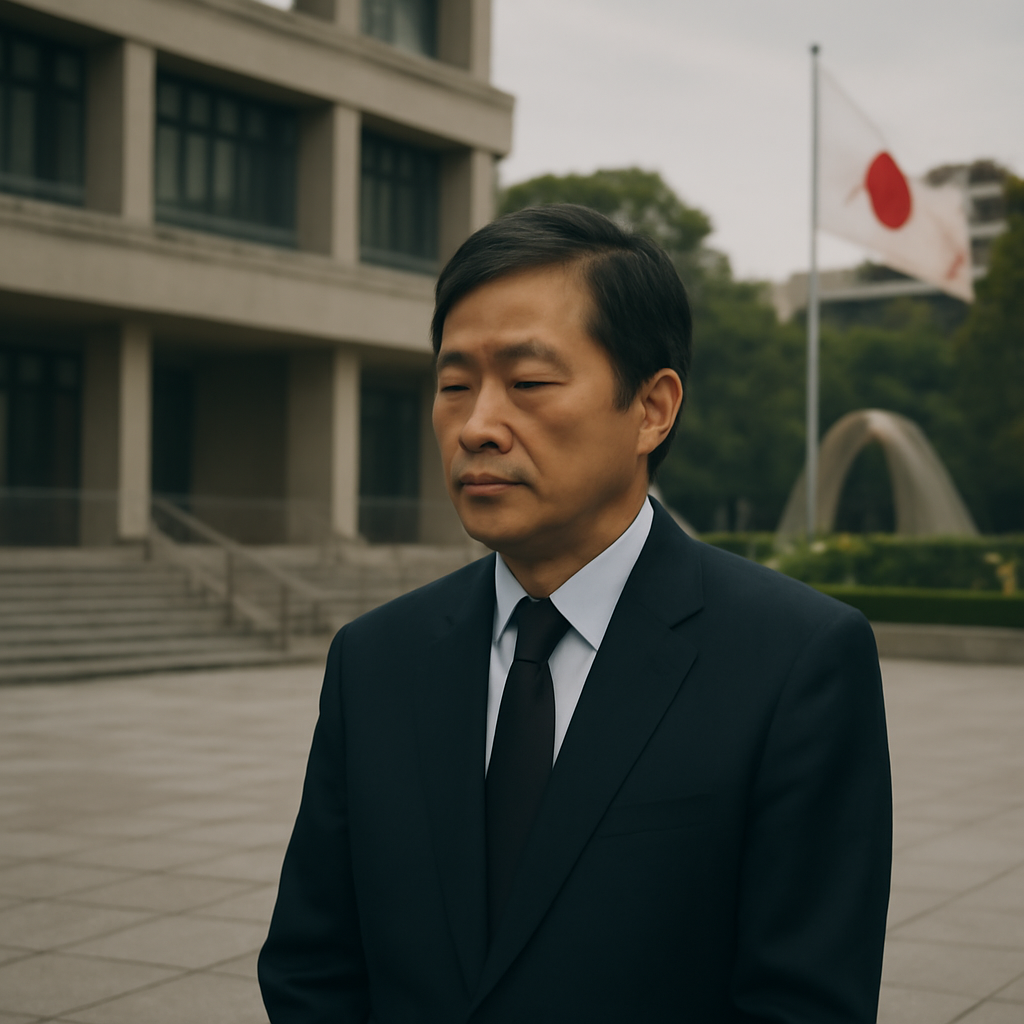
"Japan 'maintains' its Three Non-Nuclear Principles," Prime Minister Takaichi Sanae said during this year's Hiroshima and Nagasaki commemorations — a phrase that both reassures and obscures a growing strategic dilemma for Tokyo.
Contrasting tones in Hiroshima and Nagasaki
At the ceremonies marking the 81st anniversaries of the atomic bombings, the divide in Japan’s public conversation over nuclear policy was on display. Mayor Suzuki Shiro of Nagasaki described nuclear weapons as an “absolute evil,” warned against reliance on nuclear deterrence, and urged the government to uphold the Three Non-Nuclear Principles unequivocally. Prime Minister Takaichi echoed Japan’s continued adherence to the principles but emphasized a “realistic and practical” approach toward pursuing a world without nuclear weapons. When asked whether the principles would remain explicitly affirmed in three strategic documents her government plans to revise by year-end, Takaichi declined to prejudge the wording.
The Three Non-Nuclear Principles and their contested third element
Japan’s Three Non-Nuclear Principles — “not possessing, not producing, and not permitting the introduction of nuclear weapons into Japanese territory” — date to former Prime Minister Sato Eisaku’s 1967 declaration and have long been a pillar of postwar identity and Japan’s global advocacy for disarmament. Yet the third principle, barring the introduction of nuclear weapons, is emerging as the focal point of debate.
Takaichi’s privately disclosed history deepens the stakes. In a 2024 book she recounted objecting, as a Cabinet minister in 2022, to language in the National Security Strategy that stated Japan’s basic policy of adhering to the Three Non-Nuclear Principles would remain unchanged. She said she argued that the third principle was unrealistic if Japan expected U.S. extended deterrence to remain credible, and that she signed the Cabinet decision reluctantly after her request to remove the language was rejected.

Audit-ready is a season. It shouldn't be.
Evidence in spreadsheets, controls drifting between audits, frameworks multiplying on flat headcount. Nubivance runs continuous compliance on Rapid7 Cyber GRC - SOC 2, HIPAA, ISO 27001, PCI, CMMC.
End the scrambleStrategic pressures compressing policy space
The strategic environment Tokyo faces is changing rapidly: China is expanding and modernizing its nuclear forces, North Korea continues to develop nuclear weapons and more sophisticated missiles, and Russia remains one of the world’s two largest nuclear powers while deepening military cooperation with Beijing and Pyongyang. Those shifts have sharpened scrutiny of the credibility of U.S. extended nuclear deterrence.
Jennifer Lind and Daryl G. Press argued in Foreign Affairs this summer that the traditional U.S. nuclear umbrella is coming under increasing strain as adversaries acquire more credible means of striking the U.S. homeland — reviving long-standing concerns about “decoupling.” They put the dilemma bluntly: “Would an American president risk Los Angeles to defend Tokyo or Seoul?” The answer the international security community believes will be given matters more than any formal assurance.
Inside Japan, some senior officials have signaled a readiness to discuss these issues publicly. Defense Minister Koizumi Shinjiro has said nuclear issues can no longer simply be avoided in policy discussions, and former Joint Staff Chief Kawano Katsutoshi has questioned whether Japan can indefinitely assume the American nuclear umbrella will hold.
Concrete frictions: SLCM-N, port visits, and allies’ platforms
The abstract debate could become concrete in the early 2030s. The U.S. Navy is developing a nuclear-armed Sea-Launched Cruise Missile (SLCM-N) for Virginia-class attack submarines. Tokyo will ultimately face a practical question: is strict adherence to “not permitting the introduction” compatible with port visits by U.S. platforms that could carry such weapons, particularly if Washington maintains its traditional policy of neither confirming nor denying their presence?
The issue already affects defense diplomacy with other allies. France’s nuclear-powered aircraft carrier, the Charles de Gaulle, has never called at a Japanese port. During Operation Clemenceau 25, its 2024–2025 Indo-Pacific deployment, the carrier visited Indonesia, the Philippines, and Singapore — but not Japan. France’s Rafale M fighters embarked on the carrier are capable of carrying the ASMP-A air-launched cruise missile, and Paris does not publicly confirm or deny whether nuclear weapons are present aboard its strategic platforms. Rear Admiral Guillaume Pinget, then-commander of the French Pacific Command, told the author in July that France respects Japan’s laws and regulations and “If Japan invites France to come, we will see.” That cautious openness underlines the potential friction between Japan’s non-nuclear law and allied deterrence postures.
What this means for Japan, the U.S. nuclear umbrella, and France
- Japan’s national leadership and public debate: The year-end revision of Japan’s three strategic documents is the forum in which Tokyo must confront whether a literal application of the third principle can survive alongside demands for stronger allied deterrence. Takaichi’s earlier objections in 2022 and her 2024 account suggest the cabinet has already wrestled with the trade-offs.
- The credibility of U.S. extended deterrence: The argument by Lind and Press places an intellectual burden on Washington’s posture; whether adversaries believe the U.S. would accept the risk of nuclear retaliation to defend Japan is central to deterrence. The emergence of the SLCM-N will force concrete choices about basing, port visits, and policies of confirmation or denial.
- France and allied operations: Paris’s reluctance to predict future port visits to Japan, and the Charles de Gaulle’s 2024–2025 routing, show how allied nuclear-capable platforms can be constrained diplomatically by Japanese law — even when commanders and planners wish to deepen cooperation.
Abandoning the Three Non-Nuclear Principles hastily would inflict substantial political and diplomatic costs: they remain closely tied to Hiroshima and Nagasaki and underpin Japan’s credibility on disarmament. But treating them as untouchable regardless of strategic change risks widening the gap between declared policy and the deterrence architecture allies are building. The choice is not binary between armament and pacifism; it is whether the third principle can remain unchanged while Tokyo asks the United States and other partners to strengthen deterrence. The year-end security-document revisions offer a rare chance to answer that question — and, as the reporting concludes, avoiding it is itself becoming a strategic choice.