"This achievement demonstrates what is possible when we are aligned with industry on a shared imperative: delivering capability to the warfighter at unprecedented speed," Secretary of the Air Force Troy Meink said today.
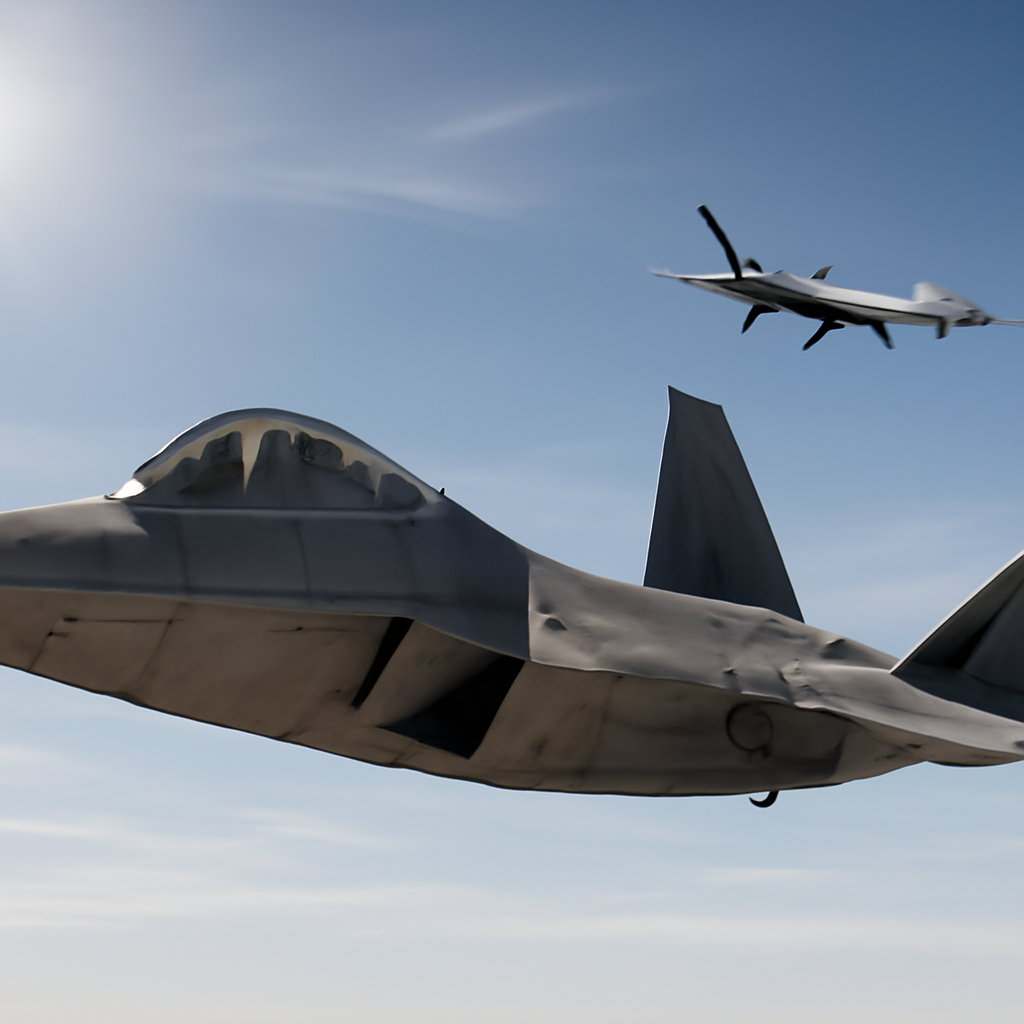
The airborne tactical-control demonstration between an F-22 and a YFQ-44A
An F-22 Raptor pilot issued commands to a pre-production YFQ-44A Fury Collaborative Combat Aircraft (CCA) drone in what the Air Force and Anduril described as an "airborne tactical-control demonstration." The event, announced today but conducted earlier this month, marked the first time an F-22 has served as an airborne "quarterback" issuing high-level tactical directives to a Fury drone, an Anduril spokesperson confirmed directly to TWZ.
According to an Air Force press release, the F-22 pilot's directives were interpreted and executed in real time by the aircraft's onboard autonomy software, which performed dynamic flight maneuvers and simulated combat tasks. Anduril's release added that both aircraft took off from Edwards Air Force Base, joined up in midair, and that the Raptor pilot sent an updated mission plan to Fury using a tactical data link to command operationally relevant maneuvers.
Where this sits in the CCA procurement roadmap
The test is part of the Air Force's Collaborative Combat Aircraft program. Under Increment 1, the service has orders for production of Anduril's FQ-44A Fury as well as General Atomics' FQ-42A Vengeance. The Air Force is planning additional, potentially different CCAs under a follow-on Increment 2.
Officials have set a goal of fielding a fleet of at least 500 Increment 1 CCAs by 2032, and current work is focused on laying the groundwork for an initial tranche of CCAs to begin entering operational service around the end of the decade.

Audit-ready is a season. It shouldn't be.
Evidence in spreadsheets, controls drifting between audits, frameworks multiplying on flat headcount. Nubivance runs continuous compliance on Rapid7 Cyber GRC - SOC 2, HIPAA, ISO 27001, PCI, CMMC.
End the scrambleTesting, autonomy software, and in-cockpit control interfaces
The demonstration relied on onboard autonomy software to translate high-level commands into real-time flight and mission actions. Neither the Air Force nor Anduril disclosed technical details about how the F-22 was configured for the test.
Past Air Force budget documents, cited in the reporting, have noted the need to integrate "tablets, cables, and associated materials" onto the Raptor for CCA control. Known work to date on in-cockpit user interfaces has centered largely on touchscreen, tablet-like devices, a starting point that Lockheed Martin has been developing along with control architectures and user interfaces for both the F-22 and the F-35. The reporting also notes longstanding concerns and criticisms about increased pilot workload, particularly in single-seat fighters, when pilots are tasked with controlling uncrewed aircraft from the cockpit.
Emerald Flag, other demonstrations, and large-force employment
Fury and General Atomics' Vengeance are scheduled to make their debut in a large-scale exercise before the end of the year, when they will be brought into the next iteration of Exercise Emerald Flag. Lt. Col. Lyndon "OTTO" Bartlett, Director of Operations for the Experimental Operations Unit (EOU), said at the AFA 2026 conference that Emerald Flag in December will be the first "tip dip of the toe in an actual force integration" for these CCAs and the first large-force employment exercise with them "for real."
General Atomics previously announced a similar demonstration in November 2025 involving an F-22 Raptor and an MQ-20 Avenger, which the company has used as a CCA surrogate in testing. General Atomics has also released imagery of a Vengeance drone flying in formation with crewed fighters without being directly controlled in flight. It is unclear from the current reporting whether plans exist to demonstrate an F-22 controlling an FQ-42A Vengeance in flight.
What this means for the Air Force, Anduril, and General Atomics
- For the Air Force: The demonstration advances a priority to integrate crewed fighters as airborne "quarterbacks" for semi-autonomous wingmen, while the EOU and other units continue to develop policies, procedures, and the operational trust required to deploy CCAs in operational contexts.
- For Anduril: The company framed the flight as a milestone in proving capability, defining operational procedures, and building operator trust; Anduril's vice president of Autonomous Airpower, Mark Shushnar, called the U.S. Air Force's CCA program "the fastest moving, most mature CCA program anywhere in the world."
- For General Atomics: The firm has run parallel demonstrations using the MQ-20 Avenger and shown the FQ-42A Vengeance flying in formation with fighters. Its prior November 2025 Raptor–Avenger demo positions the company alongside Anduril as a provider engaged in similar integration testing.
The F-22–YFQ-44A flight is a tangible step toward crewed-uncrewed teaming, but the reporting makes clear that several threads remain active: integrating control hardware and interfaces into fighters, reducing pilot workload, developing doctrine and procedures for launches, recoveries and sustainment, and demonstrating these systems in large-force employment at Emerald Flag in December. The concrete near-term milestones are therefore the exercise itself and the Air Force's stated procurement timeline to reach at least 500 Increment 1 CCAs by 2032.