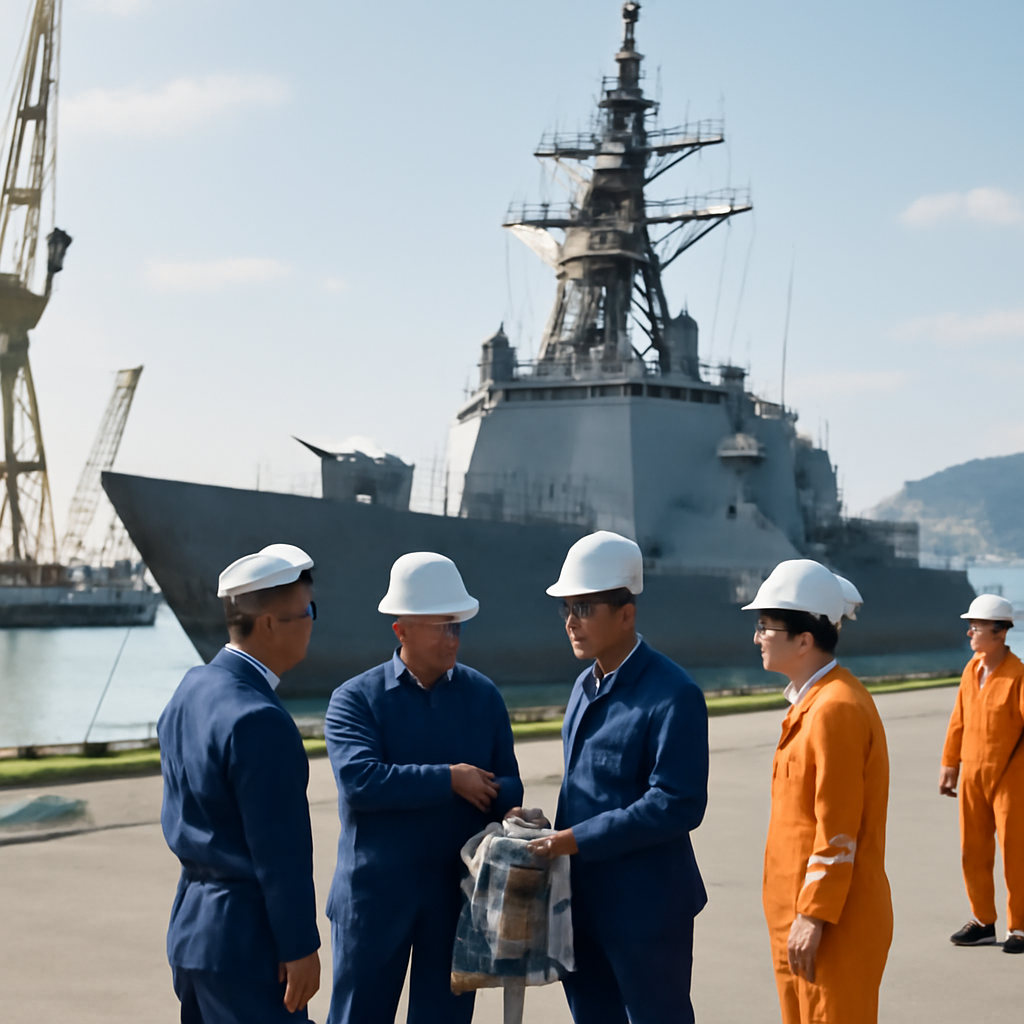
"China’s four major shipyards produced 39 warships with a total displacement of 550,000 tonnes between 2019 and 2023."
China’s shipbuilding surge and the strategic imperative it creates
The raw numbers driving naval policy in East Asia are stark. Citing a CSIS report, the BBC reported that China’s four major shipyards produced 39 warships totaling 550,000 tonnes between 2019 and 2023, and that as of 2024 the People’s Liberation Army Navy (PLAN) had 332 warships to the U.S. Navy’s 319. Those figures, paired with the region’s heavy dependence on seaborne trade, are the proximate causes cited by Tokyo and Seoul for accelerating naval modernization.
Japan’s ASEV program: sea-based ballistic missile defense
Japan has directed much of its recent naval investment into ballistic missile defense. The Japan Maritime Self-Defense Force is acquiring two Aegis System Equipped Vessels (ASEV) — sea-based BMD platforms developed after the cancellation of the Aegis Ashore effort in 2020, according to Japan’s Ministry of Defense. Each ASEV will displace roughly 14,000 tons and carry the Lockheed-Martin SPY-7(V)1 multifunction radar as the primary sensor. Naval News reports the ships will house 128 Mk.41 Vertical Launch System cells capable of firing SM-2, SM-3 and SM-6 interceptors, Type 12 anti-ship missiles and Tomahawk cruise missiles.
Construction is already underway: Mitsubishi Heavy Industries is building the first ASEV and Japan Marine United the second. The ministry says the vessels are due to be commissioned in early 2028 and 2029.

This site is the portfolio.
OSINTSights runs on Cloudflare Workers, D1, R2, and Vectorize, with an AI pipeline on Hetzner ARM. Nubivance designed, built, and operates it. We do the same for clients.
See what we buildJapan’s carrier conversions, submarines, and patrol fleet
Japan is also reshaping the JMSDF’s power-projection and undersea capabilities. The Izumo-class helicopter destroyers Izumo and Kaga are being converted to operate the F-35B STOVL variant; modifications include a squared-off flight deck and a heat-resistant deck coating at the rear to withstand STOVL exhaust. Conversion of Izumo began in 2020 and is expected to be completed later this year or in early 2027, while Kaga’s work is slated for completion in Japan’s fiscal 2027 (beginning April 1), the ministry reports.
On the undersea side, Japan has been commissioning one Taigei-class submarine per year since 2022 to replace older Oyashio-class boats. Tokyo is also continuing production of the Mogami-class frigate, including an Improved Mogami design selected by Australia and competing for New Zealand’s frigate program, and plans to introduce Sakura-class Offshore Patrol Vessels into service from March 2027. Japan’s recent defense budget request additionally sought funding for unmanned transport vessels to move troops and equipment from the mainland and Okinawa to small outlying islands in the East China Sea.
South Korea’s move toward nuclear-powered attack submarines and the KDDX destroyer
South Korea is leveraging its robust shipbuilding base to expand naval reach. In May, U.S. President Donald Trump agreed to allow South Korea to develop its own nuclear-powered submarines — a milestone cited in the report as fulfilling a long-standing South Korean aim. Seoul’s defense establishment frames nuclear attack submarines as increasingly important in light of what it sees as North Korea’s steps to develop a nuclear-powered submarine capable of carrying submarine-launched ballistic missiles.
Research fellow Yu Ji-hoon at the Korea Institute of Defense Analyses told South Korea’s Arirang News the nuclear-powered attack submarines will have greater endurance than diesel-electric boats, allowing longer patrols, the ability to stalk North Korean ballistic missile submarines and to respond more rapidly to land-based missile launches.
Concurrently, South Korea is pursuing a new 7,000-ton class destroyer (KDDX) primarily fitted with indigenous sensors, combat management systems, VLS and missiles; propulsion will rely on the GE Aerospace LM2500+G4 marine gas turbine. Hanwha Ocean is responsible for designing and building the first KDDX, which is expected to enter service in 2032. Hanwha has also been selected to supply a frigate to Thailand after winning a competition against Hyundai and foreign shipyards, with the Thai government set to announce more details later in September.
What this means for the JMSDF, the ROK Navy, and regional shipbuilders
- Japan Maritime Self-Defense Force: The ASEV program and F-35B-capable carrier conversions are intended to create layered air and missile defenses and forward aviation capability; commissioning timelines in 2028–2029 and carrier conversion completions in 2026–2027 will be key milestones to watch.
- Republic of Korea Navy: Permission to develop nuclear-powered attack submarines and the planned KDDX destroyer (service entry 2032) signal a push for longer-range endurance and more indigenous combat systems.
- Regional shipbuilders and exporters: Hanwha Ocean’s selection for international work — including a Thai frigate — highlights Seoul’s ambitions to export domestically designed platforms even as Tokyo and Seoul expand domestic fleets.
The calculus driving both Tokyo and Seoul is straightforward in the report: a rapidly expanding PLAN, persistent North Korean missile and submarine programs, and vital reliance on maritime trade. The dates and shipyard assignments given — ASEV commissions in early 2028 and 2029, Izumo and Kaga conversion windows, annual Taigei commissions since 2022, and a first KDDX in service by 2032 — provide concrete timelines for how those nations expect to meet the challenge. Whether those schedules will keep pace with the shipbuilding numbers cited for China is the practical question those timelines leave on the table.