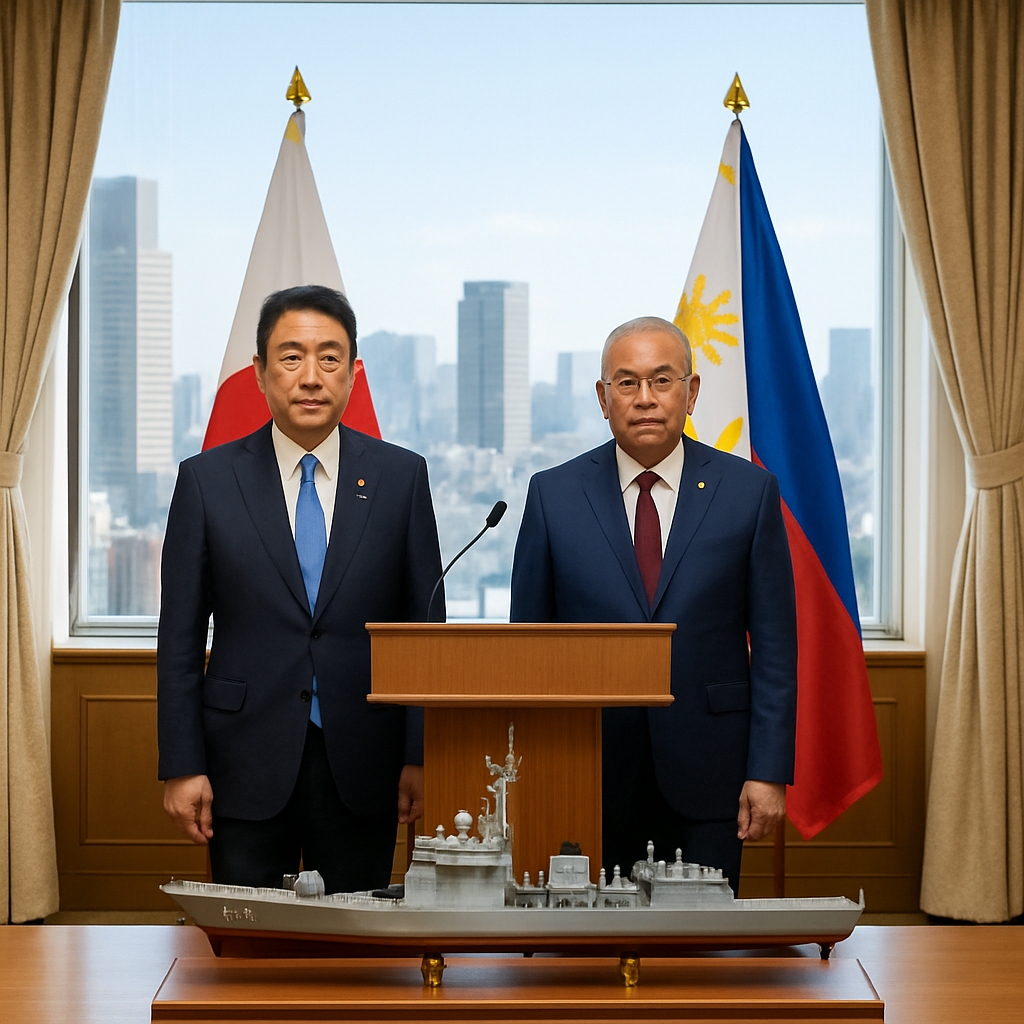
"He aims to achieve the early export of destroyer escorts through working-level consultations," Japanese Defense Minister Koizumi Shinjiro said.
Koizumi Shinjiro and Gilberto Teodoro establish a working group (May 5, Manila)
On May 5 in Manila, Japanese Defense Minister Koizumi Shinjiro and Philippine Defense Secretary Gilberto Teodoro agreed to establish a bilateral working group to push ahead with the transfer of Maritime Self-Defense Force (MSDF) equipment, including destroyer escorts and aircraft. The two ministers announced the step at a joint press conference and framed the working group as the vehicle for technical and procedural negotiations on potential transfers.
April 21, 2026 revision to Japan’s export framework as the legal pivot
For decades, Japan enforced the “Three Principles on Transfer of Defense Equipment and Technology.” Those restrictions were partially relaxed in 2014; the April 21, 2026 revision marked a more consequential shift by explicitly allowing the export of lethal systems under certain conditions. If the planned ship transfers proceed, they could constitute Japan’s first export of lethal military equipment under that revised framework, a concrete test of the new legal and policy posture.

Your town's IT department is one person. Maybe.
Ransomware crews target small municipalities because nobody's watching. Nubivance gives Maine and New Hampshire towns a security program sized to a town budget.
Protect the town officeThe Abukuma-class and the Philippines’ immediate capability gap
The Philippines has long faced a gap between regional maritime challenges and its available platforms. Chinese naval expansion — described in the reporting as a force of more than 400 vessels, including aircraft carriers, destroyers, and submarines — has sharpened threat perceptions. By contrast, the Philippine Navy currently fields a relatively modest force, including a small number of frigates and a single operational corvette. Philippine interest in the MSDF’s Abukuma-class destroyer escorts reflects a pragmatic calculation: even used Japanese vessels offer an immediate, relatively low-cost means of enhancing maritime capacity. The Abukuma class, while aging, is noted in the reporting as offering a balanced suite of capabilities suited to coastal defense and anti-submarine warfare in archipelagic settings.
Philippine modernization and budgetary constraints: Re‑Horizon 3 through 2033
Manila’s modernization effort is organized into Horizon phases; Horizon 1 and Horizon 2 delivered platforms such as FA-50 aircraft and new frigates but implementation has been uneven. Many projects remain delayed or under procurement, and multi-year contracts have placed sustained pressure on defense budgets. The expanded “Re-Horizon 3” program runs through 2033 and carries a projected budget of around 2 trillion pesos, but the reporting notes that near-term capability gaps are likely to persist — a condition that makes second‑hand platforms strategically attractive rather than merely stopgap.
What this means for Japan, the Philippine Navy, and regional security planners
- Japan’s policymakers and defense industry: The working group signals Tokyo’s intent to operationalize the April 21, 2026 export revision. Moving a destroyer escort transfer from concept to contract would shift export policy from theoretical allowance to practiced precedent and link industrial output to a strategic objective of strengthening partnerships.
- The Philippine Navy and procurement leaders: For Manila, acquiring Abukuma-class escorts would be a near-term capacity enhancer compatible with archipelagic and anti-submarine missions, while Re‑Horizon 3 and fiscal constraints continue to shape longer-term modernization priorities through 2033.
- Regional security planners: The proposed transfers are framed in the reporting as a test case for a broader strategic shift — one in which defense equipment transfers are used to enhance interoperability, strengthen partnerships, and influence the regional balance of power along critical sea lanes such as the Bashi Channel between Taiwan and the Philippines.
The establishment of a working group may read as procedural, but the reporting treats it as a clear signal of intent: if negotiations proceed and transfers occur, the Abukuma-class deal could become a tangible expression of Japan’s changing posture — moving Tokyo from strict export restraint toward active provision of military capability in the Indo-Pacific. The immediate next step is working‑level consultation; whether those talks produce the first lethal export under the April 21, 2026 framework will determine how quickly this policy shift translates into hardware and changed balances at sea.
Source: The Diplomat, "Japan’s Arms Export Shift Takes Shape in the Philippines," May 5, 2026